
Evangelical and Home-Schooling

DC 12.07pm
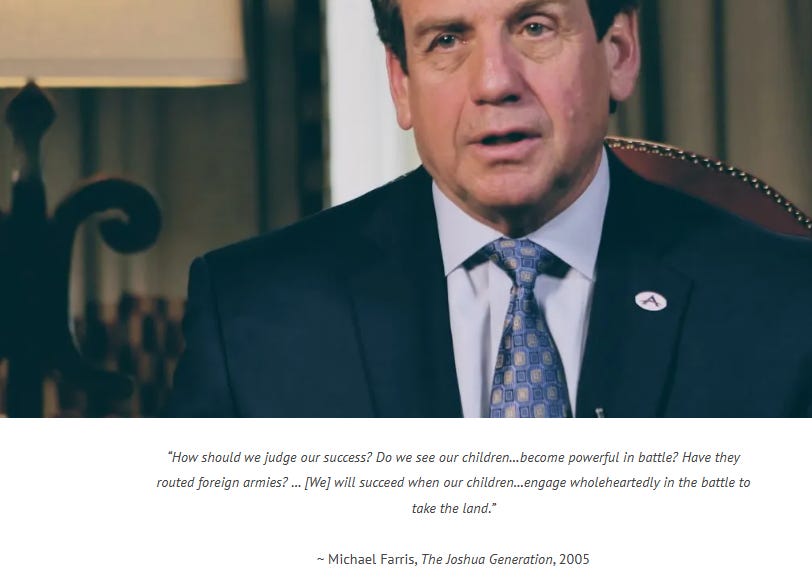
The message Michael P. Farris had come to deliver was a simple one: The time to act was now.
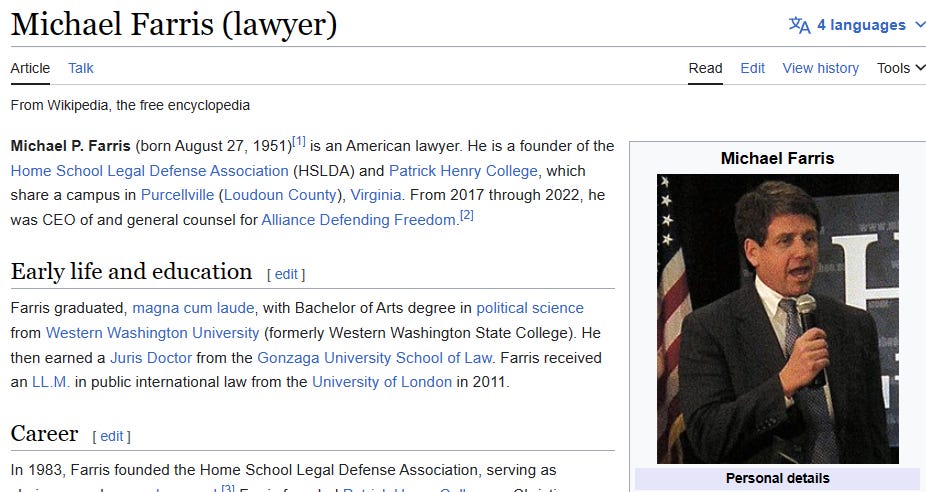
For decades, Farris — a conservative Christian lawyer who is the most influential leader of the modern home-schooling movement — had toiled at the margins of American politics. His arguments about the harms of public education and the divinely endowed rights of parents had left many unconvinced.
It was 1986 and Michael P. Farris was involved in a trial. He was representing two evangelicals who wanted to remove their children from reading material in a classroom in Tennessee. What obscene or questionable work posed a threat to a person’s faith? Why it was “Rumpelstiltskin,” and “The Wonderful Wizard of Oz.” Who knew that Dorthy and Toto were a threat to some evangelical’s faith? Or that Dorthy and Toto were pornographic?
Now, speaking on a confidential conference call to a secretive group of Christian millionaires seeking, in the words of one member, to “take down the education system as we know it today,” Farris made the same points he had made in courtrooms since the 1980s. Public schools were indoctrinating children with a secular worldview that amounted to a godless religion, he said.
The solution: lawsuits alleging that schools’ teachings about gender identity and race are unconstitutional, leading to a Supreme Court decision that would mandate the right of parents to claim billions of tax dollars for private education or home schooling.
Michael Farris outside the Supreme Court, where he hopes the conservative majority will eventually mandate the right of parents to public funding for private education or home schooling.
“We’ve got to recognize that we’re swinging for the fences here, that any time you try to take down a giant of this nature, it’s an uphill battle,” Farris said on the previously undisclosed July 2021 cal. “And the teachers union, the education establishment and everybody associated with the education establishment will be there in full array against us — just as they were against home-schoolers.”
When evangelicals speak of “religious freedom” they want to be able to discriminate, infringe and subjugate individuals. When white evangelicals speak of “religious freedom” they mean freedom only for themselves and no one else. Likewise, when evangelicals speak of “parental rights” they are actually talking about censorship and restrictions. Evangelicals have codes they speak in and it might be hard for some to understand the situation unless you once spoke “evangelical” as a language.
Michael Farris and his supporters and their goal to use home schooling as a means to allegedly dismantle public education in the United States. However, freedom of thought and independent action pose a huge threat to some evangelicals. Their goal it appears is to create a theocratic regime that would function in a failed state like Somalia or Afghanistan. This blog would suggest that Michael P. Farris is about theocratic fascism.
Over the past three years, American interest in home schooling has soared. In this series, The Washington Post explores how that rise is transforming the nation’s educational landscape — and the lives of hundreds of thousands of children who now learn at home rather than at a traditional school.
Many parents say home education empowers them to withdraw from schools that fail their children or to provide instruction that better reflects their personal values. But there is little to no regulation of home schooling in much of the country, with no guarantees that kids are learning skills and subjects to prepare them for adulthood — or, for that matter, learning anything at all.
Home-schooled children have attended Ivy League schools and won national spelling bees. They have also been the victims of child abuse and severe neglect. Some are taught using the classics of ancient Greece, others with Nazi propaganda. What all share is the near-absolute control their parents wield over the ideas they encounter.
Remarkable demonstration of how the ideology he has long championed has moved from the partisan fringe to the center of the nation’s bitter debates over public education.
A deeply religious evangelical from Washington state, Farris began his career facing off with social workers over the rights of home-schoolers and representing Christian parents who objected to “Rumpelstiltskin” being read in class.
In recent years, he has reached the pinnacle of the conservative legal establishment. From 2017 to 2022, he was the president and chief executive of the Alliance Defending Freedom (ADF), a powerhouse Christian legal group that helped draft and defend the restrictive Mississippi abortion law that led to the overturning of Roe v. Wade. ADF and its allies have filed a flurry of state and federal lawsuits over the past two years alleging that public schools are violating parental and religious rights.
Michael P. Farris, the founder and president of Patrick Henry College, shakes hands with students and faculty in 2000 at the Virginia campus that caters to home-schoolers. (Michael Lutzky/The Washington Post)
Yet it is outside the courtroom that Farris’s influence has arguably been most profound. No single figure has been more instrumental in transforming the parental rights cause from an obscure concern of Christian home-schoolers into a GOP rallying cry.
When former president Donald Trump called for a federal parental bill of rights in a 2023 campaign video, saying secular public school instruction had become a “new religion,” he was invoking arguments Farris first made 40 years ago. The executive order targeting school mask mandates that Virginia Gov. Glenn Youngkin (R) signed on his first day in office cited a 2013 state law guaranteeing “fundamental” parental rights that Farris helped write.
In Florida, a home-schooling mom introduced Farris’s ideas to a state lawmaker, setting in motion the passage of the state’s Parents’ Bill of Rights in 2021. The law, repeatedly touted by Gov. Ron DeSantis (R) on the presidential campaign trail, laid the groundwork for the state’s controversial Parental Rights in Education Act, dubbed by its critics the “don’t say gay” bill.
“He is our hero,” Patti Sullivan, the home-schooler involved in Florida’s 2021 law, said of Farris. “He is the father of the modern movement in parental rights.”
Fundamental parental rights measures have been proposed or enacted this year in more than two dozen other states, according to a Post analysis using the legislation-tracking database Quorum, and in March, a federal parents’ bill of rights passed the Republican-controlled House.
Farris has not been personally involved in pushing the most recent bills, which have been fueled by anger over covid-19 mask mandates and how schools are handling Black history, sexual orientation and gender identity. Tiffany Justice, co-founder of the right-wing group Moms for Liberty, which has become a powerful force in the parental rights movement since its launch less than three years ago, said it would be a mistake to overemphasize the impact of conservative Christian home-schoolers on the battles now playing out across the country.
Justice said she has met Farris but that the arguments he was making in the 1980s haven’t strongly influenced her organization, whose members have pushed to remove some books with LGBTQ+ themes from schools and to restrict what teachers can say about race and gender.
“It’s 2023,” she said. “There are a lot of things that people thought 40 years ago.”
Yet to those who have followed Farris’s career, the adoption of his arguments by so many families unconnected to home schooling is a measure of his success. In the eyes of his critics, he has masterfully imported an extreme religious agenda into the heart of the nation’s politics through the seemingly unobjectionable language of parents’ rights. Some argue that it has always been the goal of the most radical Christian home-schoolers not merely to opt out of the public schools but to transform them, either by diverting their funding or allowing religion back into the classroom.
“Everyone should be aware of Michael Farris and his influence on the Christian right,” said R.L. Stollar, a children’s rights advocate who was home-schooled and has long warned of the conservative home-schooling movement’s political goals. “To Farris’s credit, he is really good at what he does. He is really good at taking these more extreme positions and presenting them as if they are something that would just be based on common sense.”
Farris, 72, has a long track record of taking stands on the right. He argued in 2003 for the authority of states to criminalize gay sex, a position the Supreme Court rejected in the landmark case Lawrence v. Texas. He aided the legal effort to keep Trump in power by overturning the results of the 2020 presidential election and has urged what he calls a “Joshua Generation” of young home-schoolers to “engage wholeheartedly in the battle to take the land,” expanding the political and cultural power of conservative Christians.
Michael P. Farris is the most powerful figure in the Religious Right that you’ve never heard of—unless you were a homeschooler. If you were a homeschooler, his name inspires either immense pride or overwhelming anger. This is because Farris—love him or hate him—is very good at what he does. And what he does is coerce people through law to show preference to and enshrine his Christian Nationalist worldview.
An activist-lawyer who began his career successfully leading opposition to the Equal Rights Amendment and defending sodomy laws, Farris quickly rose to prominence in the Religious Right when he turned his attention to homeschooling. He founded the Home School Legal Defense Association (HSLDA) in 1983, a homeschool lobbying organization that was called “The Most Powerful Religious-Right Lobby You’ve Never Heard Of” by The Establishment. Through HSLDA, Farris led the successful fight to almost entirely deregulate homeschooling in all fifty states. As of today, for example, only two states prohibit convicted child abusers from homeschooling. Because of his efforts, many journalists who document the Religious Right refer to Farris as one of the “four pillars of homeschooling.”
But Farris has not limited his activism to homeschooling. He successfully led the opposition to the U.S. ratification of the United Nations Convention on the Rights of the Child, arguing it violates fundamental parental rights. This has left the U.S. the only country in the world that has not ratified the Convention. To further cement this victory, Farris founded the Parental Rights Organization, which is attempting to pass constitutional amendments to state constitutions in all 50 states as well as to the federal Constitution, to prohibit states from recognizing children’s rights as a valid legal concept.
Most recently, Farris became the president of the Alliance Defending Freedom (ADF), which is designated by the Southern Poverty Law Center as a hate group due to its support for the criminalization of non-heterosexual behavior and the forced sterilization of trans people. As ADF president, Farris won the 2018 case of Masterpiece Cakeshop v. Colorado Civil Rights Commission before the Supreme Court, reversing a state order that a bakery had to bake a wedding cake for a same-sex couple. And while Farris originally opposed the presidency of Donald Trump, he eventually warmed up to Trump—and Trump rewarded him by appointing Farris to the short-lived 1776 Commission in 2020. The 1776 Commission’s purpose was to create religious and patriotic education for children—a concept that is very familiar to Farris.
After Trump’s failed insurrection attempt on January 6, 2021, journalists and leaders across political and religious aisles began examining the reality of Christian Nationalism—a reality that many people of color, homeschool alumni, exvangelicals, and scholars of white evangelicalism have tried to shine a light on for decades. But instead of reflecting on his own culpability, Farris issued a statement on Facebook on January 23, 2021 in which he argued that “Christian Nationalism” is merely a “pejorative,” a leftist epithet against “mainstream conservative Christians” who believe in objective truth and morality. The phrase itself, Farris implied, has no inherent or true meaning. Farris described the phrase as “demonizing” because it dares to “equate millions of mainstream conservative Christians with dangerous radicals.”
Farris doubled down on this with an additional Facebook post on March 10, 2021, where he claimed “the left wants the public to believe that white evangelicals are all dangerous radicals.” But no, Farris says, people like himself—“mainstream conservative Christians”—in fact “pose no threat” to others. Everyone worried about Christian Nationalism is just “confused.” While he did not deny that he seeks Christian cultural and political supremacy, he assured us that, “A Christian culture will not produce a tyrannical government.” (Apparently Farris does not consider the enslavement and segregation of Black people in the United States tyrannical.)
Farris’s repeated dismissal of Christian Nationalism—a phrase that perfectly encapsulates his own worldview—is more than just fascinating. It matters—a lot. It matters because Farris is gaslighting us. For decades, Farris has advanced an agenda that is Christian Nationalist through and through. Indeed, Farris’s version of Christian Nationalism is—as we shall see—strikingly similar to the late R.J. Rushdoony’s version of Christian Nationalism, which is called Christian Reconstructionism. (For more about Rushdoony, see Julie Ingersoll’s excellent book, Building God’s Kingdom.) Both Farris and Rushdoony envision a government built on “God’s law,” and by that they mean a white evangelical understanding of Jewish law applied to the United States of America.
To better understand how Christian Nationalism perfectly describes Farris’s own worldview, let us first consider what Christian Nationalism is.
Understanding Christian Nationalism
Christian Nationalism, also referred to as Christofascism, is both an ideological movement and a sociopolitical movement. Ideologically, Christian Nationalism advances the idea of the United States being a Christian nation—a new Israel—founded upon Christian principles and uniquely blessed by God as the protector of freedom worldwide. Some Christian Nationalists, Kristin Kobes Du Mez writes in Jesus and John Wayne, go so far as to argue that, “America is God’s chosen nation” (p. 4). Sociopolitically, Christian Nationalism advocates for enshrining in law a 20th and 21st century white evangelical understanding of morality—often referred to as “Judeo-Christian” morality. Sometimes Christian Nationalism argues we should return to enforcing a white evangelical understanding of Jewish law, but this is not always the case.
Christian Nationalism has, to some extent or another, always existed in the United States. Its origins can be directly traced back through Trump’s overwhelming support from white evangelicals, to Rushdoony visiting the Reagan White House in 1980 to lobby for churches to stay tax-exempt despite their whites-only private schools, to the origins of the Religious Right in the white anti-school-desegration movement in the mid-1900s, to the early 19th century pro-slavery theologians, many of whom were white evangelicals. The history of Christian Nationalism is the history of Christian supremacy and white patriarchy. Christian supremacy and white patriarchy are the dual elements fueling Christian Nationalism in the United States. For detailed histories and analyses of Christian Nationalism, see the books Jesus and John Wayne by Kristin Kobes Du Mez, Building God’s Kingdom by Julie Ingersoll, and The Power Worshippers by Katherine Stewart.
Michael Farris’s relationship with Christian Nationalism is similarly extensive. For decades, Farris has fought tirelessly to enshrine in American law his white evangelical worldview, with the claim that his worldview best reflects the intent of the American Founding Fathers. From his humble beginnings trying to keep opera houses from serving alcohol to shepherding Masterpiece Cakeshop to the Supreme Court, Farris zealously pursues a nakedly Christian Nationalist agenda.
To better understand Farris’s relationship with Christian Nationalism, let us look at two of his books: his 1992 book Where Do I Draw The Line? and his 2005 book The Joshua Generation.
Where Do I Draw The Line?
Where Do I Draw The Line? is ostensibly about preserving the religious freedoms of white evangelicals—a group Farris believes is under threat. Indeed, Farris argues that, “Christians are the most-castigated minority” (p. 15). In reality, the book is about protecting white evangelicals’ power to discriminate against groups they believe are dangerous and/or immoral, especially non-Christians and LGBTQIA people. Farris contends the power to discriminate is a right Christians have, one of many fundamental human rights “given to us by God” (p. 14).
While Where Do I Draw The Line? is ostensibly about religious freedom but actually about discriminatory power, that difference makes no real difference to Farris and his analysis. This is because, to Farris, the power to discriminate is the definition of religious freedom. We see this in the 1992 federal Religious Freedom Restoration Act, the drafting committee of which Farris served as chairperson. The Religious Freedom Restoration Act has a long, documented history of being used to preserve the discriminatory power of white evangelicals. This is no coincidence. Farris makes clear that this was its purpose. The chapter in which Farris discusses the Religious Freedom Restoration Act, “The Battle for Religious Freedom,” is concretely about one thing: ensuring that “religious exceptions will be granted for laws of general application.” To Farris, this means that white evangelicals should be exempt from anti-discrimination law, especially regarding “laws of general application that prohibit discrimination against women in employment” and “a city or state gay rights law” (p. 130).
Throughout Where Do I Draw The Line?, Farris advocates for the right of white evangelicals to discriminate against people who stray from their moral ideals. Farris argues for the power to discriminate against: unmarried couples (p. 12, 109, 116-117); LGBTQIA people (p. 12, 17, 25, 49, 90-94, 110, 130, 142-143, 160-161, 203-204); people who consume alcohol (p. 24, 37); non-Christians (p. 26); Buddhists (p. 45); and women (p. 102-103, 110, 130).
Farris most frequently targets LGBTQIA people. No other group receives anywhere near the same amount of attention and vitriol in this book. Farris promotes discrimination against them over three times more often than any other group. Considering Farris’s long-standing support of sodomy laws, this is not surprising. But it also helps show how Farris’s belief in the right to discriminate relates to his vision of the United States as a Christian nation.
Farris believes that, to be faithful to the God of the Christian Bible, Christians must act as purifiers of the world until Jesus returns. Farris writes, “To be the salt of the earth means that we are to act as agents for purifying society, just as salt is an agent to keep meat pure. If the salt doesn’t do its job, society goes rotten” (p. 29). To keep society from going rotten, therefore, Farris argues Christians must have the right to discriminate against immoral or dangerous people. This is how they redeem the culture and bring us back to what they say is our uniquely Christian heritage.
To Farris, “the Christian heritage of this country” (p. 22) means that “the founders of this country believed that the principles in God’s Word should be used in our nation” (p. 26). And while God intends “for all nations to obey His moral principles” (p. 25), Farris says, the United States is unique because our founders wanted Christianity to serve as the foundation of all American law and government. As an example of this, Farris positively cites Delaware’s state constitution in 1776 that stipulated that government office holders must “profess faith in God the Father, and in Jesus Christ His only son, and in the Holy Ghost” (p. 26). Farris yearns to return to such a time, when only Christians held power.
Farris believes freedom, or rights, are based on God’s Word: “We have the heritage of our forefathers who taught us the principles of moral and political freedom based upon the precepts of God’s Word” (p. 205, emphasis added). This means God’s Word is more foundational to Farris than rights. Rights are subordinate to God’s Word, and thus so is democracy, which is how we achieve those rights. Farris makes this explicit when he takes fellow conservative George Will to task for writing that, “A central purpose of America’s political arrangement is the subordination of religion to the political order, meaning the primacy of democracy” (p. 131). To Farris, Will’s statement—that religion should be subordinate to democracy—is blasphemous. Farris believes the opposite: democracy should be subordinate to religion.
Farris does qualify this somewhat. He says he is “not one of those people” who “advocate the idea that America should enact the Old Testament law right down to the rules for conducting trials” (p. 25, emphasis in original). This qualification clearly has Rushdoony in mind, as Rushdoony does argue for enacting much of Jewish law in the United States. (It is, however, somewhat of a straw man, as Rushdoony never issued “a universal call to implement all of the Old Testament laws—just those that are still applicable.”) But Farris then waters down his disagreement, immediately clarifying that, “I do believe the moral principles of God apply to every age. The principles of the Ten Commandments, for example, will forever be valid and should be honored in modern America” (p. 25). This is exactly what Rushdoony says in his book Faith and Obedience: An Introduction to Biblical Law: “Grace and law remain the same in every age” (p. 13) because the Ten Commandments are “intended to be valid for all time and in every civil order” (p. 23).
Because Farris believes democracy should be subordinate to religion, pluralism—valuing all voices, not just Christian ones—is the enemy to Farris. Farris writes that, “[Francis] Schaeffer warned us that pluralism—that is, what the liberals mean by pluralism—is simply ‘the period of transition from one orthodoxy to another” (p. 16). This is nearly identical to the language used by Rushdoony in Faith and Obedience: “In any society, any change of law is an explicit or implicit change of religion.” Rushdoony, like Farris, takes this to mean that pluralism, or tolerance, is antithetical to a Christian nation: “There can be no tolerance in a law-system for another religion. Tolerance is a device used to introduce a new law-system as a prelude to a new intolerance” (p. 17).
To better understand what Farris thinks should replace democracy and pluralism in the United States, let us turn to his 2005 book, The Joshua Generation.
The Joshua Generation
Written a few years after founding Patrick Henry College, The Joshua Generation is primarily a victory lap on Farris’s part. Farris celebrates the many alleged academic and spiritual accomplishments of the Christian homeschooling movement and how Patrick Henry College alumni are infiltrating every level of American government. But its overarching theme is dominionism, the idea that American Christians have a God-given mandate to “take back” the United States for God. According to one of dominionism’s most well-known proponents, C. Peter Wagner, this mandate comes from the first chapter of Genesis: “The nuts and bolts of dominion theology begin in the first chapter of the Bible,” where “the original stated intention of God was to create the human race so that they would ‘have dominion over…all the earth’” (Dominion!, p. 63, emphasis in original).
Dominionists like Farris often make a distinction between what they call the “Moses Generation” and the “Joshua Generation.” The Moses Generation are the parents of current children. They are preparing their children for mighty things, just like Moses and the Israelites raised up Joshua to do mighty things. The children, in turn, are the Joshua Generation, and must use the education and training their parents give them in order to become capable of and skilled at entering every level of American government and society in order to retake it for God’s glory. Farris makes this all explicit in The Joshua Generation. The following passage lays bare Farris’s motivations:
“On the political front, we should not be content that we have gained recognition of our constitutional right to teach our own children. While these battles are important and will always continue to some degree, homeschool freedom is not the end goal. It is a means to a far greater end…
“If the Christian homeschooling movement is to call itself a long-range success, then it must produce a generation of great faith. While the personal faith of each person and family is the key, we should see works that illustrate and validate the vibrancy of that faith…
“How should we judge our success? Do we see our children administering justice, gaining what was promised, shutting the mouths of lions, and quenching the fury of the flames? Is our weakness turned to strength? Have they become powerful in battle? Have they routed armies? …
“In short, the homeschooling movement will succeed when our children, the Joshua Generation, engage wholeheartedly in the battle to take the land” (p. 10-11).
Just like he tried to do in Where Do I Draw The Line?, Farris tries in The Joshua Generation to distance himself from Rushdoony. Farris qualifies his above statements with the following: “The goal is not a political coup or the establishment of a New Israel” (p. 12). However, he again negates this distinction, stating “although taking the land may certainly include political activism” (p. 12). Instead of a coup or establishing a “New Israel,” which would be using political transformation to achieve cultural transformation like Rushdoony advocates, Farris prefers using cultural transformation to achieve political transformation. Specifically, he wants to use homeschooling and Christian higher education to craft the new generation as soldiers for his culture wars—and obtain power that way. But even still, this means obtaining power at the top of government—and then using that power to advance Christian Nationalism. So it’s the same transformation Rushdoony wants; Farris just uses a different technique.
As Farris explains, he wants to see homeschooled children become, not healthy or mature or intelligent, but powerful. He wants them to become “future senators, governors, presidents, and Supreme Court justices,” people “who will rise to the top levels of government, law, journalism, media, religion, art, business, and science” (p. 1). According to Farris, we “desperately need those who aim for the top” (p. 160). And the best way to do this is through a “farm system” approach to children: “If we put enough of our people into the ‘farm system,’ eventually some will start making it to the major leagues” (p. 161).
The “farm system” Farris wants to use is religious and patriotic education—in other words, exactly what Trump’s 1776 Commission promoted. Farris believes that a proper education should lead to two results: (1) the student becoming a Christian and (2) the student becoming a patriot. Thinking wistfully of early American colleges, Farris says, “Christians and patriots. That was all that was needed. It was on these two core characteristics that early American professors could build the skills that students needed to succeed” (p. 144-145).
What Farris’s Christian Nationalism Would Look Like in Real Life
While Farris says he opposes enforcing Jewish as U.S. law, he nonetheless advocates for theocracy—the same form of government advocated by Rushdoony. In his foreword to his father’s book Faith and Obedience, Mark Rushdoony defines theocracy as “the rule of God” where “the authority of His revealed Word” reigns sovereign (p. 1). This is exactly what Farris wants, too.
Throughout Where Do I Draw The Line? and The Joshua Generation, Farris makes quite clear the sort of world in which he wants to live. He wants to live in a world where white evangelicals can discriminate against anyone, including women, LGBTQIA people, non-Christians, and unmarried couples. He wants to live in a world where only Christians can hold office (Where Do I Draw The Line?, p. 26). He wants to live in a world in which everyone is unified behind a white evangelical worldview, where unity “describes the predominant characteristic of a worldview in which there is but one standard of measure: God Himself, as revealed in His Word and His world” (The Joshua Generation, p. 132). He wants to live in a world where LGBTQIA people would be punished or even killed for being queer (The Joshua Generation, p. 63).
While people like Farris and the late Francis Schaeffer find Rushdoony to be too “extreme,” they don’t differ much in terms of the world they envision. They have quibbles here and there about the details (do they want queer people locked up or stoned or hanged?), but they all believe in the idea of a Christian United States, they all believe God’s Laws are applicable to the United States, and they all support the same twisted version of “religious freedom” in which white evangelicals’ power to discriminate is preserved in law and blood. The difference between Rushdoony and Farris is like the difference between Christian Patriarchy and Complementarianism: the difference is a sleight of hand, a matter of mere degrees and not category.
“Do I want as many people as possible in this country to come to Christ? Yes, I do,” he said. “Do I want to use the government to accomplish that? I would absolutely oppose that with everything in my being.”
His parental rights agenda, he said, reaches beyond creed. And as more people embrace those ideas, he believes his patient strategic mantra — “take as much ground as you can take at the moment” — is paying off.
“I don’t want to say it’s my personal legacy,” he said. “It’s the movement’s legacy. Have I been a key player in the movement? Absolutely. It would be false modesty to say anything other than that.”
Police officers separate protesters and counterprotesters in June outside Saticoy Elementary School in Los Angeles, which has become a flash point for Pride Month events across California. (Jae C. Hong/AP)
In 1980, the oldest of Farris’s 10 children, Christy, began attending kindergarten at an elementary school in eastern Washington, giving Farris and his wife, Vickie, their first and only experience as parents of a public school student. It lasted about two months.
After that, they moved to a different part of the state and enrolled Christy at a private Christian school. But even there, Farris said, they became concerned their daughter was being unduly influenced by other 6-year-olds. In 1982, they began home-schooling, part of a vanguard of evangelical Christians rejecting the secularization of American society. Vickie, the family’s primary educator, would devote the next 33 years of her life to lessons at the dining room table.
Home schooling at the time was rare, its legality uncertain. The Farris family, like others, confronted suspicion: Farris said a neighbor once asked one of his daughters, then about 6, if she was learning how to read. In Farris’s telling, the girl responded by reading aloud from the front page of the newspaper.
In many states, school administrators and prosecutors viewed home education as truancy or even child neglect. After repeatedly hearing from parents accused in such cases, Farris, a graduate of Gonzaga University School of Law, hit upon the idea of a “home-school union” of families to share court costs. In the spring of 1983 — a few months before Farris moved his family to Northern Virginia so he could work for the conservative Concerned Women for America — he co-founded the Home School Legal Defense Association (HSLDA).
The basic idea, according to Farris: “You touch one of us, we all come to fight.”
Though it frequently worked on behalf of Christians, the association also represented Black Muslims, and atheists.
“From my theological perspective, God gave those children to them, not to me,” Farris said. “And I’m going to defend their right.”
Over the next decade, Farris and the HSLDA were at the forefront of courtroom and political battles that eventually led not only to the legalization of home schooling in every state but also to notably lax oversight for home educators in much of the country.
He also showed a keen interest in reshaping the public schools his clients were fleeing.
In the early 1980s, Farris argued that a high school English class was promoting a religion of “secular humanism” by teaching “The Learning Tree,” a novel by Black filmmaker Gordon Parks. His efforts on behalf of his client to have the book removed from the curriculum were rejected by the 9th Circuit Court of Appeals.
But his most famous confrontation with public school officials came during a 1986 trial in Tennessee. His clients were born-again Christians who argued their children should not be required to read “Rumpelstiltskin,” “The Wonderful Wizard of Oz” and other material that they said undermined their religious beliefs.
A federal judge agreed, ordering that the children could opt out of the school’s reading lessons. But the decision in the case, Mozert v. Hawkins, was reversed by the 6th Circuit Court of Appeals, which ruled that merely exposing children to ideas did not violate their rights. When the Supreme Court declined to hear his appeal, Farris was crushed.
In a 1987 speech, he called public schools “very, very dangerous” and “per se unconstitutional” because of the worldview they conveyed to students, according to “Battleground,” a 1993 book about the case.
“Inculcation of values is inherently a religious act,” he said. “What the public schools are doing is indoctrinating your children in religion, no matter what.”
Farris’s uncompromising positions gained him a following among conservative Christians, who helped him win the Republican nomination for Virginia lieutenant governor in 1993. But his views on education — especially his assertion in a 1990 book that public schools are “a godless monstrosity” — became a drag on his general election campaign. Prominent Republicans refused to endorse him. Democratic incumbent Don Beyer’s campaign tirelessly mocked Farris’s courtroom arguments against “The Wizard of Oz.”
In a good year for the GOP — Republicans won both the governor’s and attorney general’s races by double-digit margins — Farris lost by nine points.
But Farris wasn’t finished. Soon after his election loss, he began incorporating his arguments into a cause destined to dominate Republican political discourse: parental rights.
On an October morning in 1995, Farris, then 44, sat before a House Judiciary subcommittee and urged legislators to pass the Parental Rights and Responsibilities Act. The bill had been introduced by conservatives in Congress, but Farris, as he acknowledged in his testimony, was one of its authors.
Share this article
Share
He wanted Congress to decree that parental rights are fundamental, according them the same high level of deference that courts show to freedom of speech and of worship. Confusion abounded among judges over how they should balance the rights of parents against the duties of school officials and social workers, Farris contended.
“We are simply clarifying a right that exists — a right which comes from God,” Farris said.
To its opponents, the bill was far from an innocuous clarification, and the stakes for kids were potentially huge.
The law could shield abusive parents and wreak havoc in schools, children’s welfare advocates testified. Then-Rep. Barney Frank (D-Mass.) predicted a barrage of lawsuits against schools from religious parents over subjects and materials they found offensive. Melvin Watt, an African American congressman from North Carolina, worried about the bill’s implications for the perspectives of racial and religious minorities.
“Having seen for all the years of my life how the curriculum in classes in schools has been pretty much devoid of any experiences in this nation from the Black side of America, it is to me kind of scary,” Watt said.
The bill never made it out of committee.
The parental rights movement won a more modest victory later that year when Michigan legislators adopted a bill Farris helped draft. But in 1996, the heavily publicized defeat of a Colorado ballot measure that would have enshrined parental rights in the state’s constitution seemed to be the movement’s death knell, recalled Greg Erken, a conservative activist who worked on the Colorado campaign.
“As so often happens in politics, people thought it was a loser rather than a winner,” Erken said.
Not Farris. For several years, he receded from politics, founding Patrick Henry College — the country’s first catering specifically to home-schoolers — in 2000.
Michael Farris, left, stands on the balcony outside the president's office of Patrick Henry College at its dedication in 2000. Jim Gilmore, then the governor of Virginia, is beside him. (Tracy A. Woodward/The Washington Post)
Then, in 2007, Farris and other home-schooling leaders created a new parental rights group. Parentalrights.org, later joined by the Parental Rights Foundation, would never achieve its loftiest objective: an amendment to the U.S. Constitution declaring the fundamental right of parents to “direct the upbringing, education, and care of their children.”
It was in state capitols — not the halls of Congress — that the organizations were destined to find success.
In 2013, Farris wrote a Virginia bill closely modeled on his proposed constitutional amendment. He took it to Brenda Pogge, a Republican state delegate who had home-schooled her own children and volunteered on his lieutenant governor’s campaign. After some revisions, the bill passed the Republican-controlled state legislature.
The new law was “kind of a sleeper,” Pogge recalled in a recent interview. That changed dramatically eight years later, when an up-and-coming Republican gubernatorial candidate began to invoke parents’ rights on the campaign trail. Farris said he was among those who urged Youngkin to promise “to get rid of all the politics in the public schools.”
“Say that a thousand times,” Farris recalled advising Youngkin. “You’ll be governor of Virginia.”
Virginia Gov. Glenn Youngkin (R) speaks to parents at Crestview Elementary School in Henrico County with state Sen. Siobhan S. Dunnavant (R-Henrico) in August. (Gregory S. Schneider/The Washington Post)
Youngkin acknowledged Farris’s counsel during his campaign and said he has continued to offer valuable input since he won office.
“Mike has been just an incredible contributor to protecting parents’ rights and advancing this whole cause,” Youngkin said in an interview.
But some doubt that Farris and his political allies truly believe that the rights of all parents are worth protecting.
In July, Youngkin once again cited the 2013 state law when he overhauled policies on how schools should deal with transgender students. Trans kids are now supposed to use single-occupant bathrooms or those matching their biological sex. School officials are not to address them by their preferred names or pronouns without a parent’s written request — and when parents do make such a request, the new policy states, teachers aren’t obligated to respect their wishes.
Labeling that a victory for parents’ rights angers Laura Jane Cohen, the mother of a recent high school graduate who identifies as transgender nonbinary.
“Whose rights? What parents? Who are these people that you claim to be representing? It’s not me,” said Cohen, a Fairfax County School Board member and Democratic candidate for the Virginia House of Delegates. “It is offensive to me, the idea that this is supposedly a parents’ rights movement. Because it’s not any parents I know.”
While he has fought in court for parents across the political and religious spectrum, Farris said he doesn’t believe that parents should have the right to help children transition to a different gender.
“Parents who engage in a behavior that causes long-term harm to their children — that crosses the barrier of what parental rights protects,” he said.
The best way to accommodate different ideas about how schools should handle such issues is to give parents as much choice as possible in how their kids are educated, Farris said, through universal voucher programs like those created in a handful of conservative states.
It’s a goal he shares with some powerful allies.
In May 2021, Farris attended a gathering of conservative activists at which former attorney general William P. Barr denounced public schools’ “indoctrination with a secular belief system” that is “antithetical to the beliefs and values of traditional, God-centered religion.”
Farris was approached after the speech by Peter Bohlinger, a Southern California real estate magnate who helps lead Ziklag, a group devoted to expanding Christian influence over American culture and government.
Membership in the organization — named after a town in the Bible that David used to organize raids against enemies of the ancient Israelites — is restricted to people with a net worth of at least $25 million, according to a page on Ziklag’s website that was viewed by The Post but has since been made private. The group envisions schools that welcome prayer and “a conservative, biblical worldview in science, humanities and the arts,” according to a Ziklag document that was among several recordings and other materials obtained by Documented and shared with The Post.
Neither Bohlinger nor several other Ziklag representatives responded to detailed questions about the recordings and documents.
As Bohlinger later recounted in one video, he approached Farris — then head of the Alliance Defending Freedom — about using the courts to achieve a far-reaching resolution to their concerns about public education.
Several weeks later, Farris was on the call with Ziklag members to make his pitch.
“Parents are being forced to choose: either pay for themselves for a form of education that is consistent with [their] moral worldview or send their kids into a system where they will be deliberately undermined,” Farris said, adding that school officials were “directly attacking the Christian worldview.”
It was a version of the argument he had been making for 40 years, but the stakes were almost inconceivably larger. Hanging in the balance were not the preferences of a tiny community of home-schoolers but the fate of tens of millions of children in America’s public schools.
Farris had recently set up a Center for Parental Rights at ADF. Bohlinger laid out the plan on the donor call: ADF lawyers would file lawsuits they hoped would lead to a Supreme Court ruling that declared a constitutional right to vouchers for private and home schools. As a result, Ziklag’s education committee estimated in one document, the public education system could lose about $238 billion a year — a third of its total funding.
At a Ziklag gathering in June 2021, Peter Bohlinger answered a question about how the group would take on the “Goliath” of the nation’s public education system. (Video: Obtained by Documented)
Farris declined to discuss his Ziklag conversations with The Post, saying they were confidential.
ADF received a $444,249 grant from Ziklag in 2021, according to tax records — close to the $500,000 Farris requested. Ziklag gave ADF another $514,491 the following year, tax records show.
ADF has filed several lawsuits in state courts challenging schools’ instruction on racism or gender transition policies. Among the plaintiffs are Virginia parents arguing they should be reimbursed for education costs after pulling their children out of public schools they say taught an anti-racist curriculum. ADF has also filed amicus briefs in federal lawsuits brought by its allies asserting that school policies on gender transition are unconstitutional.
None of those lawsuits ask the courts to establish a universal right to school vouchers. ADF declined an interview request but issued a statement saying that “strategies to protect parental rights are constantly evolving.”
“Mr. Farris has worked on parental rights issues for many years and accomplished much in this area,” the group said. “ADF does not share all his views and is not pursuing all his theories.”
Farris told that ADF’s lawsuits reflect “a more modest approach” than he once envisioned but could help lay a foundation for his larger goals. “I don’t think that the ground is ready for moving as rapidly as I had hoped originally,” he said.
Legal experts said that even if the Supreme Court’s conservative majority struck down the school policies being challenged, it is unlikely the justices would upend America’s educational landscape by declaring a constitutional right to public funding for private and home schooling.
“I don’t see five votes for that,” said Douglas Laycock, an emeritus professor of law at the University of Virginia. “There might not be any votes for that.”
Farris himself sought to manage expectations on his call with Ziklag donors, saying that even with the court’s favorable composition they faced a hard — and possibly long — road to victory.
But so had home-schoolers during their legal battles decades earlier. Those fights had eventually led to broad acceptance of parents’ right to educate their children at home.
Now the time had come, Farris argued, for another revolution in public opinion — not toward home-schoolers but toward the education system they had left behind. Whether or not the lawsuits succeeded, he told the donors, their work would have an important consequence.
“More and more people,” Farris said, “will be upset about what’s going on in the public schools.”
=========END————

Thank you, as always, for reading. If you have anything like a spark file, or master thought list (spark file sounds so much cooler), let me know how you use it in the comments below. Thank you so much for letting me vent! If you enjoyed this article, you can give pledge to me (click PLEDGE button) or simply share this article with a friend. It helps me more than you realise.
If you enjoyed this post, please share it.
______________


Professor Hendrik, Professor Eric, and another person, Prof David A. Andelman, former Bureau Chief NYTimes recommended my substack, also some Chief Technology of Financial Times (FT) recommended my substack, not only subscribe. I'd be happy to get more & more PLEDGE and recommendations for better crafted writing (via Bank Central Asia (with my full-name ADI MULIA PRADANA, clearing code 0140119, account number 0201558866 or via STRIPE. For me, prefer Bank Central Asia).
If a friend sent this to you, you could subscribe here 👇. All content is free, and paid subscriptions are voluntary.
——————————————————————————————————
-prada- Adi Mulia Pradana is a Helper. Former adviser (President Indonesia) Jokowi for mapping 2-times election. I used to get paid to catch all these blunders—now I do it for free. Trying to work out what's going on, what happens next. Now figure out and or prevent catastrophic of everything.




(Very rare compliment and initiative pledge, and hopefully more readers more pledges to me. Thank you. My note-live blog about Russia - Ukraine already click-read 6 millions, not counting another note especially Live Update Substack (mostly Live Update Election or massive incident)
=======
Thanks for reading Prada’s Newsletter. I was lured, inspired by someone writer, his post in LinkedIn months ago, “Currently after a routine daily writing newsletter in the last 10 years, my subscriber reaches 100,000. Maybe one of my subscribers is your boss.” After I get followed / subscribed by (literally) prominent AI and prominent Chief Product and Technology of mammoth global media (both: Sir, thank you so much), I try crafting more / better writing.
To get the ones who really appreciate your writing, and now prominent people appreciate my writing, priceless feeling. Prada ungated/no paywall every notes-but thank you for anyone open initiative pledge to me.

(Promoting to more engage in Substack) Seamless to listen to your favorite podcasts on Substack. You can buy a better headset to listen to a podcast here (GST DE352306207).

Listeners on Apple Podcasts, Spotify, Overcast, or Pocket Casts simultaneously. podcasting can transform more of a conversation. Invite listeners to weigh in on episodes directly with you and with each other through discussion threads. At Substack, the process is to build with writers. Podcasts are an amazing feature of the Substack. I wish it had a feature to read the words we have written down without us having to do the speaking. Thanks for reading Prada’s Newsletter.



Wants comfy jogging pants / jogginghose amid scorching summer or (one day) harsh winter like black jogginghose or khaki/beige jogginghose like this? click

Headset and Mic can buy in here, but not including this cat, laptop, and couch / sofa