
Harrison Ford, POTUS, and Independence Day

DC 12.28pm / Belfast - Dublin - London 5.28pm
Unlike nowadays with TOO MUCH options for tv series and movies, both in theatre (we in Indonesia called “BIOSKOP”, from Dutch language “Bioscoop”) or in OTT (over-the-top) services, 25-30 years ago there were really few options for Indonesian people at home. I still remember that, at least between 1994-2005, only several TV series in terrestrial TV (not paid TV), such as The X-Files, Renegade, Martial Law (Sammo Hung), Ally McBeal (YES, Callista Kay Flockhart, same Irish descent like….her husband Harrison Ford), 24, Dawson’s Creek, FRIENDS, Fugitive (tv series, not movies).
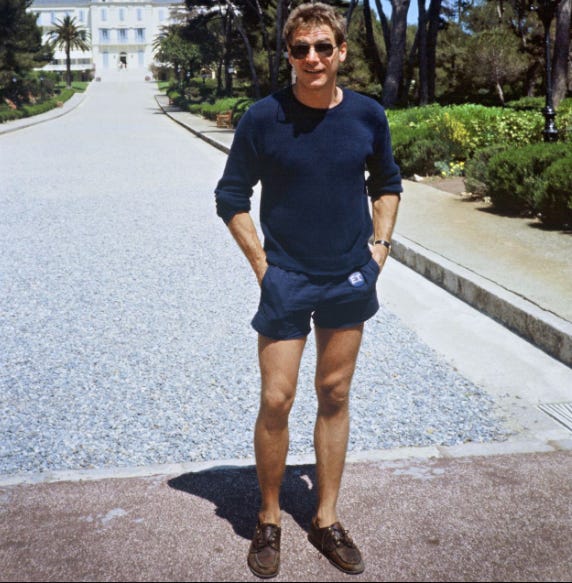
Currently Indonesia is the 3rd biggest market of Korean Drama subscribers, and at least a big 15% of Netflix revenue worldwide, big 7 of Disney+ Hotstar revenue.
My dad passed away in 2000. In 1994-1997, before he collapsed since 1999, I waiting him to back to home every Wednesday (he back home every 1.5 month, sometime 2 months from his field/construction site), with watching The X-Files, so I already memorizing several episodes before Disney+ Hotstar / DisneyPlus Hotstar in Indonesia attached The X-Files as one of a lot of options series and movies. The X Files airs in Indonesia every Wednesday, 11pm local time (around 11am in NYC), and yes, I've actually had insomnia since toddler age.
Waiting for my mom to prepare meals for me and my little brother around 2003-2004, I watched 24 and (series TV) Fugitive, aired daily but on 1am - 3am Indonesia time/GMT+7 (around 1pm - 3pm in NYC). Again, I already memorized every episode 24 before 24 to be one of the series in Disney+ Hotstar Indonesia.
On the movie side, similar rare. Maybe I am watching thousand times about “Air Force One” (yes, Harrison Ford), “Enemy of the State” (Willard “Will” Carroll Smith II), Star Wars: A New Hope (David Prowse, Mark Richard Hamill, the late Carrie Frances Fisher, and again Harrison Ford), Golden Eye (yes, James Bond’s Pierce Brendan Brosnan OBE), and few options, because Indonesia TV very limited to buy copyrights.
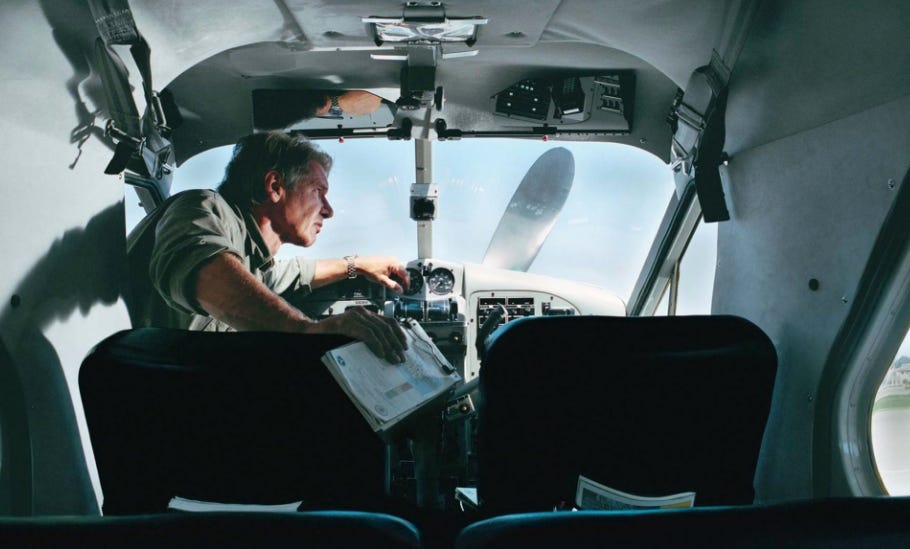
When I get older, I try to watch more movies and series, even movies in 1930s. But for a long time, I've associated POTUS to Harrison Ford (Air Force One), thanks to Indonesia TV channels repeatedly airing it. “Get out from my plane.”
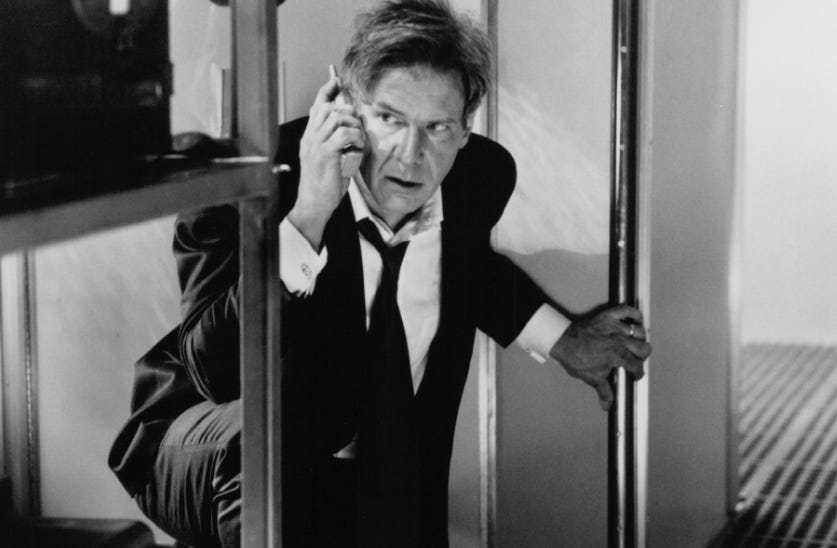
Yes, the first ever “Jack Ryan” cinematic universe is Alexander “Alec” Rae Baldwin III, but Harrison Ford has a very strong image about this role. Imagine: 6 years before “Good Friday Agreement”, Harrison Ford, an Irish descent like Biden & 21 other POTUS, play a role in “Patriot Games”, and Jack Ryan hates the Irish because the ultra-radical wing of IRA (on “Patriot Games”) is trying to kill his wife and daughter Sally Ryan.
Not only because CIA’s Jack Ryan, but maybe (more related) his role POTUS on “AIR FORCE ONE”, one of a lot of reason I am learn/studying International Relations, and not only about U.S. - Russia relation.
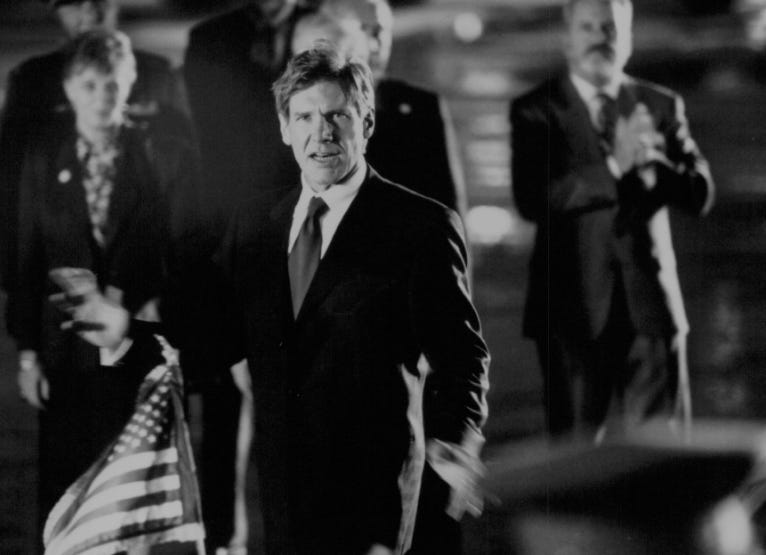
Like or not, for a lot of moviegoers/sinefil/cinephile (and me), AIR FORCE ONE crystallized Ford's leading man image better than 'Indiana Jones' or 'Star Wars', although this movie just get (until today) 6.5 (rating) in IMDB.
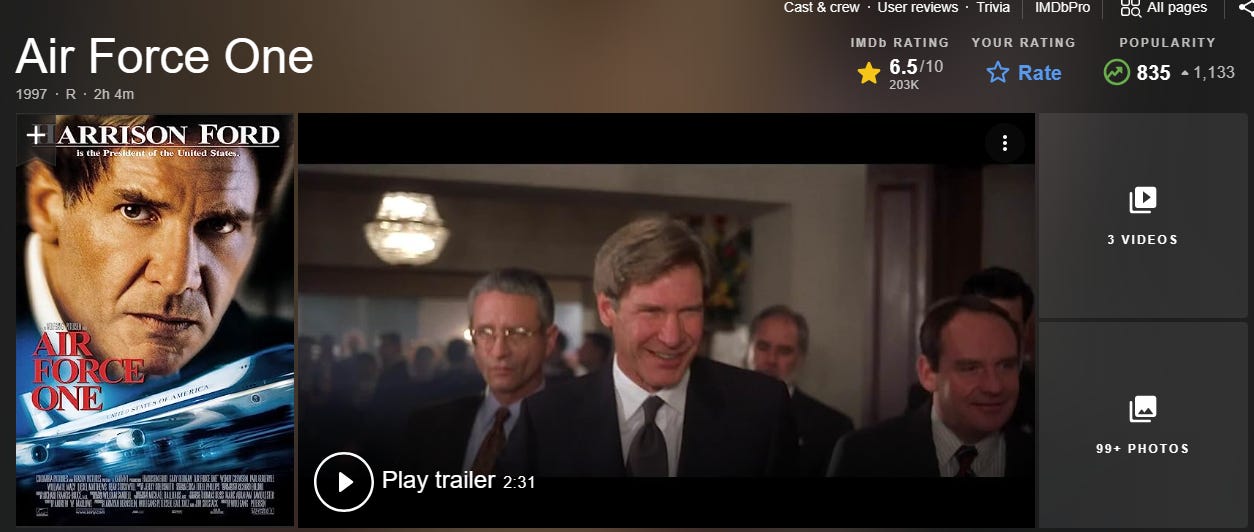
Air Force One, the Wolfgang Petersen blockbuster from 1997 where Russian terrorists hijack the U.S. President's plane and hold the White House staff hostage, is quintessential Harrison Ford in a way that requires his fictional history precede him. No movie better summarizes Ford's crackingly magnetic persona — and it wasn't even written for him.
Air Force One producers initially offered the role of Marshall to Kevin Costner. Costner was too busy and insisted no actor accept the role except Ford. It might be nostalgia talking, but it's impossible to imagine anyone else helming this popcorn blockbuster. Ford was in his 50s, and Air Force One distills his career into a frozen-in-amber moment: his appeal, his easy yet resonant presence, and his back-to-back achievements. His few villain roles aside, Ford always evokes a sense of safety: no matter the hardships portrayed onscreen, good will triumph and viewers will have a damn good time at the movies to boot.
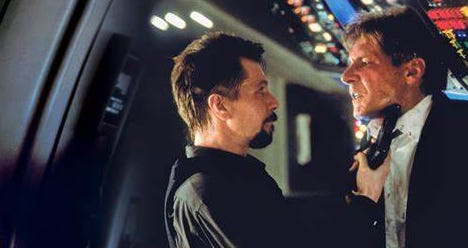
(Harrison Ford and Gary Leonard Oldman. Air Force One)
So how did Air Force One pull that off? It's a prime example of "right place, right time." Ford was a beloved figure who never rested on his cinematic laurels, but the quality of his films dipped in the 2000s. Firewall is a forgettable waste of everyone involved, Cowboys & Aliens was a divisive flop, and we don't talk about Indiana Jones and the Kingdom of the Crystal Skull. Audience tastes were slowly shifting away from traditional action blockbusters, especially with superhero material growing in popularity. Star Wars: The Force Awakens ushered in a new era of reboots in which Ford participated. His name will always be a draw, and he thankfully has no plans to retire. But Air Force One unintentionally marked the upcoming end of an era. Ford would remain, but within 15 years, the time of the original mid-budget film would, unfortunately, be over.
Air Force One was one of 1997's box office giants. It earned $315 million worldwide, an impressive feat in the same year Titanic dominated everything. Don’t forget another blockbuster 1997: James Bond’s Tomorrow Never Dies. There are many reasons it's a movie that wouldn't be made today. Its particular brand of rah-rah patriotism and assured belief in American invincibility hasn't been seen for decades. Western cinema shrugging off that Jingoistic arrogance is a vast improvement, but instead of depicting healthy, selfless masculinity, we have Gerard Butler's grim, dead-eyed, violent B-movie extremism.
Harrison Ford's President Marshall was just a dude with relatable personality quirks. He didn't seek violence but enacted it to protect his loved ones, and his crooked smile was like cracking open a pot of gold. In turn, Harrison Ford as an actor is an irreplaceable gift. Han Solo and Indiana Jones kickstarted his contributions to film, but consistently strong efforts like Air Force One cemented his legacy as one of the last living people who can truly be called a movie star. No IPs need apply.
Harrison Ford’s historic acting résumé offers plenty of unforgettable endings, but only one film pivots on the word “fluffy.”
In “Morning Glory,” a 2010 workplace comedy about a young producer (Rachel McAdams) who attempts to revitalize a ratings-starved morning show by hiring a legendary nightly news anchor (Ford), Becky is thinking about leaving the breakfast TV program she helped save. Viewership is climbing, the network is happy, and she’s fielding bigger and better offers from the likes of NBC. (“Daybreak” is part of a fictional network with the call sign, if you can believe it, IBS.) Her greatest challenge has been managing the ego of her star acquisition: Ford’s eight-time Peabody winner, Mike Pomeroy. The crabby hard-news reporter rebukes her suggestions (“You want me to do stories about Baked Alaska? After the career I’ve had?”), refuses to play nice with his co-anchor (a frog-kissing Diane Keaton), and generally makes her job (and everyone else’s) next to impossible.
But then he finds out she might leave, and his black heart finally starts beating. Abandoning the desk mid-broadcast, Mike shouts at an executive producer, “I need eggs!” Suddenly, he’s ordering staffers to assemble the show’s kitchen and donning a Daybreak apron. When Becky glances at a TV screen — in the middle of her big job interview — she’s stopped cold at the sight of the former war correspondent cooking up a frittata. “Occasionally I make them at home, but only for people I really care about,” Mike says, referencing an earlier argument with Becky and letting her know she is, in fact, a person he cares for.
His callbacks don’t end there. In her many fights with Mike, what really sent Becky over the edge — the leaden straw that broke the TV producer’s back, if you will — was when he balked at saying, of all words, “fluffy.” Becky lost her shit, Mike dug in his heels, and here we are: She’s looking for a new job, he’s desperate to keep her on his team. So as Mike remembers the “beautiful Italian movie star” who taught him how to make this delicious fried omelette, he also makes sure to add that “the key to a great frittata is a very hot pan, because that, my friends, is what makes it” — Mike pauses, points to the camera, and lands the kicker — “fluffy.” Becky sprints back to Daybreak, reunites with Mike, and the duo literally end the movie by walking into the sunrise.
…OK, so maybe “Morning Glory’s” ending isn’t as unforgettable as cinema’s best comedies (it’s no “22 Jump Street”!), but what makes Mike and Becky’s heartwarming send-off so memorable can be boiled down to a simple factor: Harrison Ford. As when he embodies Han Solo or Indiana Jones, Ford saves the day. He steps up at the eleventh hour, wins over a reluctant female partner (albeit in a strictly platonic fashion), and becomes the hero audiences know and love. Thus is the template for so many of Ford’s roles in so many of his movies, and it carries over whether he’s whipping eggs or whipping snakes. But if you take a longer look — a longer look than a so-so movie like “Morning Glory” tends to invite — you can see a side of Mr. Ford that’s only getting better with age. Mike Pomeroy may not be an action hero, but it’s Ford’s comedic prowess that carries the film.
To note that Ford, one of history’s most iconic movie stars, can be funny is like saying Tom Cruise can be fast. From his early breakthroughs playing a sassy, solitary space cowboy in “Star Wars” and a sassy, solitary archeological cowboy in “Raiders of the Lost Ark,” the actor’s pointed quips and boyish shrugs have delivered huge laughs in Hollywood’s biggest blockbusters. It’s just that being funny isn’t what Ford is known for.
That may be a good thing, considering his track record for choosing comedies is pretty awful. Over the decades, Ford has only made a handful of actual comedies (movies that aim for the laugh first), and only a few of those are actually good movies. But he’s been perfecting his comic instincts throughout his career, wielding humor with increasing precision even as his projects fail to live up to his talents. Ford’s clunky, often-unsuccessful comedies created a void, of sorts, where one of his most endearing skills went underutilized. Audiences knew he could be funny in spurts — in between throwing punches or wooing a love interest — but he wasn’t expected to carry a comedy.
Now, he’s delivered another great performance in a less-than-great project… and it feels like a revelation. Why? Time, talent, and TV. The Apple TV+ series “Shrinking” draws from the audience’s lengthy history with Harrison Ford, relies heavily on his deft comic talents, and allows us to appreciate both thanks to the extended time offered by TV. What seems familiar at first becomes extraordinary over the 10-episode first season.
And it all starts with a good teacher.
When Ford Was a Funny Work-in-Progress
Dialing the wayback machine to 1979, it’s two years after “Star Wars” and two years before “Raiders.” Ford has saddled up alongside Gene Wilder for a comedy-western playing a character not far removed from Han Solo. Instead of an interstellar smuggler, he’s a bank robber, and instead of pairing up with a hairy, screaming Wookie, he partners up with a hairy, shouting rabbi. Sporting a bushy beard and long curls, Wilder plays Avram, a recent graduate of a Polish seminary who’s sent to San Francisco to start a new synagogue. But when thieves steal his travel money, Avram finds an unlikely guide (and protector) in Ford’s Tommy Lillard. Together, they make their way across a perilous American landscape, learning each other’s customs and forming an unlikely friendship.
“The Frisco Kid” was rightly panned upon release. Tonally all over the map and way too long as a result — some of the slapstick scenes don’t even follow their own logic, and seem forced into the picture to hit a studio quota — “The Frisco Kid” consistently reads as more of a drama with silly bits than a comedy with emotional heft. It’s also more of Wilder’s movie than Ford’s, the latter of whom doesn’t show up for nearly 30 minutes and often becomes an extraneous bystander, waiting and watching in the background while Wilder’s rabbi teaches Judaism to cowboys, settlers, and Indigenous Americans.
Ford’s comedic touch is similarly unpolished, but you can see the elements of the actor’s future stardom throughout. Introduced sleeping on a train car with a brimmed hat laid casually over his face — a napping style soon to be made cool by Indiana Jones — he wakes up, robs the passengers by lying to them (claiming his nonexistent partner is standing behind them with a shotgun), ends on a quip (“Better to give than to receive, ain’t it folks?”), and hops off the speeding train with his stolen bounty. Later, his angry/scared shouting can be a little too raw — he’s dialed into his character’s reality instead of the situation’s comic intentions — but even when his tough talk gets a bit jittery, his outbursts remain oddly endearing. During Tommy’s last-minute heroics, Ford redeploys his iconic “Star Wars” shooting stance and his surprise entrance (clad in a white undershirt unbuttoned to the navel) leaves no doubt of his natural charisma.
Best of all, Ford’s performance feels fresh. Having Wilder as a scene partner had to play a hand in his comedic development. Their camaraderie is the film’s strongest aspect, and it boosts Ford’s affability by association. I’m not sure what Southern accent he slips in and out of, but he’s trying, and that’s fun. The litany of Jewish terms he mangles are mostly tossed aside, which lets Tommy’s misplaced confidence add an extra layer to each messed up attempt at friendly assimilation, and his inspirational final speech shows glimpses of the furious vulnerability Ford has now harnessed for decades.
By the time his next “comedy” rolls around, Ford is dialed in, and “Working Girl” reaps the benefits. Nine more years of acting experience, including four entries in his two blockbuster franchises, help Ford hone his skills for Mike Nichols’ 1989 Oscar-winner, in which he plays the irresistible dreamboat, Jack Trainer. His growth is quickly evident, not only in how he charms and disarms Tess (Melanie Griffith) on their first “date,” but in his attempts to hold up a one-sided conversation after she passes out midway through. (Ah, the ’80s: When a woman mixing muscle relaxers with a stranger’s tequila shots were treated as good, clean fun.)
The emotive jitters Ford exhibited a decade earlier have been smoothed into a relatable nervous tension. “Herb tea?” he asks his clearly unconscious date, and before she can’t answer, he dejectedly admits, “I don’t have any.” Such sheepish, innocent, and futile attempts to impress Tess aren’t simply for laughs; they support Ford’s romantic close-up: “Man, you sure are pretty,” Jack says, and it’s the jump from absurdity to sincerity that ingratiates the character to the audience.
Despite the film’s success — and Ford’s flattering turn in it — comedies become few and far between for the actor. Over the next decade-plus, the star embraces more action movies (“Indiana Jones and the Last Crusade,” “Patriot Games,” “The Fugitive,” “Air Force One”) and weighty dramas (“Presumed Innocent,” “The Devil’s Own”). But in between growls to get off his plane, Ford is fine-tuning what’s become his best-known archetype; a guy who surfaced onscreen as Han Solo and Indiana Jones and off-screen in intermittent interviews and Hollywood lore: the grump.
Typically, the Grump™ is found in unwanted, uncomfortable circumstances that could range from life-threatening (like being framed for murder or seeing his airplane taken over by terrorists) to mundane (like speaking to dumb-dumbs, or being forced to read the word “fluffy” on TV). At first, the Grump™ resists. He fights for his freedom, fights the bad guys, fights the rules of polite society, or fights with the usually younger know-it-alls telling him what to do. Then there’s a fork in the road: When the Grump™ is right to be grumpy, he advances his position until he saves the day. But when the Grump™’s grumpiness impedes his progress, he slowly cedes ground until a tolerable compromise can be found. He opens up just a little, but the gesture speaks volumes, and the reformed Grump™ — in one way or another — still saves the day.
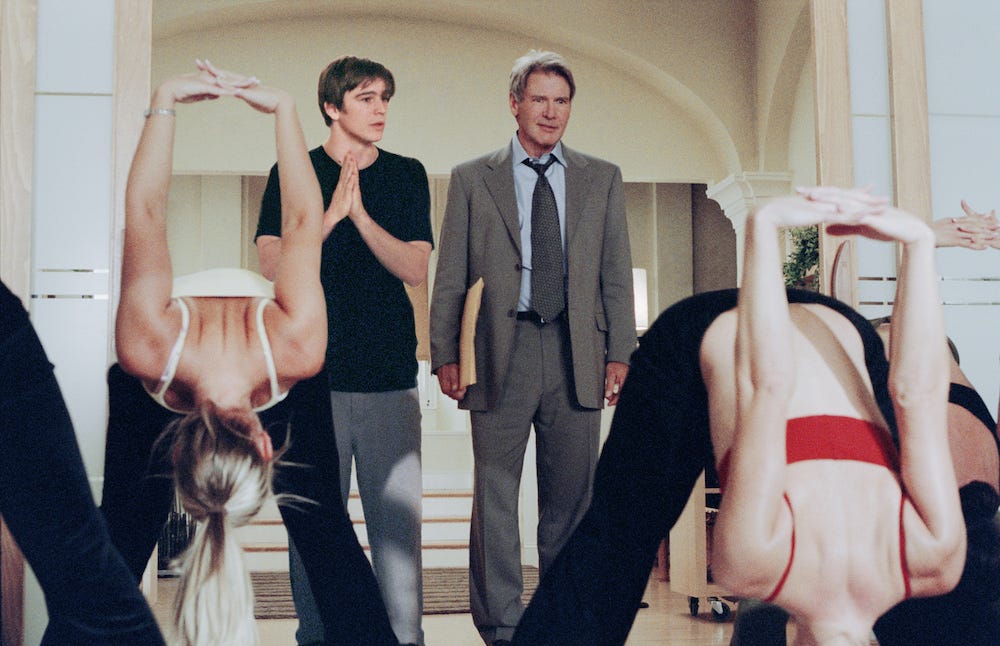
The older Ford gets, the easier it is for audiences to embrace his reluctant heroes as crotchety father figures. You’ve got your laugh-forward action flicks, like “Hollywood Homicide,” where he’s the reluctant mentor to a young whipper-snapper (Josh Hartnett). In “Six Days, Seven Nights,” he’s almost 30 years older than his love interest, Robin (Anne Heche), but Ford’s “man’s man” persona — an airplane pilot forced into survival mode after a crash — helps to land banter about their age gap while still selling himself as an attractive partner (especially when compared to Robin’s wimpy fiancé, played by an extra whiny David Schwimmer). A similar if nicer version plays out in the 1995 remake of “Sabrina” — a romance misleadingly labeled a rom-com, despite a dearth of actual jokes — where he’s more than two decades older than Julia Ormond’s titular lead, yet wins her over with an odd combination of competency, vulnerability, and extreme wealth.
Through a fourth “Star Wars” and “Indiana Jones,” Ford cruises along as the world’s gruffest, toughest, handsomest papa bear. (There’s a case to be made that the actor’s contributions to our culture helped elevate the once-infantilized “daddy” into today’s capital-D “Daddy,” but that’s a whole other essay.) Still, playing the Grump™ time after time also provided opportunities to sharpen other tools — comedic tools (you know, like a hacksaw). He would occasionally subvert his surly public image for a few chuckles, either in fleeting moments with an aging Han or Indy, or during funny, part-time dalliances in silly pictures like “Anchorman 2” and “The Expendables 3.” Heck, whole comedies were based around thawing Ford’s icy exterior — like “Morning Glory,” where a random fan recognizes Ford’s legendary broadcaster on the street and sums up how many fans may remember the actor’s Grump™ phase: “Everyone was eating stuffed zucchini, and you were all cranky about it!”
Enter: “Shrinking.” In a lot of ways, Paul Rhoades fits snugly within the actor’s Grump™ zone. Paul is a successful therapist with his own practice in Pasadena, CA. He reluctantly mentors his two other staffers, Jimmy (Jason Segel) and Gabby (Jessica Williams), and — since he’s grown distant with his own daughter — Paul even makes time (in secret) for Jimmy’s kid, Alice (Lukita Maxwell). Even though he’s an award-winning advisor to others, Paul can only help himself so much, and he struggles to mend fences with his only child. (He hasn’t even told her about his Parkinson’s diagnosis.)
Co-created by “Ted Lasso’s” Bill Lawrence and Brett Goldstein, “Shrinking” is packed to the gills with bubbly, over-the-top personalities, which are both intolerable in their artificiality and make excellent foils for Ford. When Gabby scolds Paul about his water consumption while drinking from the world’s largest sippy cup — “Do you know what percentage of yourself is actually made of water?” — Paul’s response is a dismissive, ” I know what percentage of myself doesn’t give a shit,” which makes it easy to side with the dehydrated Grump™. When Jimmy does what Paul specifically tells him not to do — telling patients how to fix their lives instead of letting them make better choices for themselves — it’s easy to side with Paul because, well, Jimmy is an idiot and Harrison Ford is not.
“Shrinking” wears out Jimmy’s immature idiocy pretty fast, but Ford as the scary boss/disapproving father figure proves an indefatigable resource — and an adaptable one. As the season goes on, Paul evolves from the constant voice of reason into a person all his own. He’s not just earning laughs by shutting down the excessive enthusiasm or poor instincts of others; he’s creating laughs by making surprising choices all his own.
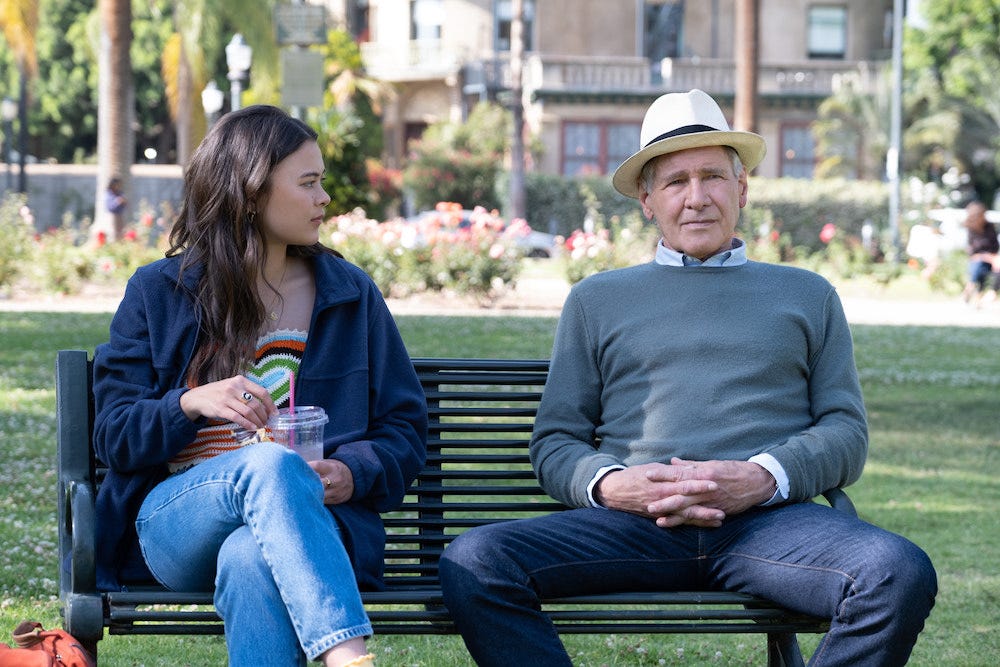
Some come from familiar places, like when Ford’s towering movie star image is undercut by silly lines like “You’re the mama!” or when Paul misuses the term “raw-dogging.” Then there are meta gags that play off his iconic roles, like when Paul gets made fun of for wearing a brimmed hat or repeatedly calls himself a hero. Still more jokes seem to emerge from the amount of time Ford gets to fill on a TV show, like the awkward way he walks out of Jimmy’s office in the premiere or the extra reaction shot he leans into at the end of opportune scenes.
That last example included, plenty of what’s great about Paul seems to come from Ford’s comic instincts. It’s the way he points and pumps his fists while singing along to Sugar Ray, and the delight he takes from instilling fear in strangers. It’s the defeated manner in which he places weed gummies in his mouth, and the honking laugh he lets out, hours later, when they hit. It’s in his timing, which has been there since the beginning, and the purpose he gives to each funny beat, which wasn’t. In a sea of cartoon characters, he holds onto Paul’s reality while still hitting every absurd punchline, every stretch to reach said punchline, and every cutesy line reading.
“Shrinking” capitalizes on viewers’ decades-long relationship with Ford and makes the most of his comedic skills. Plus, simply by existing in the TV medium, it magnifies those aspects over five hours of story. It may not be a great show, but it’s an impeccable delivery device for one of Ford’s best performances.
At the end of “Morning Glory,” when Mike and Becky are walking into the sunrise, the young producer reads her star anchor a review of their new-and-improved show: “His gravity leavens the silliness of morning TV making for an incongruous but somehow perfect match,” she quotes. “Turns out that after 40 years in the business, the real Mike Pomeroy has finally arrived.”
“Shrinking” certainly isn’t that emblematic. No one is arguing Ford should have been starring in sitcoms for the past 30 years. But the fact that he hasn’t, combined with the evident attention he’s paid to developing those skills anyway, makes seeing them in action now, five decades into one of the most widely appreciated careers in film history, so thrilling. He’s a perfect match for the material, even if the material is still less than he deserves.
Harrison Ford and Calista Flockhart's love story is one for the ages.
After meeting at the Golden Globes in 2002, they began dating. And despite their 22 year age gap (Ford was 59 when they began dating, Flockhart was 37), they have made their blended family work. Ford would go on to propose to Flockhart in 2009 (on Valentine's Day!) and they married in 2010 in New Mexico.
"I'm in love," Ford said in 2003, a year after they began dating. "Romantic love is one of the most exciting and fulfilling kinds of love and I think there is a potential for it at any stage of your life." They're still in love to this day, and going strong in 2023—in June, Flockhart joined Ford at the premiere of his newest (and probably final) Indiana Jones film.
Look back at Harrison Ford and Calista Flockhart's relationship, from 2002 up until present day:
January 20, 2002
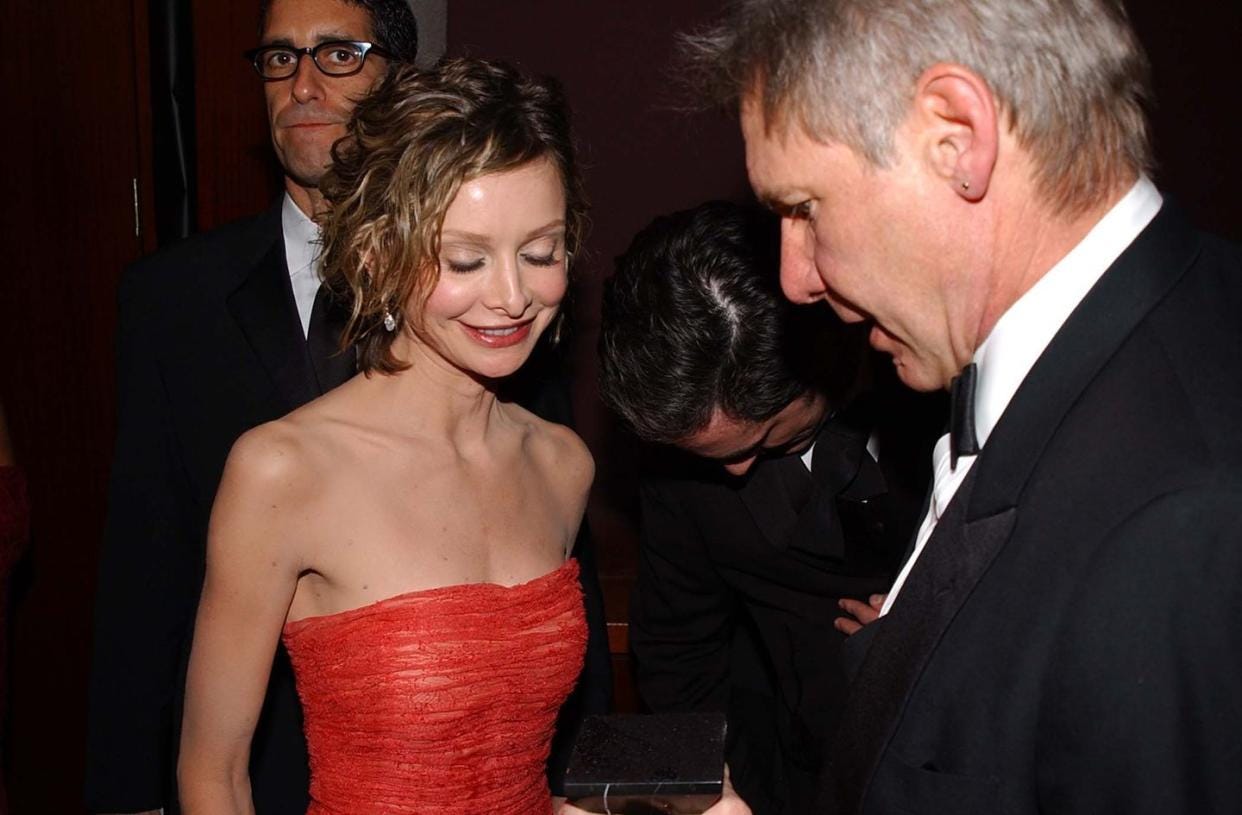
Flockhart and Ford first met at the 2002 Golden Globes, when he received the Cecil B. DeMille Award and she was nominated for her role in Ally McBeal. During their first meeting, Ford spilled wine on Flockhart.
2002
One of their earliest dates takes place in the company of James Marsden, Flockhart's Ally McBeal costar. "I'm a harbinger of a wonderful, long relationship, I take the credit for that," Marsden joked on The Late Late Show with James Corden. Here, the couple was snapped by paparazzi in summer 2002.
2002
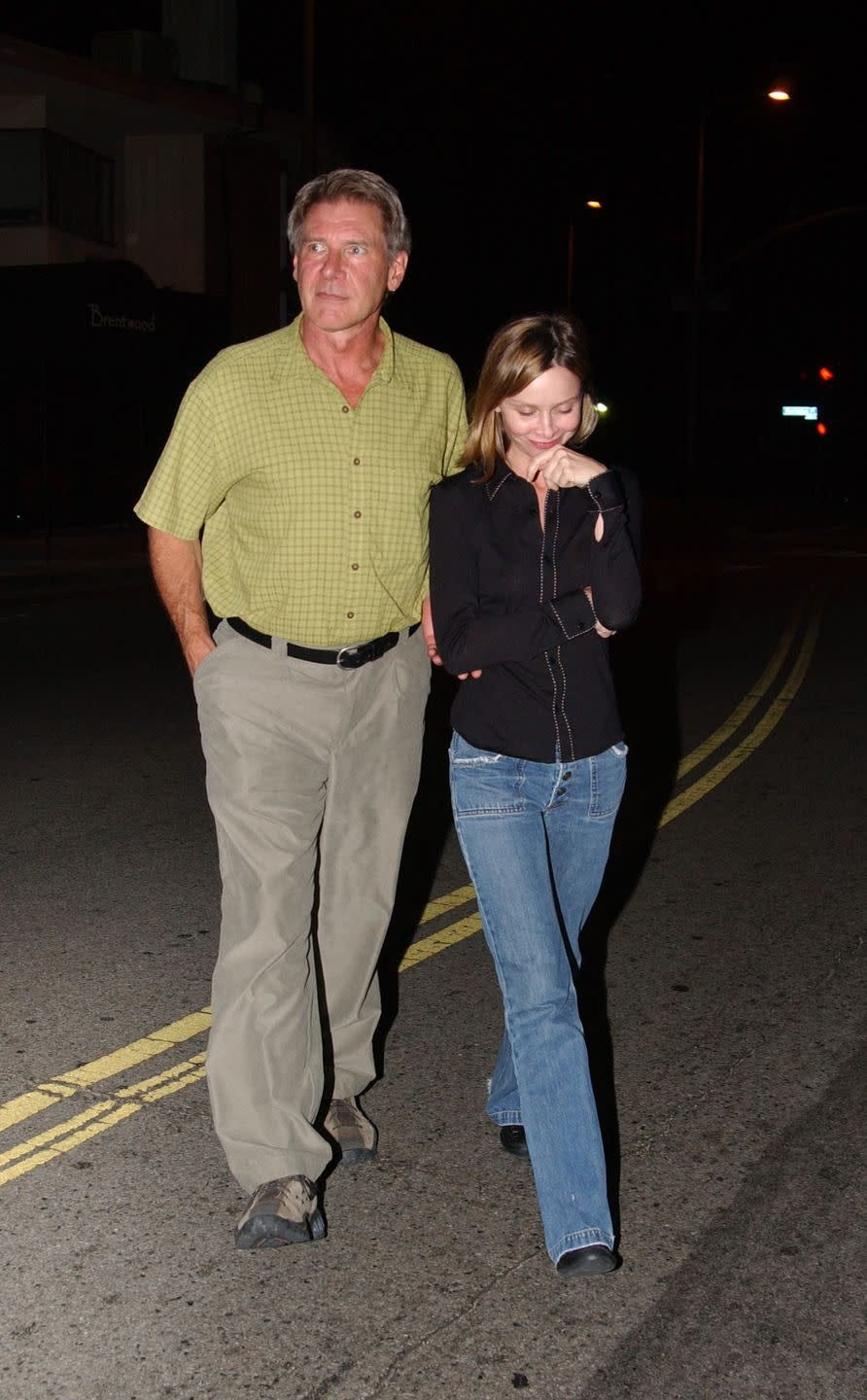
"I watched Ally McBeal from time to time before I met her, but now she won’t let me watch it," Ford said early into their relationship. "She doesn’t like to see herself."
2002
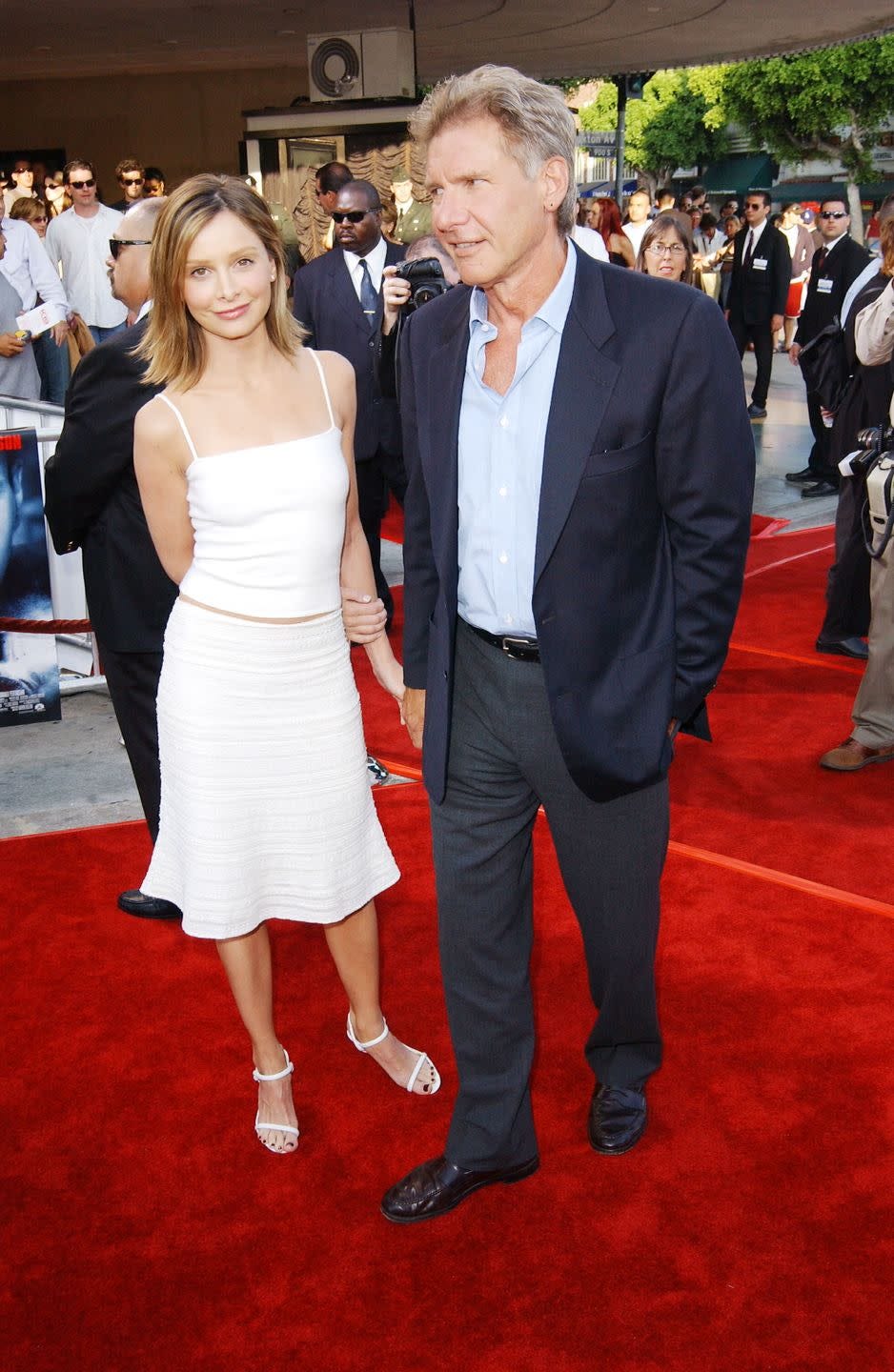
The 22-year-age gap was the subject of a lot of tabloid news, but it didn't bother Flockhart. "It doesn't faze me," she said. "Sometimes I even say, 'Wow, I keep forgetting that he's 22 years older than me.' It doesn't factor into our relationship at all."
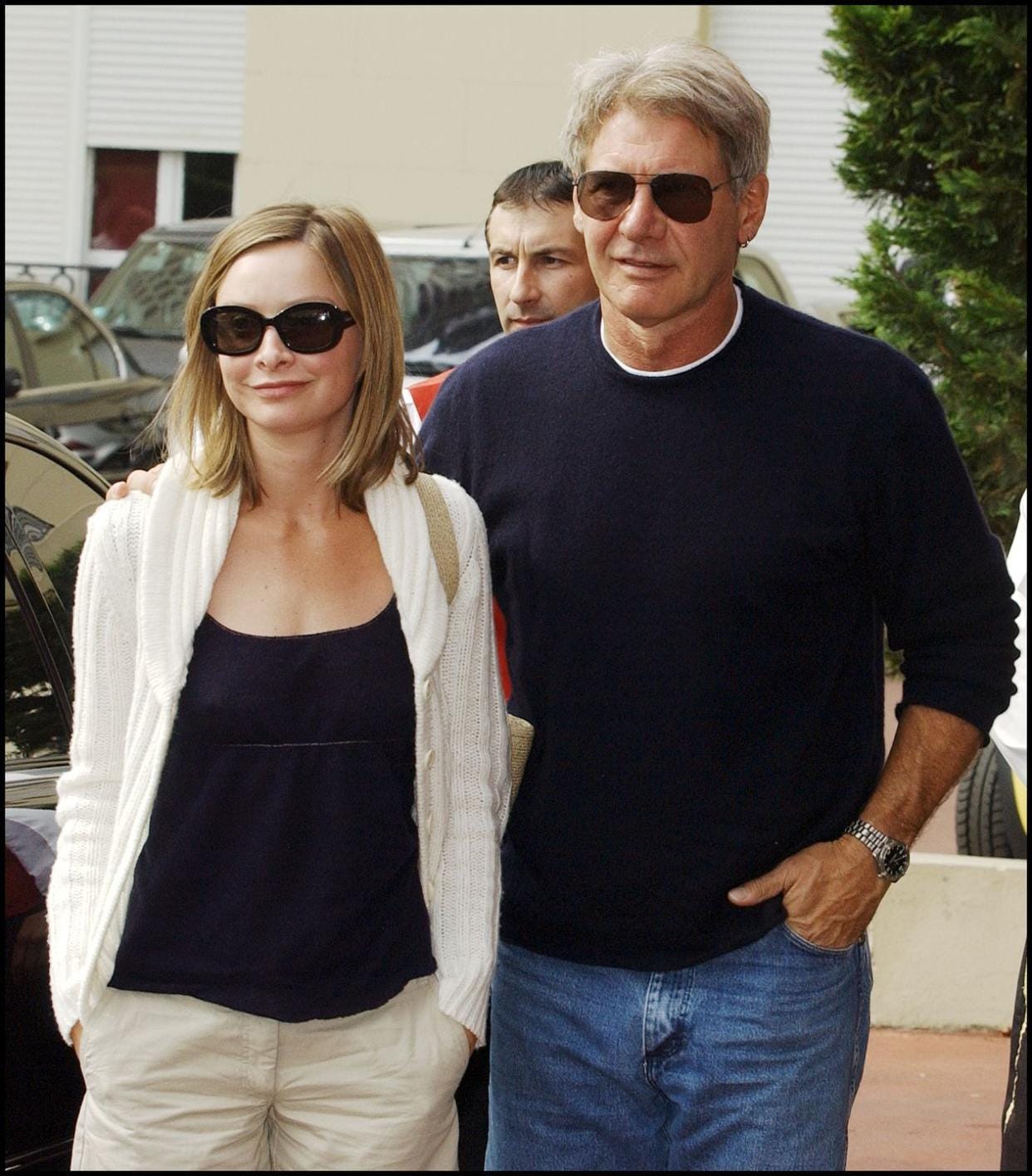
2003
Sometime in early 2003, they move in together. The two are pictured here at the Golden Globe Awards, a year after they met.
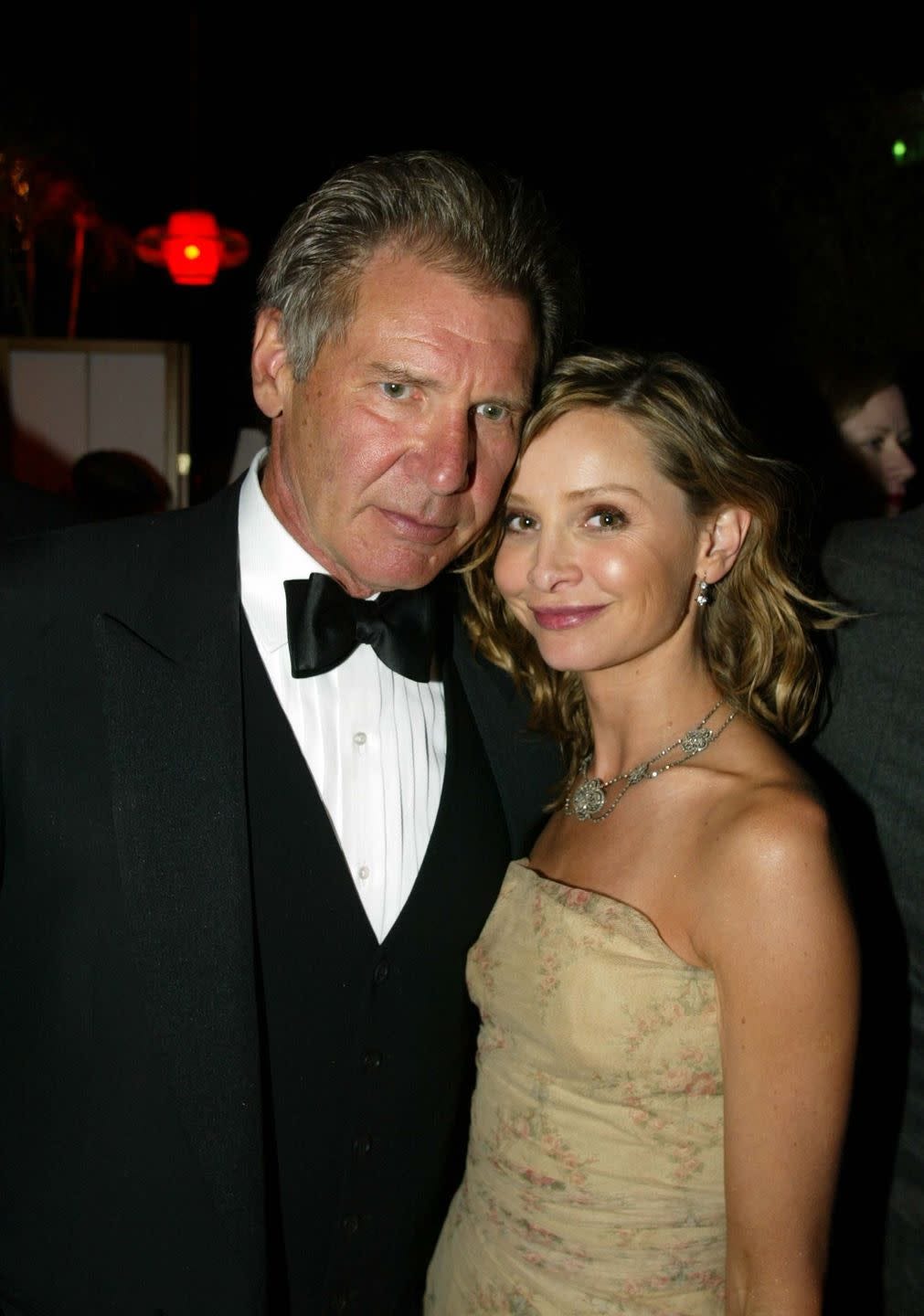
2003
A year before they met, Flockhart adopted Liam, and Ford would later adopt him, too.
"She's a mother by choice — she adopted Liam before we met, as a single parent, which is an awesome responsibility to take," Ford said. "She's devoted herself to Liam and has done a really wonderful job raising him. I'm happy to now have a part of the job."
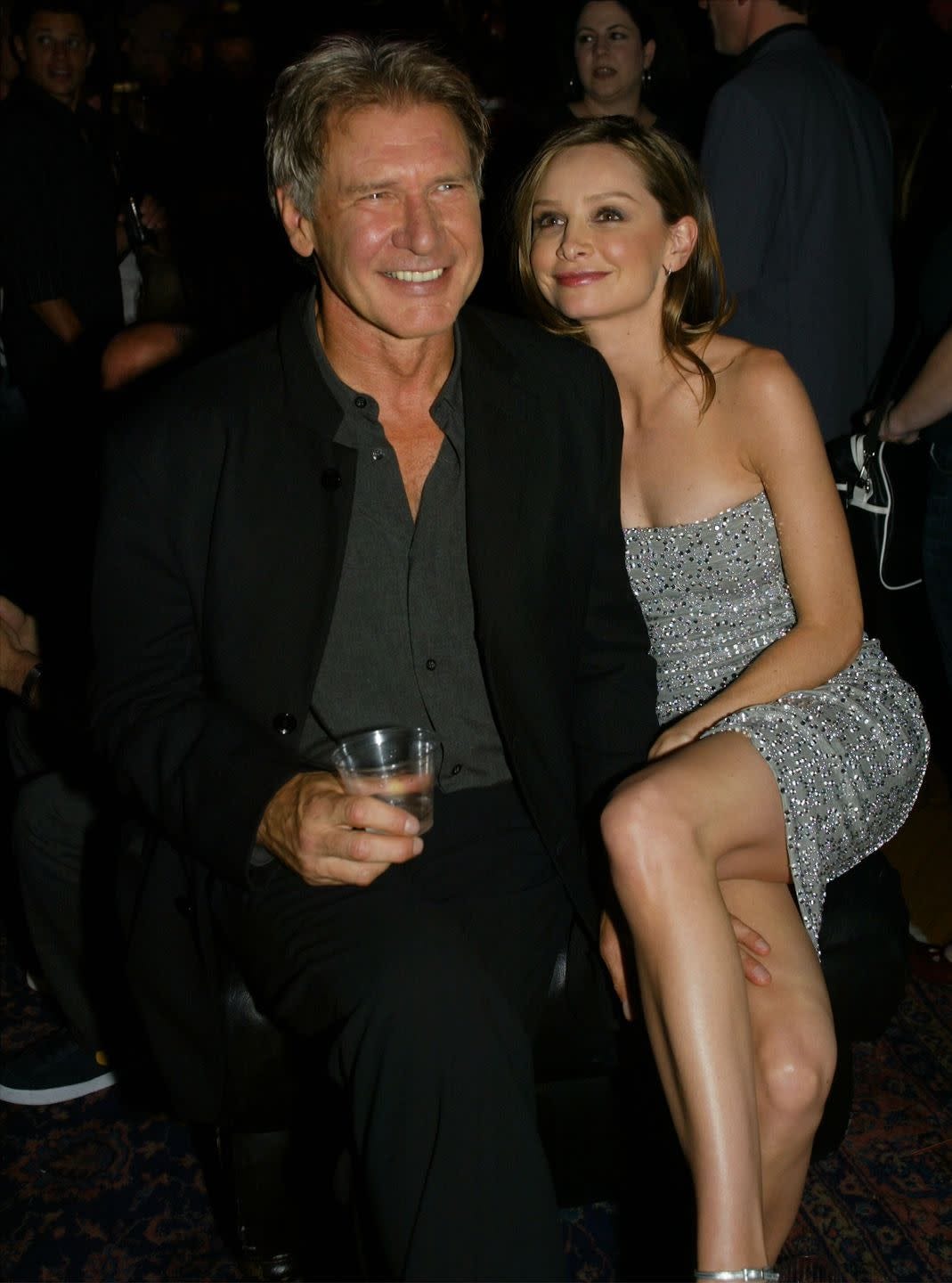
2004
They continue to date and keep a low profile throughout the next few years.
That year, they took a trip to Llangollen, Wales. "It was just the three of us – Calista, myself and Liam – and it was really fun and a real pleasure," Ford reminisced. "I’ve often taken narrowboat journeys in France and England too – it’s something I like to do. There’s nothing quite like it to slow your life down."
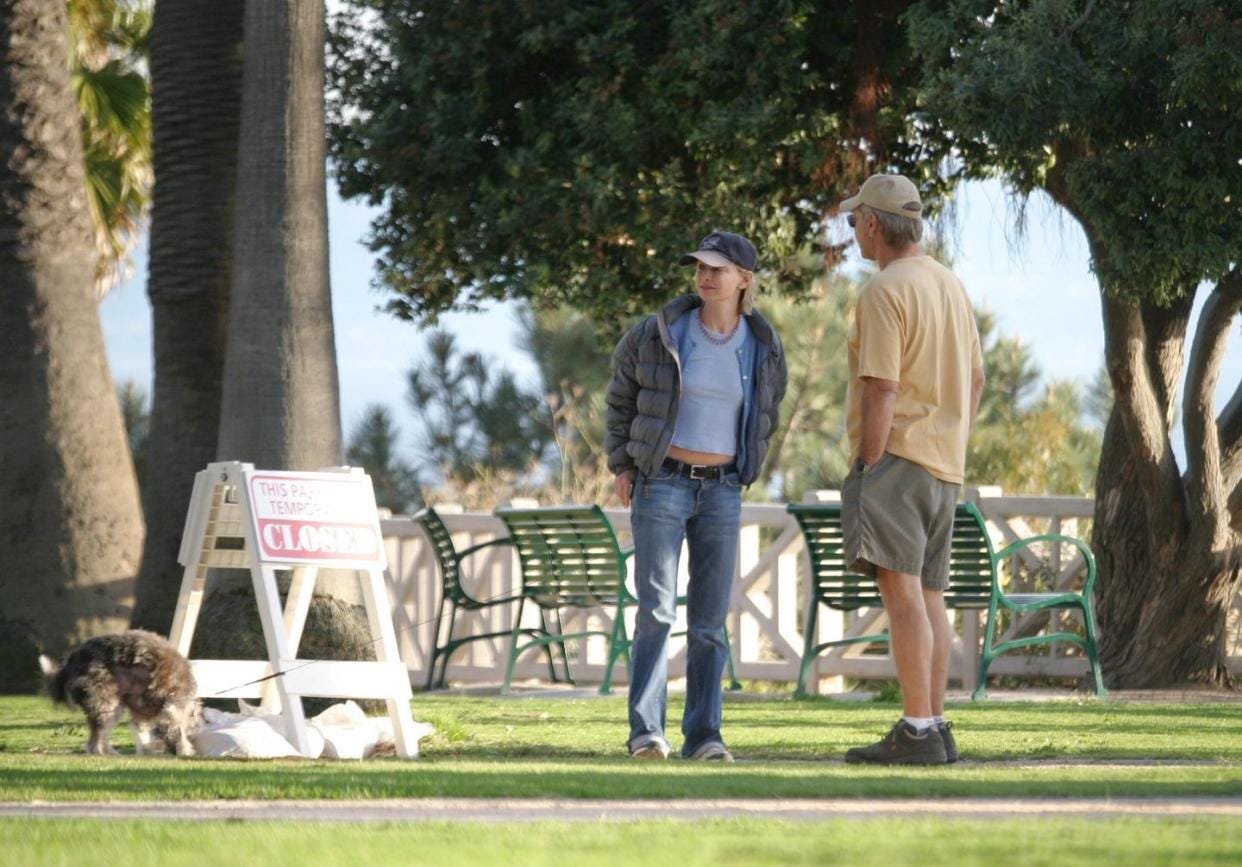
2005
The couple attends Venice Film Festival together, and look very in love as they arrive by boat.
"I like the way he looks first thing in the morning," Flockhart once said. "It’s not handsome. It’s more cute. He looks like a little boy. You know how when you wake up in the morning and you’re kind of puffy and rumpled and you look kind of vulnerable? That’s what he looks like."
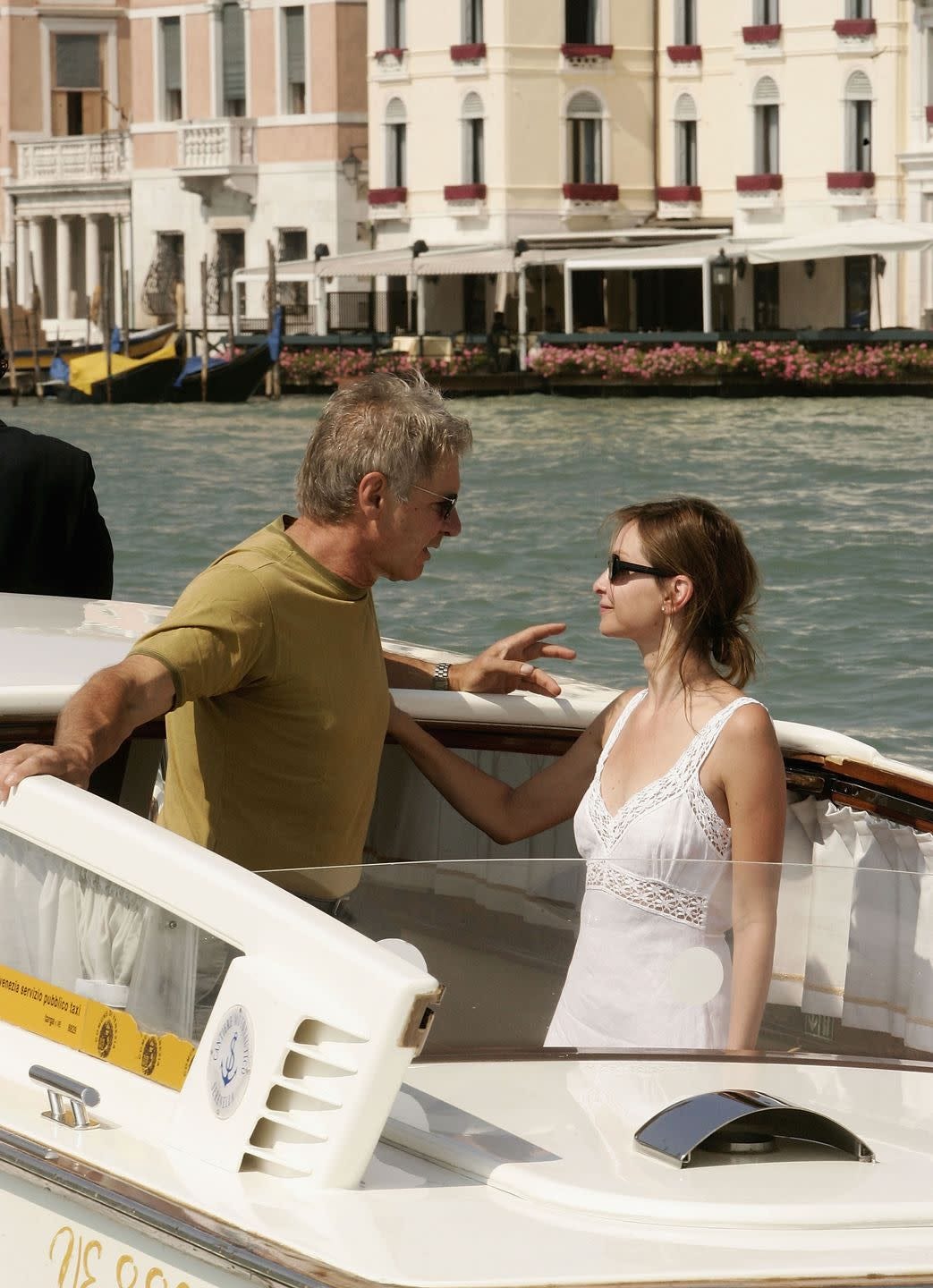
2006
Ford, an avid pilot, is glad Flockhart supports him in his hobby. "I'm thrilled because it's so important to me and it's the kind of thing that's so much more fun with somebody who really enjoys it," Ford said. "Liam loves to fly. Calista likes the process, she likes what she sees from the air, she likes seeing me happy. I think a lot of it has to do with that she loves to see me doing something that I love."
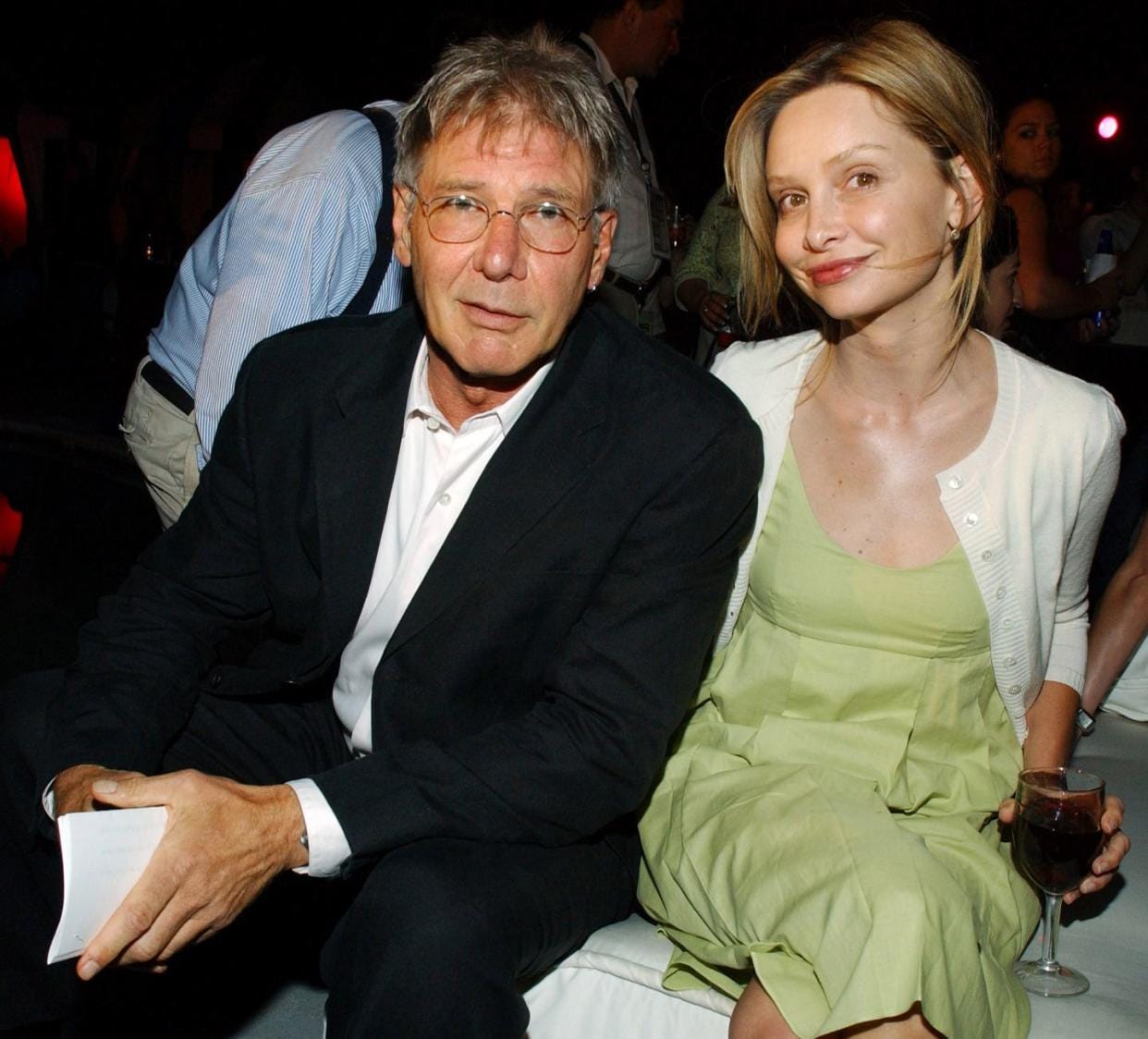
2007
Ford and Flockhart step out with Liam to participate in serving Thanksgiving dinner to the Skid Row homeless at the Los Angeles Mission.
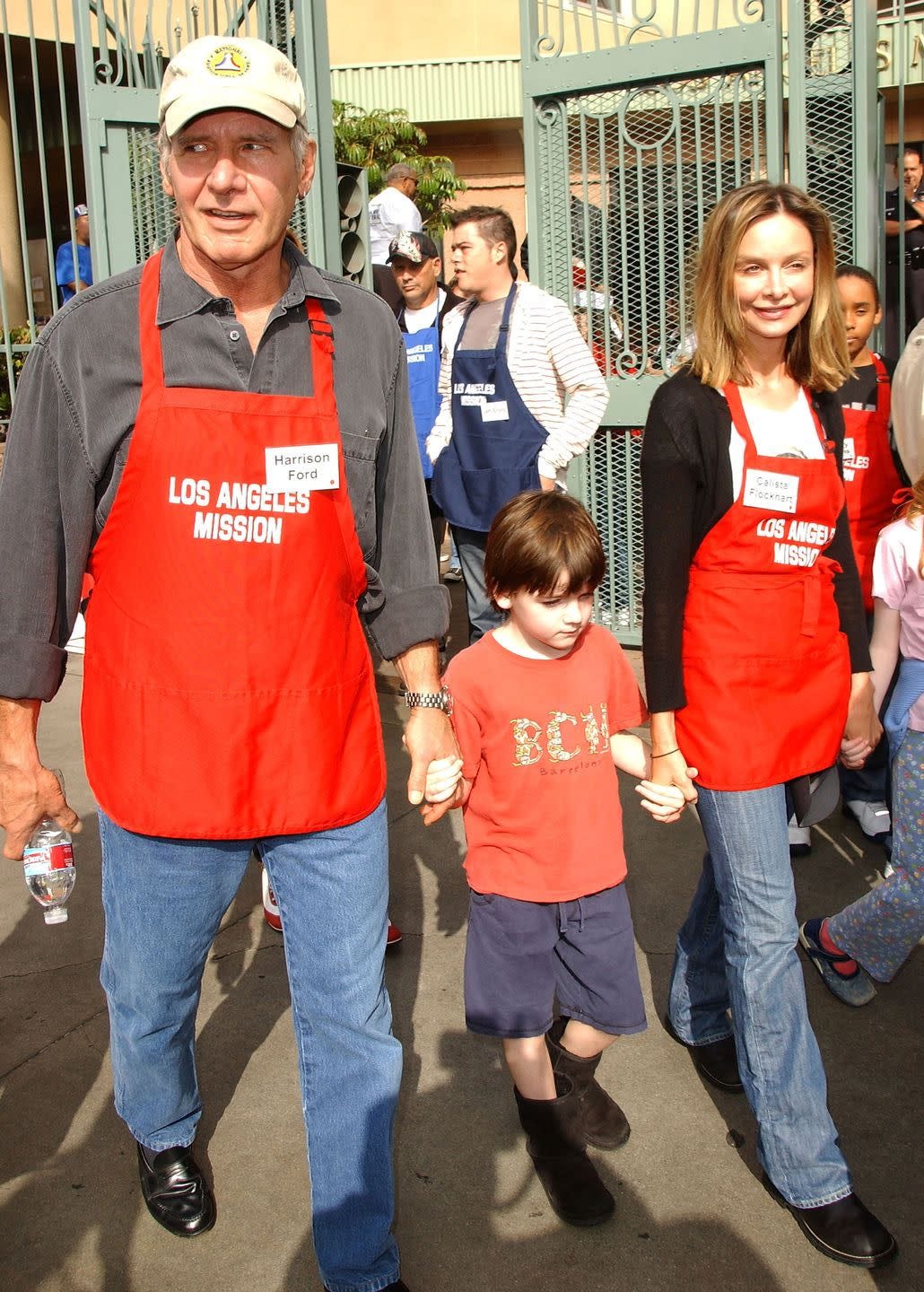
2008
The couple can always be counted on for a glamorous red carpet moment. Here, they're pictured at the Oscars.
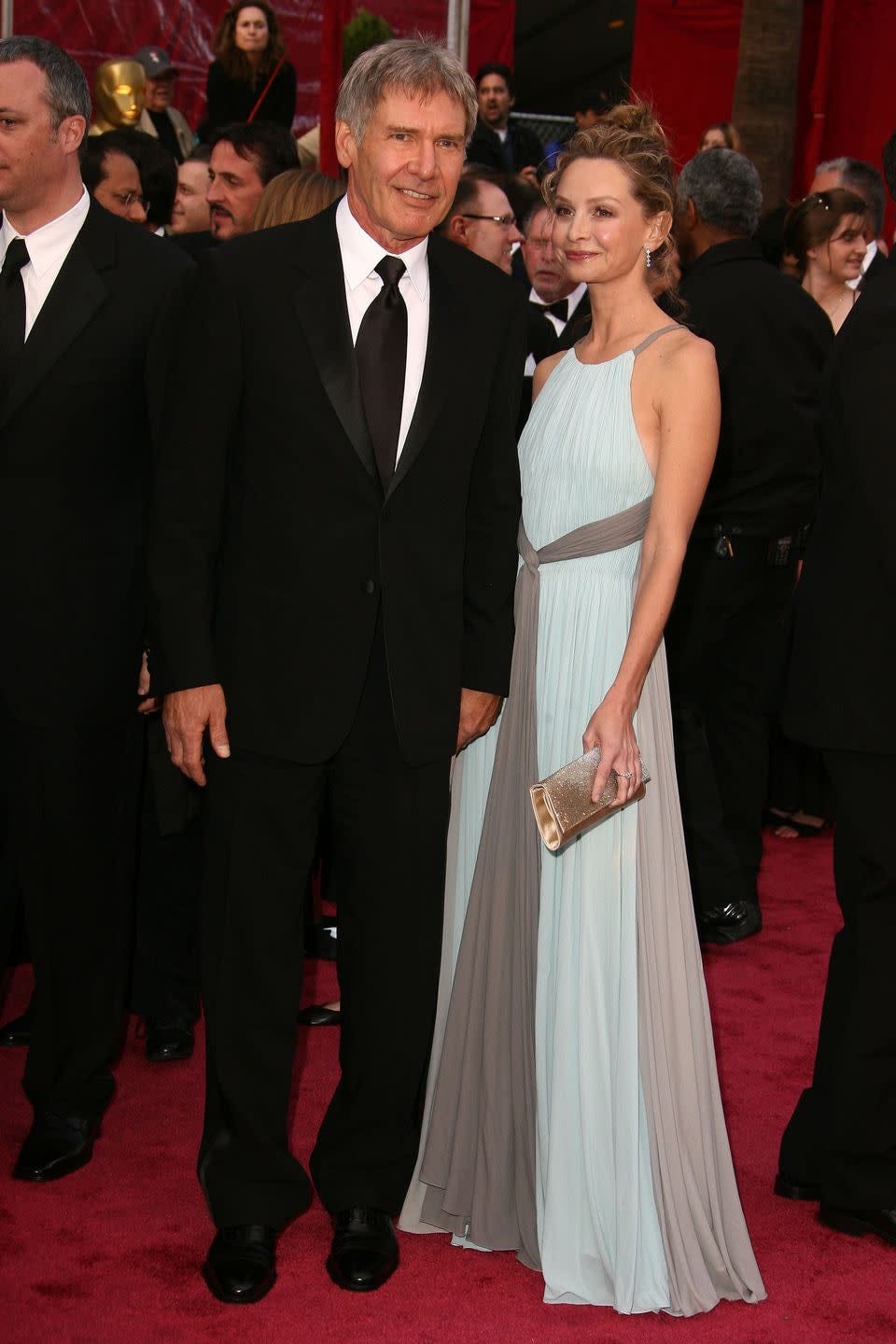
2008
Flockhart joined Ford at the Cannes Film Festival for the premiere of Indiana Jones and the Kingdom of the Crystal Skull, his first Indiana Jones film in two decades.
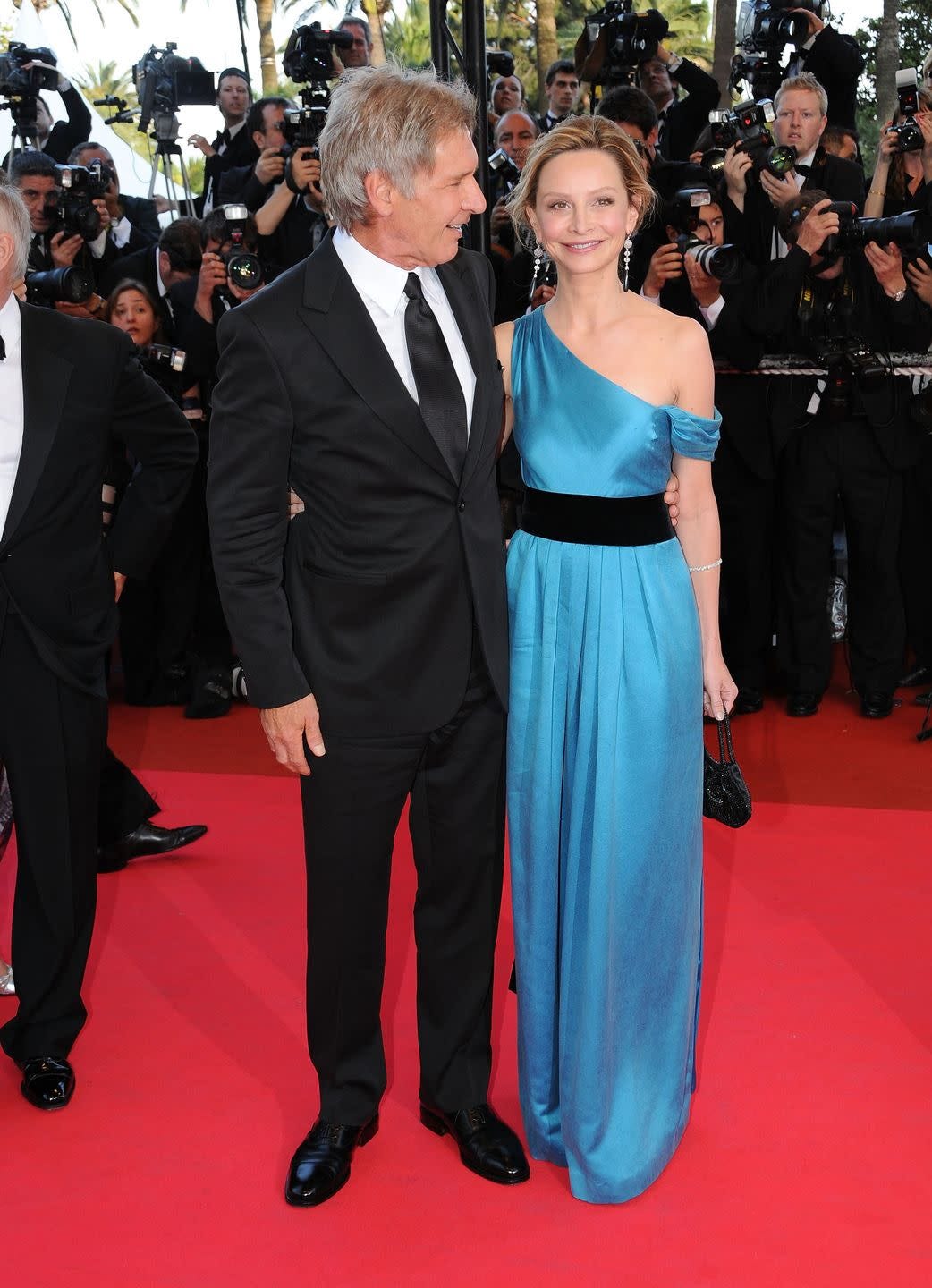
2009
Ford proposes to Flockhart on Valentine's Day 2009. In September, you could see her engagement ring at a screening of The Proposal (how fitting!) in September (pictured here).
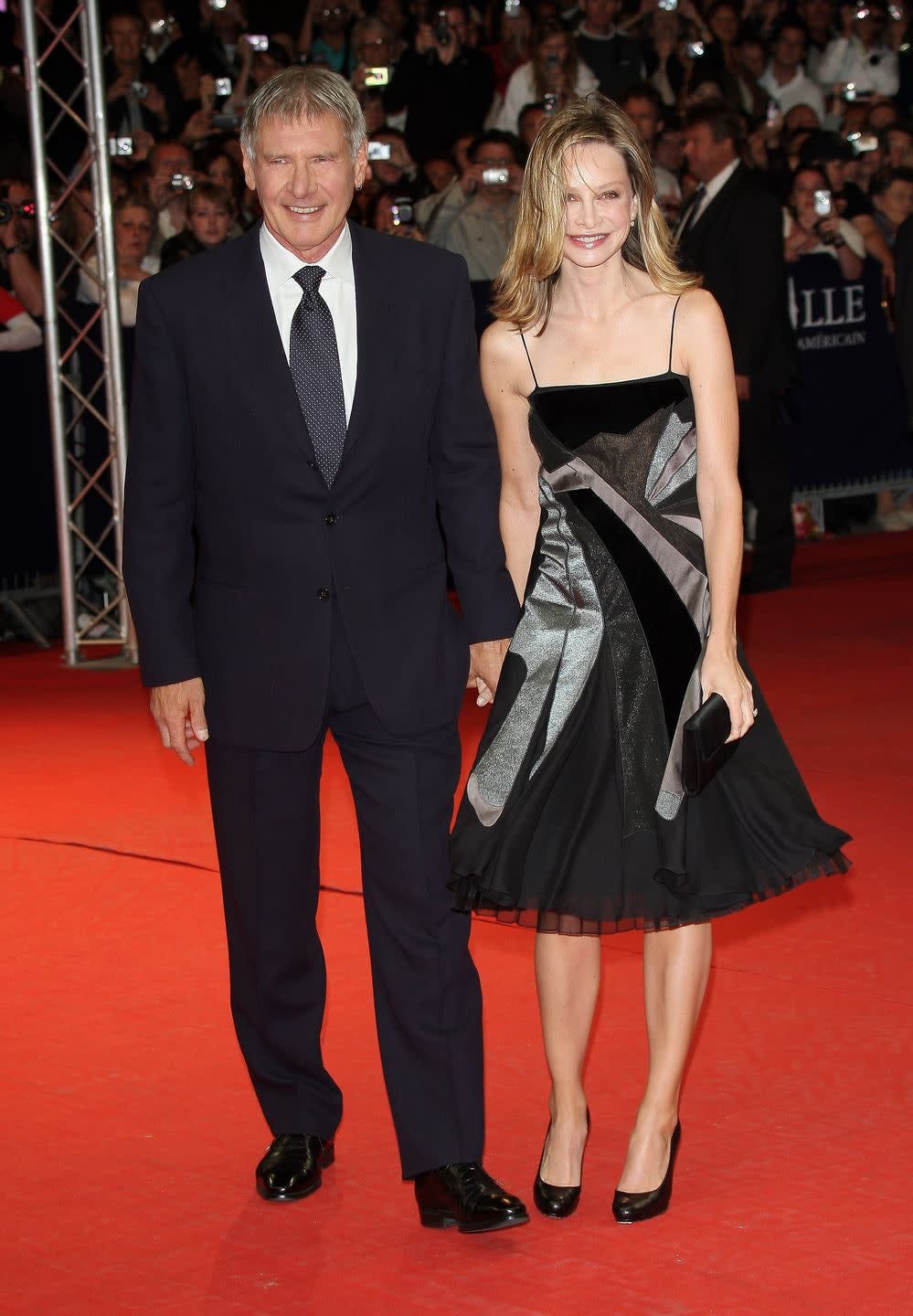
2010
In 2010, they tie the knot in New Mexico, while Ford was filming Cowboys & Aliens. Their wedding ceremony took place at the New Mexico Governor's Mansion and was officiated by then-Governor Bill Richardson. Ford apparently wore jeans on the big day.
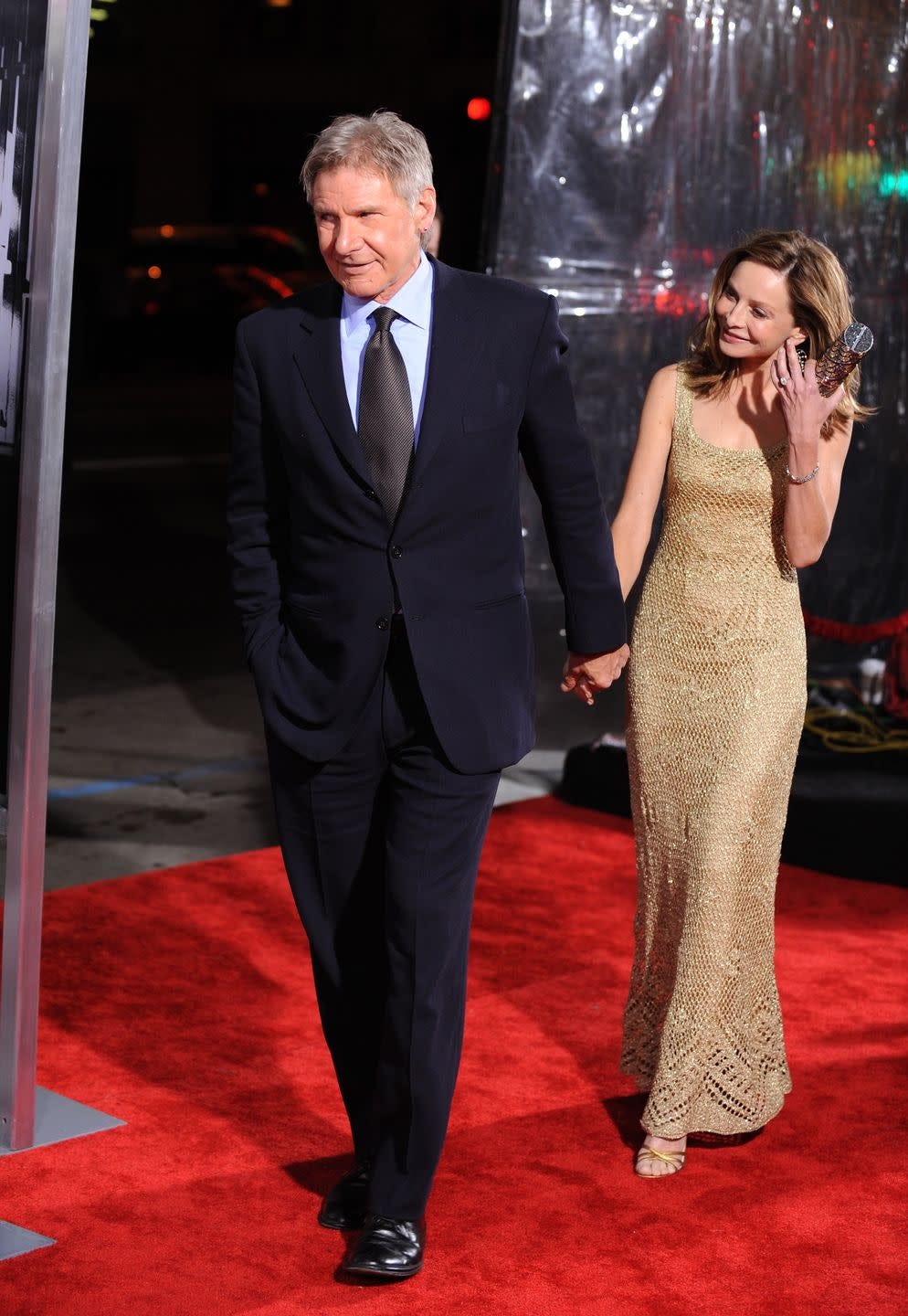
2011
Here, they are pictured in Los Angeles hugging. Now, their home base remains L.A. but they also spend time on a ranch home in Jackson Hole, Wyoming.
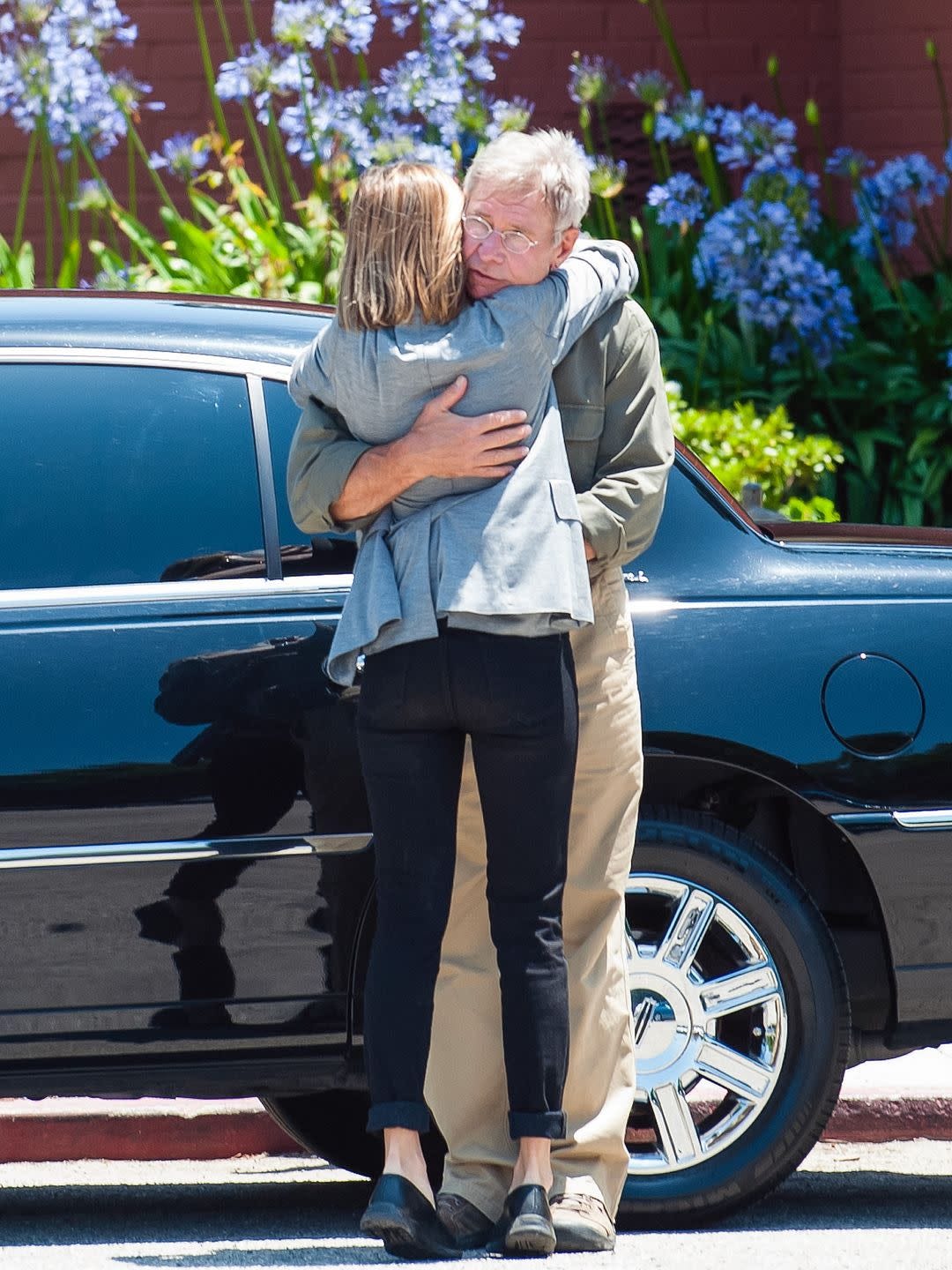
2011
"On the weekends, I do whatever Calista and Liam want to do," Ford shared about his family routine while not filming. "We’ll take a couple of hours on Sunday morning to go motorcycle riding or go for a hike. I just made a birdhouse with my son."
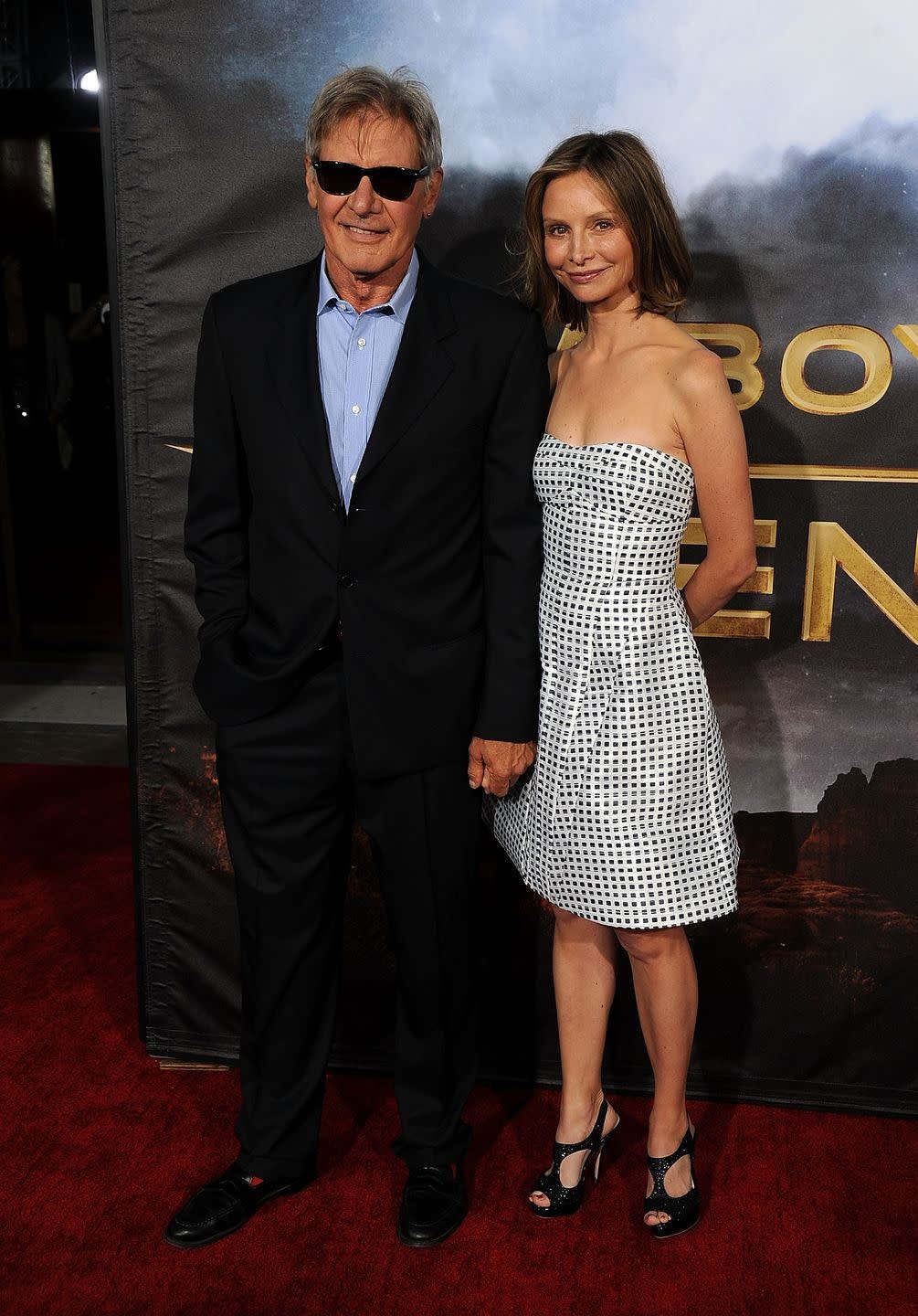
2012
"I think retirement’s for old people," Ford said of his ongoing career. "I’m still in the business, thank you. I have a young child of nine years old, and I want to live as long as I can to see him grow up."
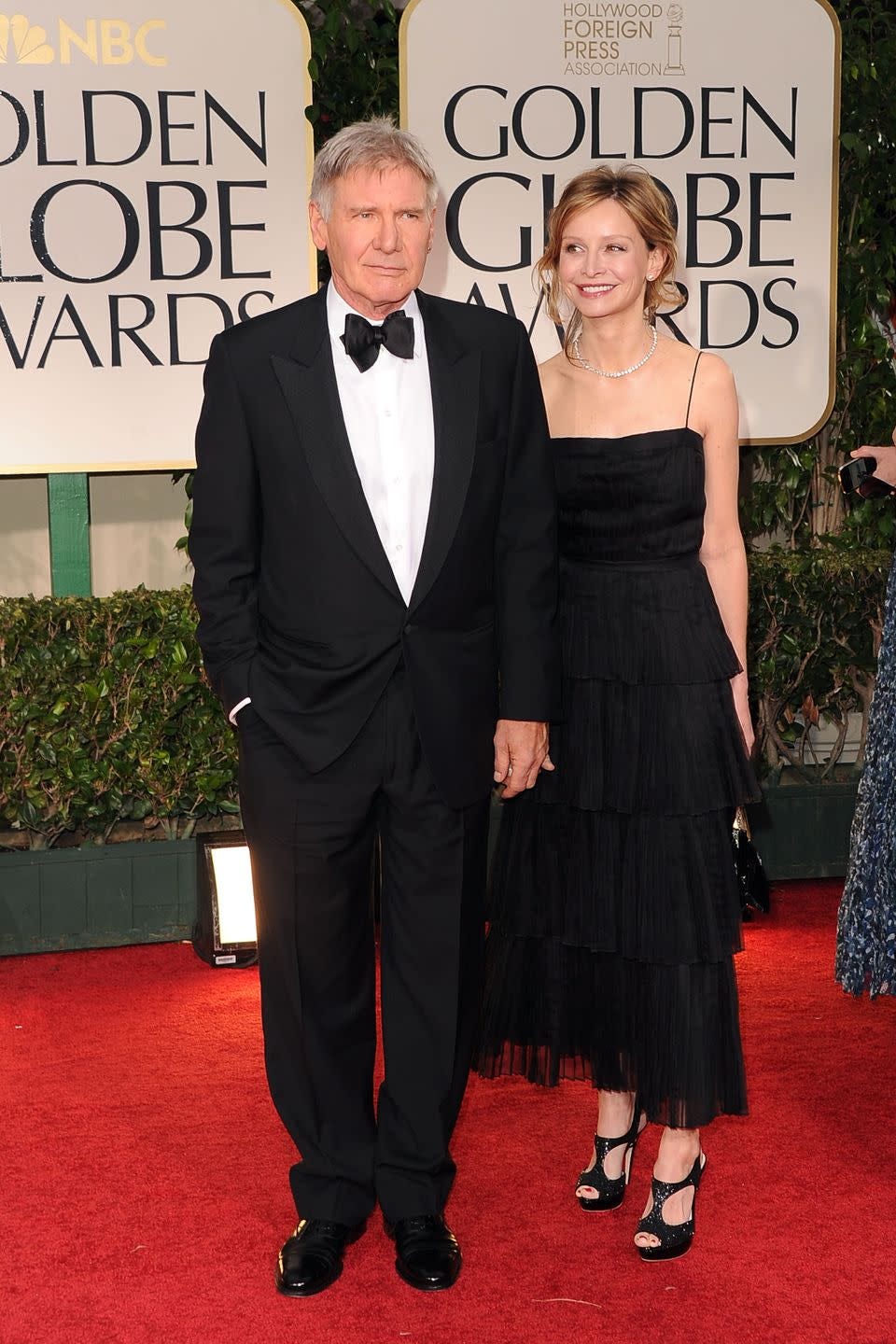
2013
The two look like regular proud parents at an event for their son Liam. A decade later, Ford reflected, "If I’d been less successful, I’d probably be a better parent."
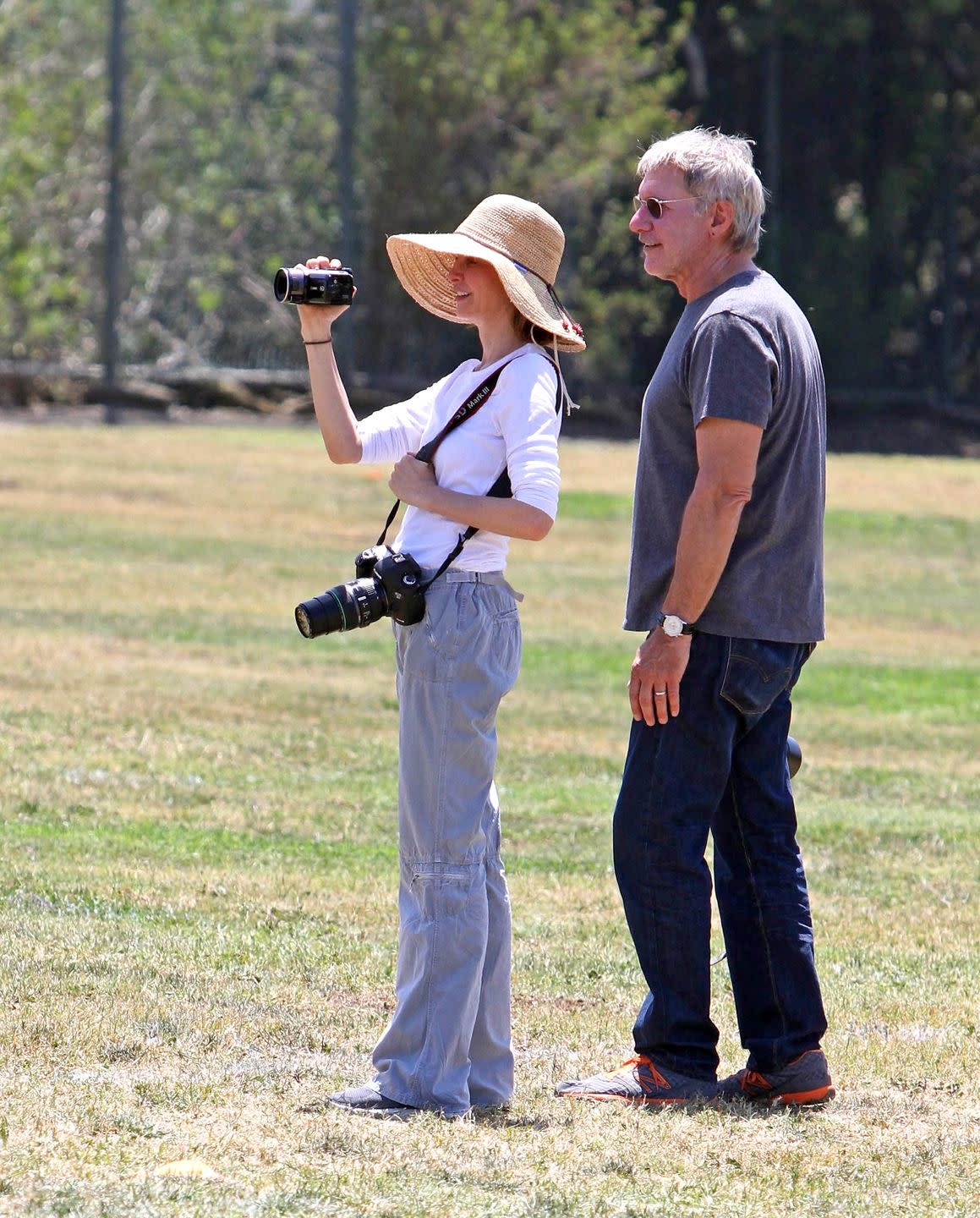
2014
Ford, Flockhart, and Liam (sitting next to Ford) attend a hockey game together.
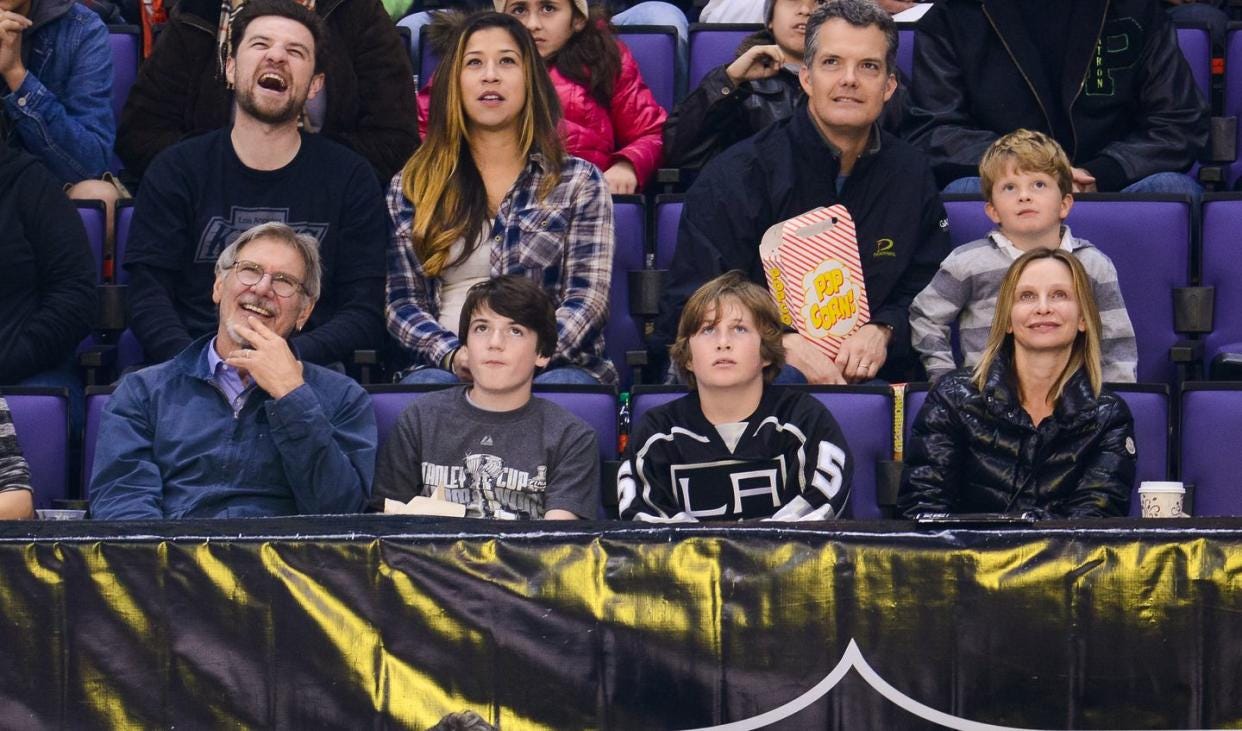
2014
Though he's one of our biggest movie stars, Ford has admitted he's not a movie lover. "I should be watching more, just out of respect for what the business has given me. I love being transported by a movie. A great story," he told Esquire. "But I do other stuff. I do the dishes instead of watching the movie."
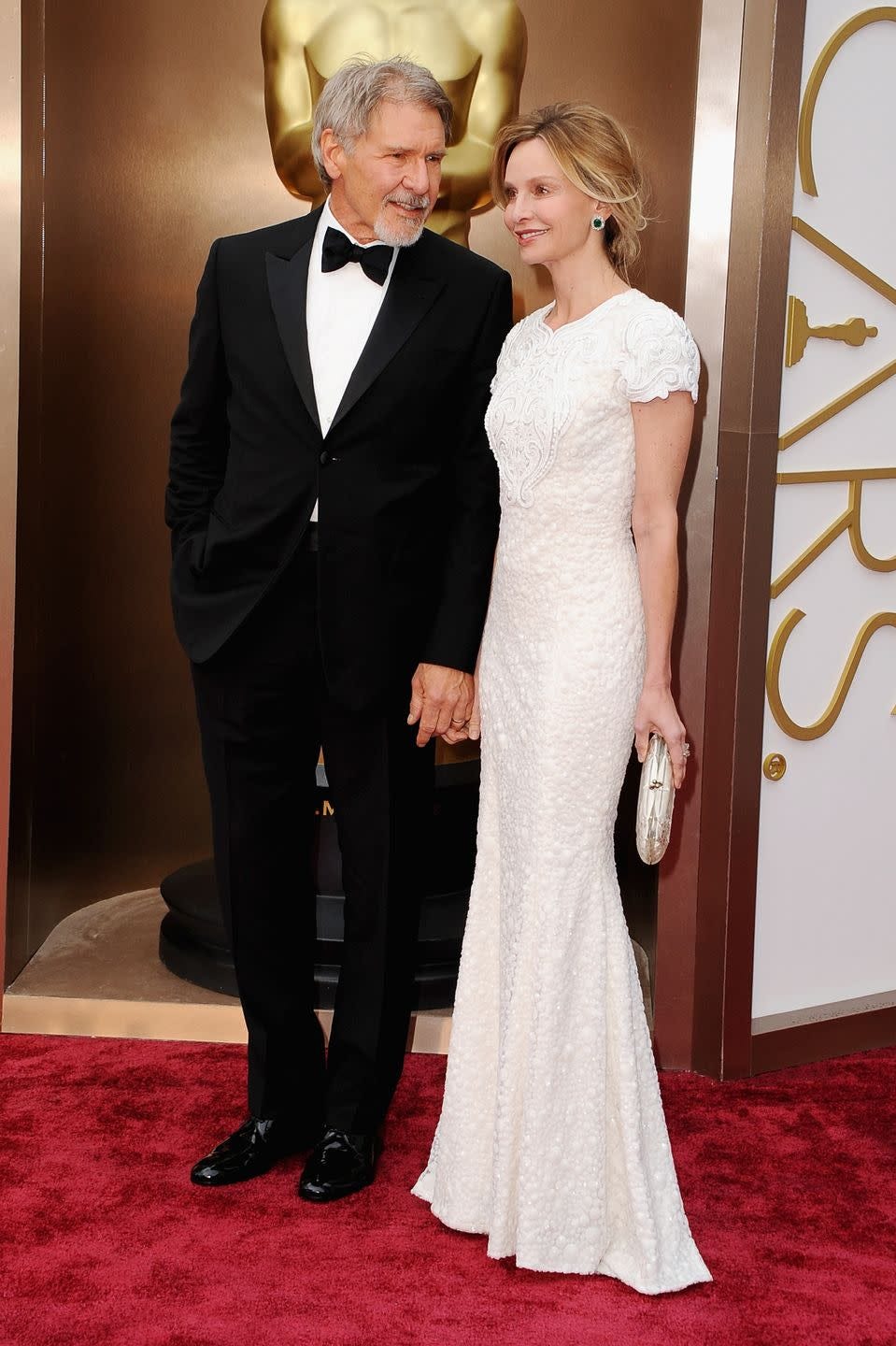
2015
Ford says his secret to a long and happy marriage is "don't talk" and "nod your head."
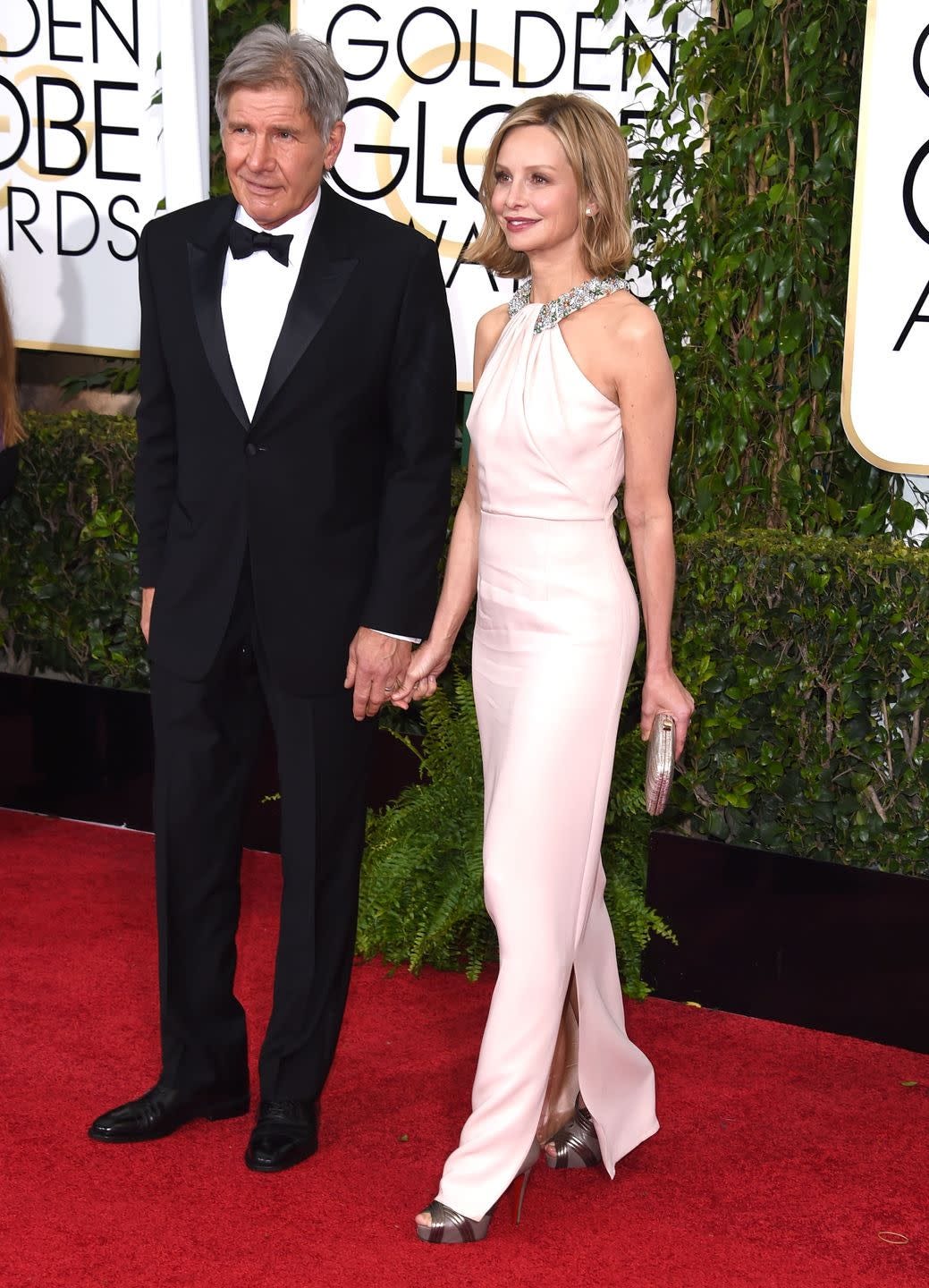
2015
Kiss cam! Flockhart and Ford kiss at a Lakers basketball game, as Liam laughs next to his mom. In 2015, Flockhart joked that Ford was just learning how to text, but doesn't know how to use emojis.
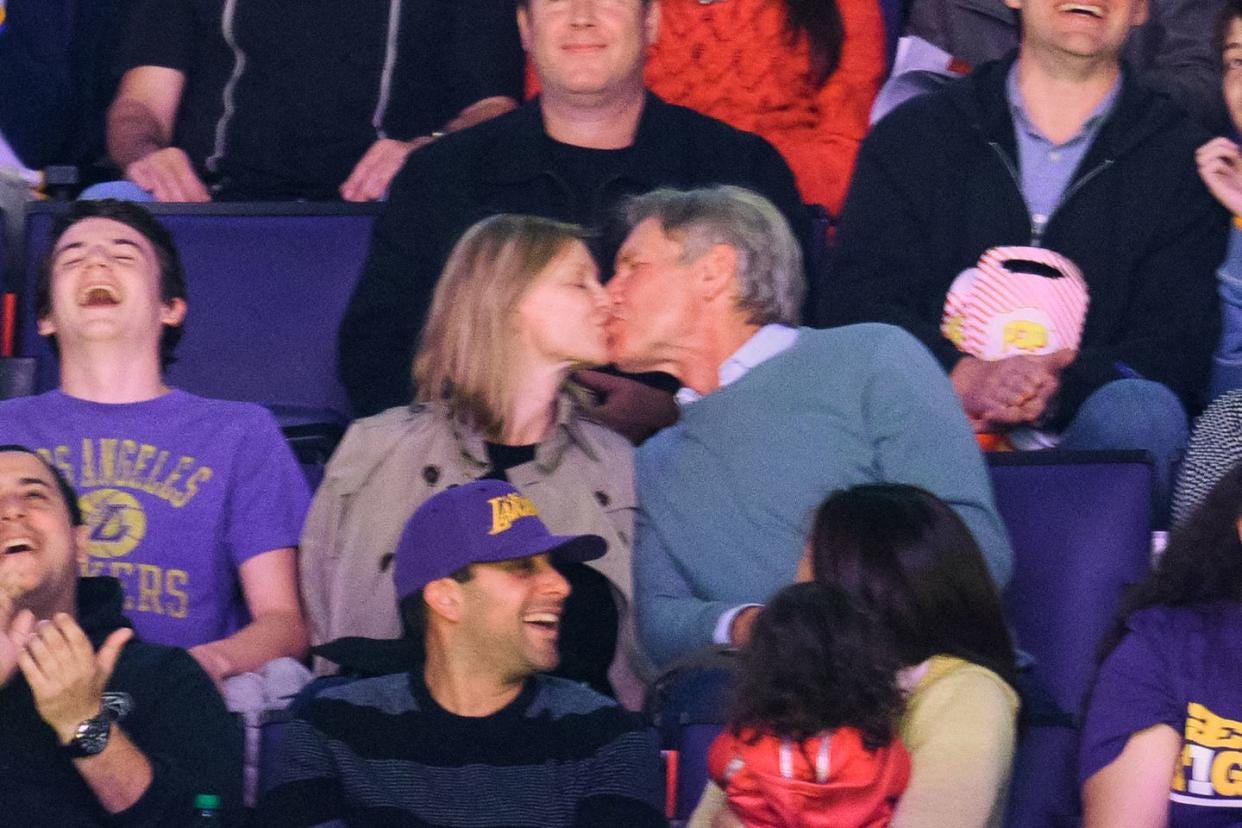
2015
2015 was a scary year for the couple; in March, Ford made an emergency landing in his plane and suffered a broken pelvis. "It was a really hard, scary time for our family," Flockhart said months later. "I think it just makes you realize, once again, that life can turn on a dime. We just have to appreciate every second we’re here, because you never know."
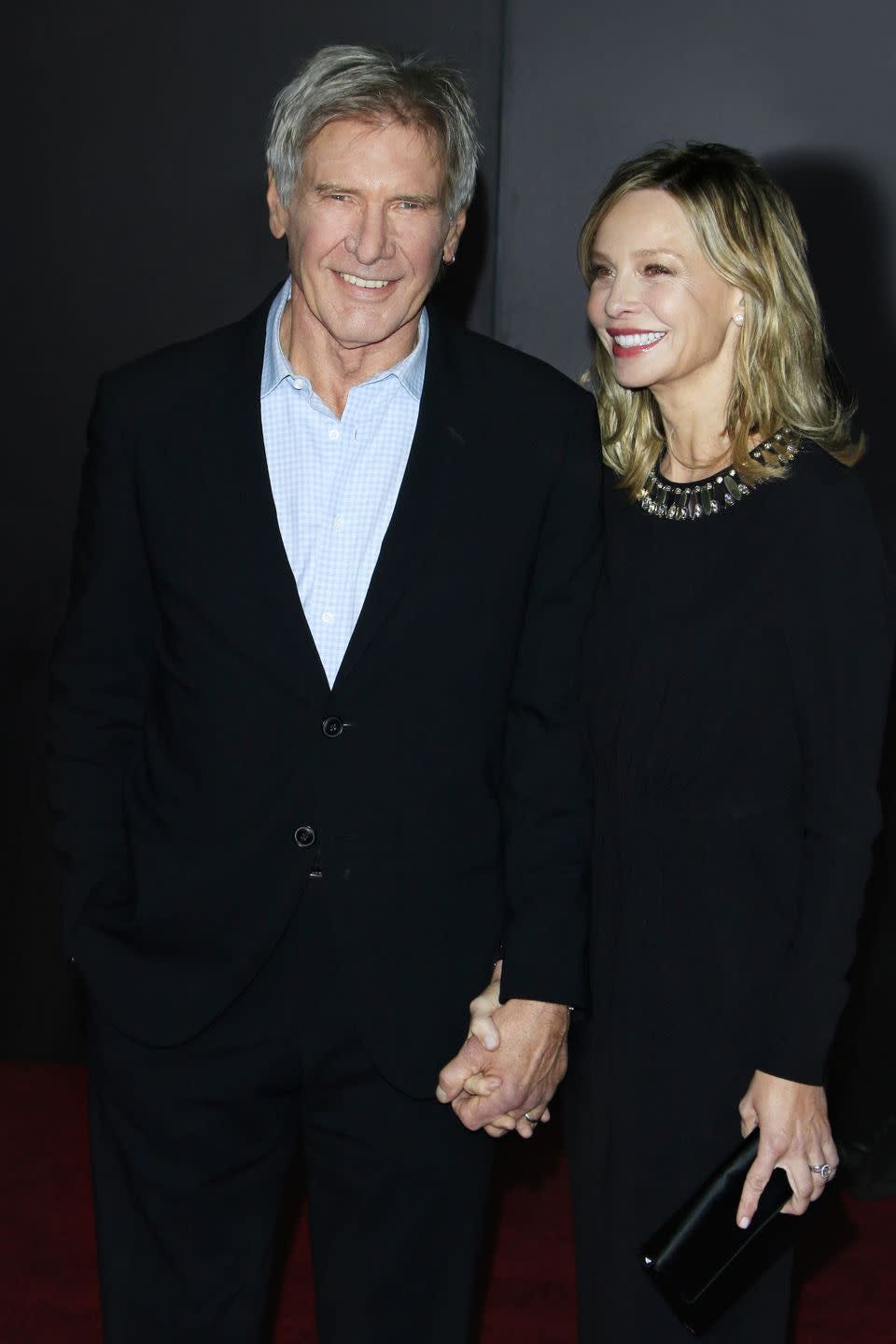
2016
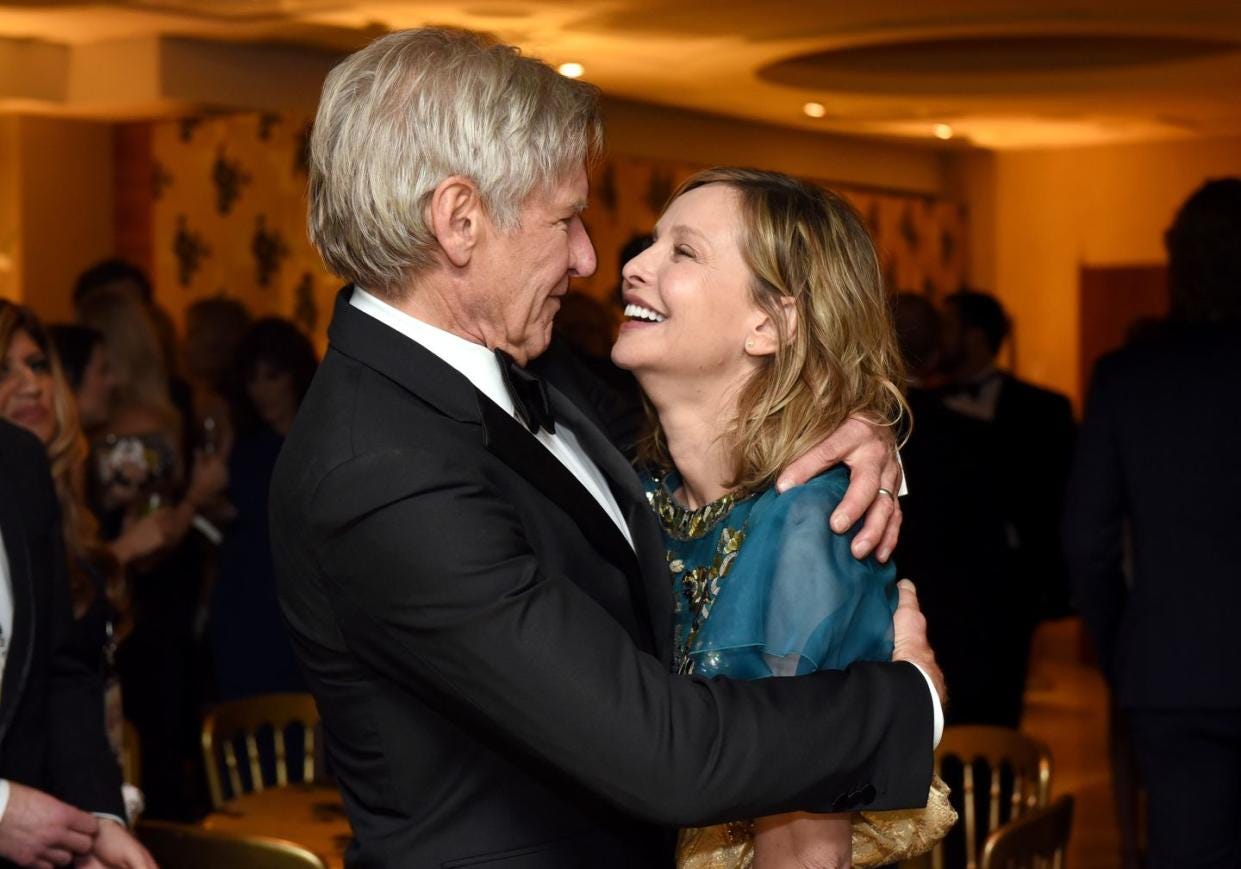
14 years after they met at the Golden Globes, the two are still so happy to be together.
2016
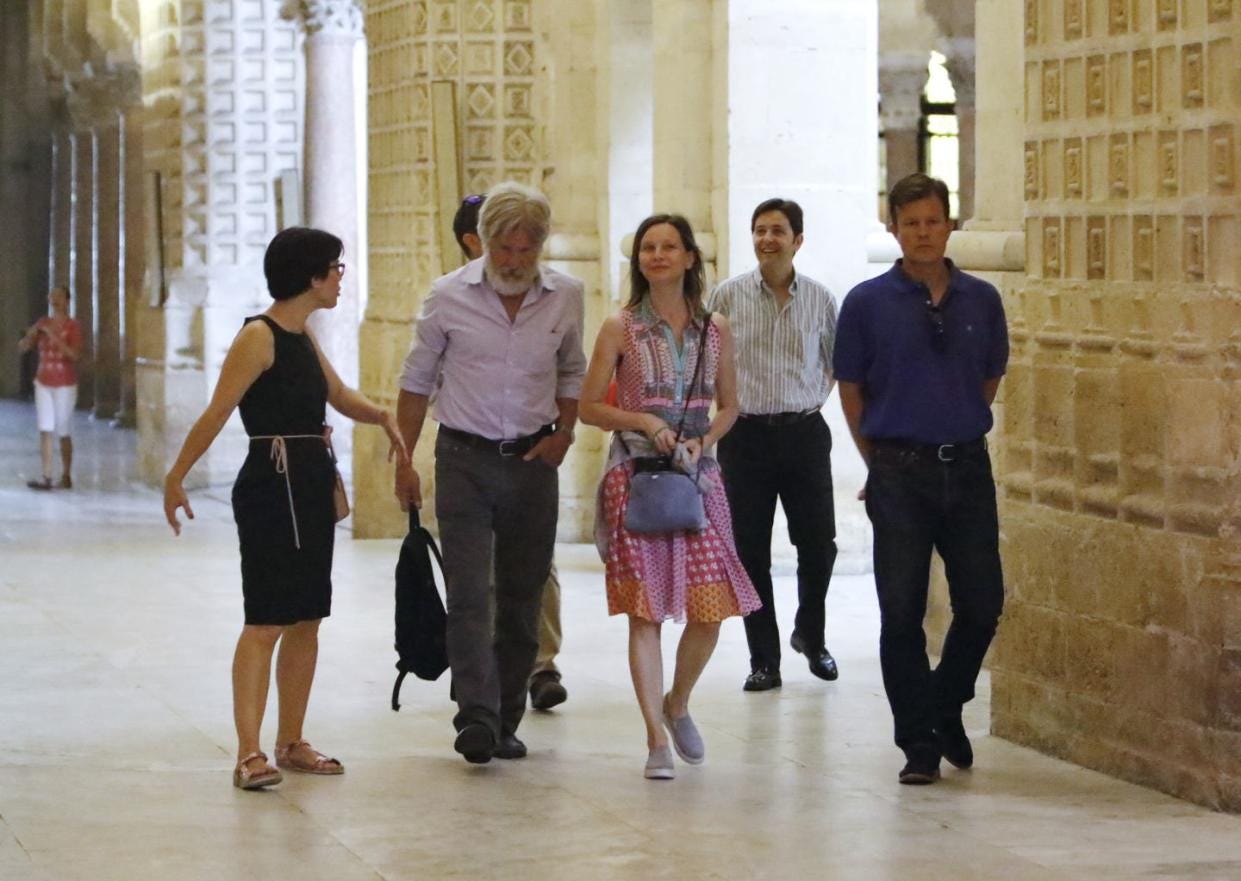
Remember when Ford had a massive beard? Here, the two are on vacation in Cordoba, Spain, touring the Mosque-Cathedral.
2017
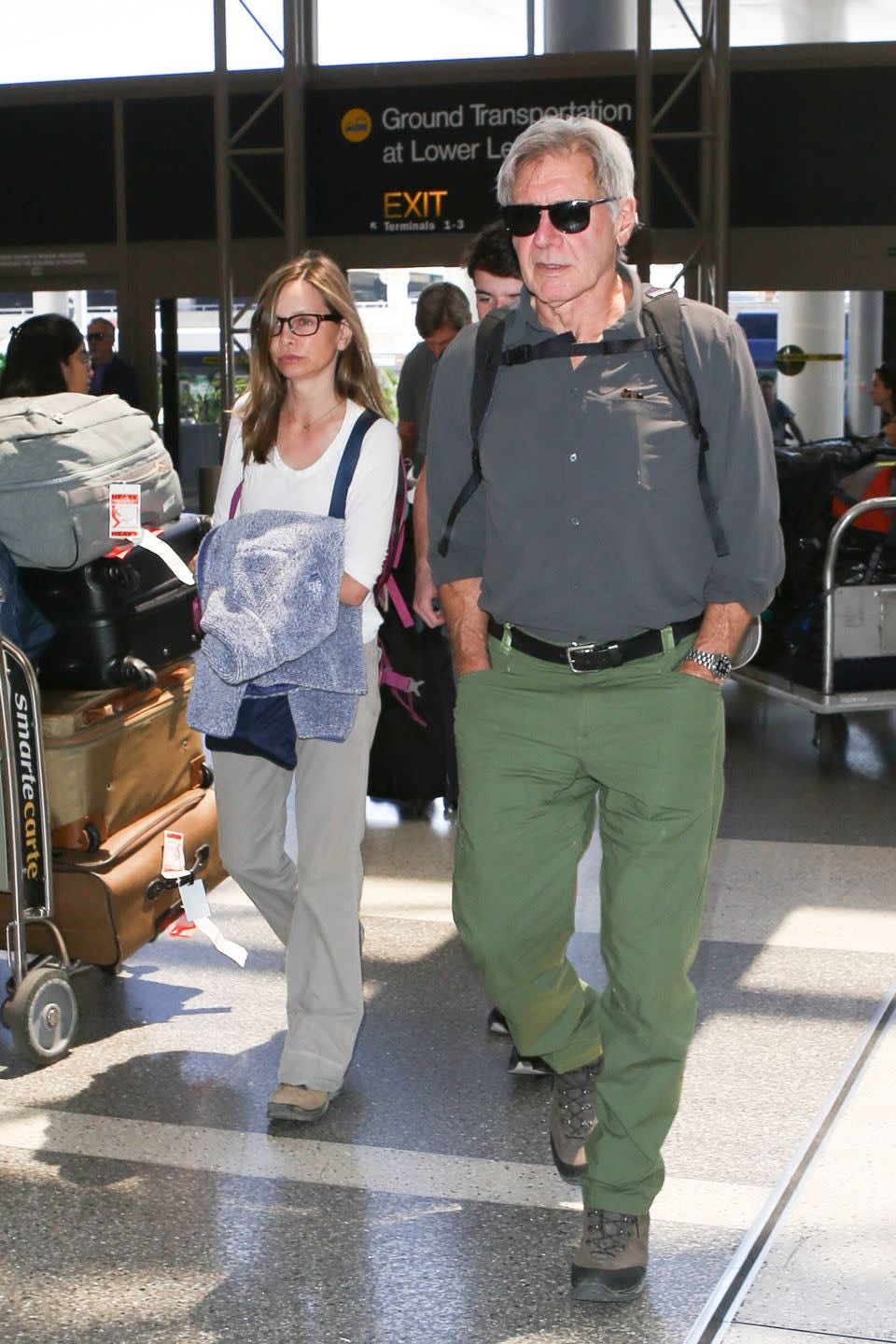
Though their age difference remains a topic of conversation, Flockhart said in 2017, "The truth is, I sometimes feel very much older than Harrison."
Though they're rarely snapped in public, paparazzi did get a photo of them at LAX.
2018
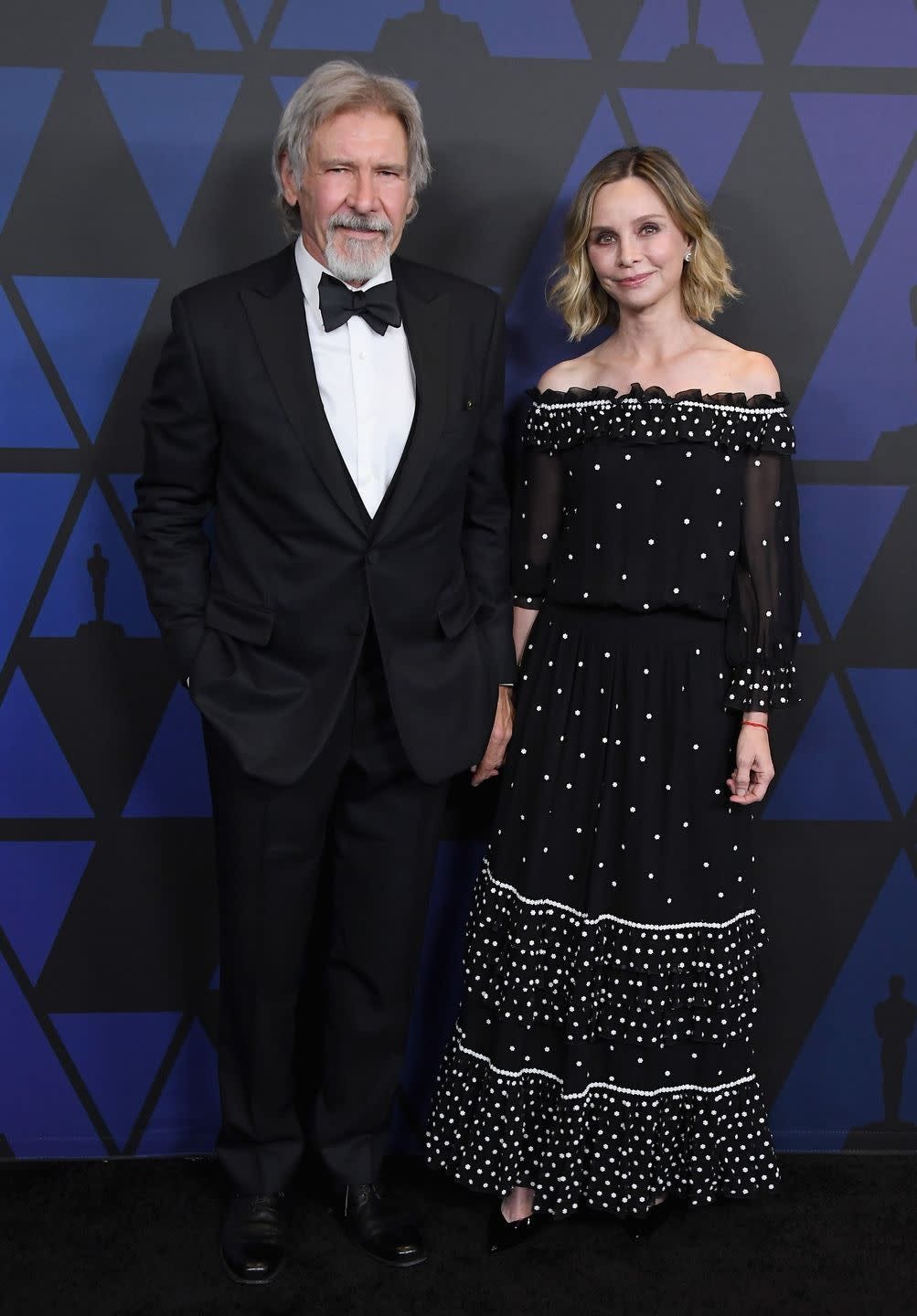
Their red carpet appearances become fewer as the years gone on—here, they attend the Academy of Motion Picture Arts and Sciences's 10th annual Governors Awards.
2022
Ford revealed the two hope to work on a project together one day. "She's just going back to work after having devoted herself to the raising of our son, Liam, for the last 20 years," he said, saying Flockhart is "enjoying going back to work. I'm hoping we will find something to do together."
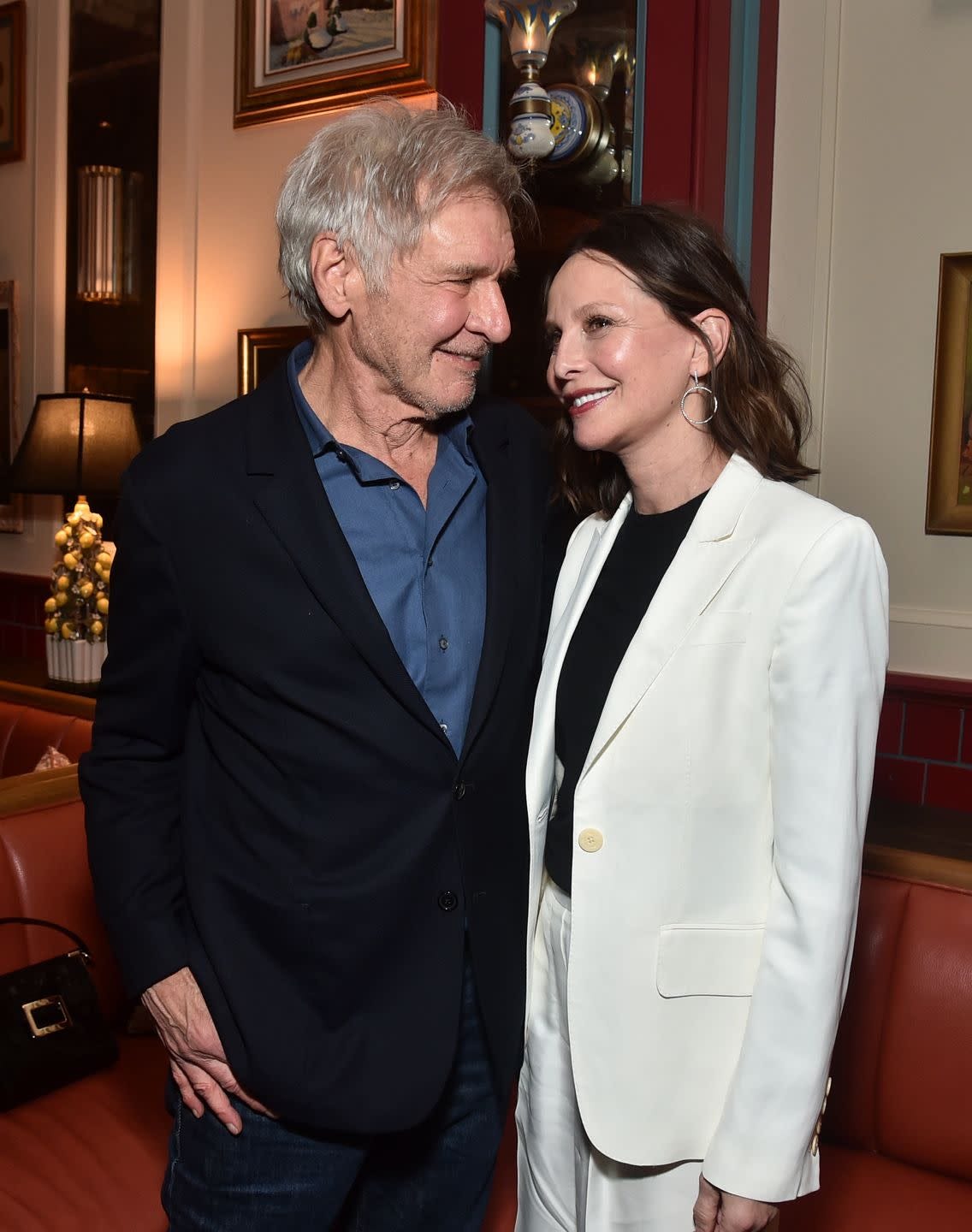
2023
"My life has been enabled by my lovely wife, who has supported my passion and my dreams, and I'm grateful," Ford said at the Cannes Film Festival. Speaking to Flockhart, he said, "I love you too. You've given my life purpose and meaning and I'm grateful for that, so grateful."
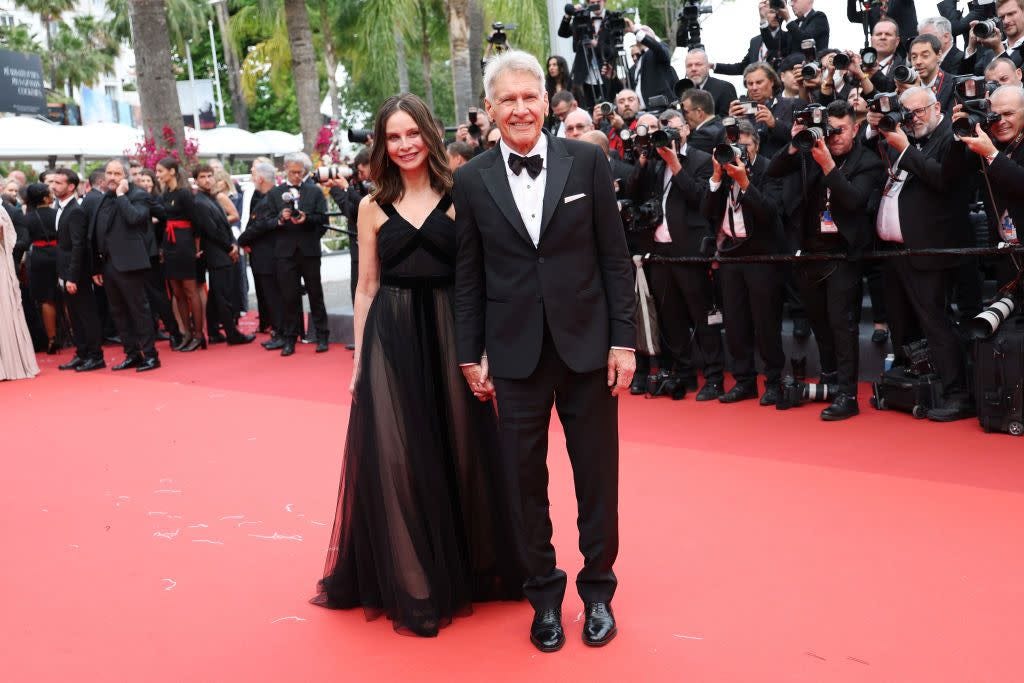
2023
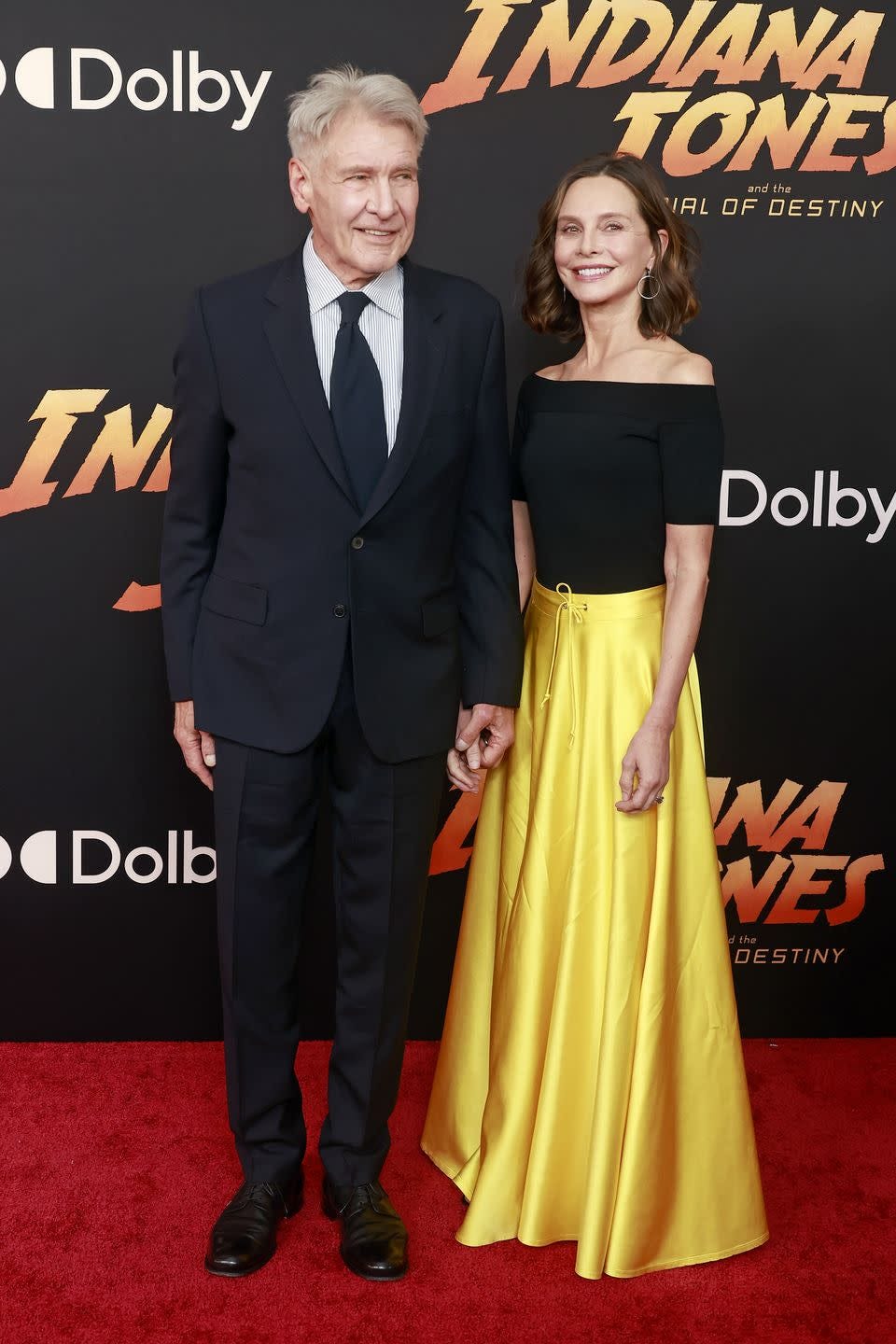
At the premiere of Indiana Jones and the Dial of Destiny, they celebrated their 13th wedding anniversary. Flockhart's support, Ford said on the carpet, "means everything. She grants me the time and the energy to pursue my passion."
==========END————
Thank you, as always, for reading. If you have anything like a spark file, or master thought list (spark file sounds so much cooler), let me know how you use it in the comments below.
If you enjoyed this post, please share it.
If a friend sent this to you, you could subscribe here 👇. All content is free, and paid subscriptions are voluntary.
————
-prada- Adi Mulia Pradana is a Helper. Former adviser (President Indonesia) Jokowi for mapping 2-times election. I used to get paid to catch all these blunders—now I do it for free. Trying to work out what's going on, what happens next. Arch enemies of the tobacco industry, (still) survive after getting doxed. Now figure out, or, prevent catastrophic situations in the Indonesian administration from outside the government. After his mom was nearly killed by a syndicate, now I do it (catch all these blunders, especially blunders by an asshole syndicates) for free.

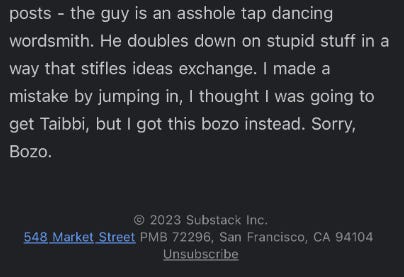
(Very rare compliment and initiative pledge. Thank you. Yes, even a lot of people associated me PRAVDA, not part of MIUCCIA PRADA. I’m literally asshole on debate, since in college). Especially after heated between Putin and Prigozhin. My note-live blog about Russia - Ukraine already click-read 4 millions.
=======
Thanks for reading Prada’s Newsletter. I was lured, inspired by someone writer, his post in LinkedIn months ago, “Currently after a routine daily writing newsletter in the last 10 years, my subscriber reaches 100,000. Maybe one of my subscribers is your boss.” After I get followed / subscribed by (literally) prominent AI and prominent Chief Product and Technology of mammoth global media (both: Sir, thank you so much), I try crafting more / better writing.
To get the ones who really appreciate your writing, and now prominent people appreciate my writing, priceless feeling. Prada ungated/no paywall every notes-but thank you for anyone open initiative pledge to me.

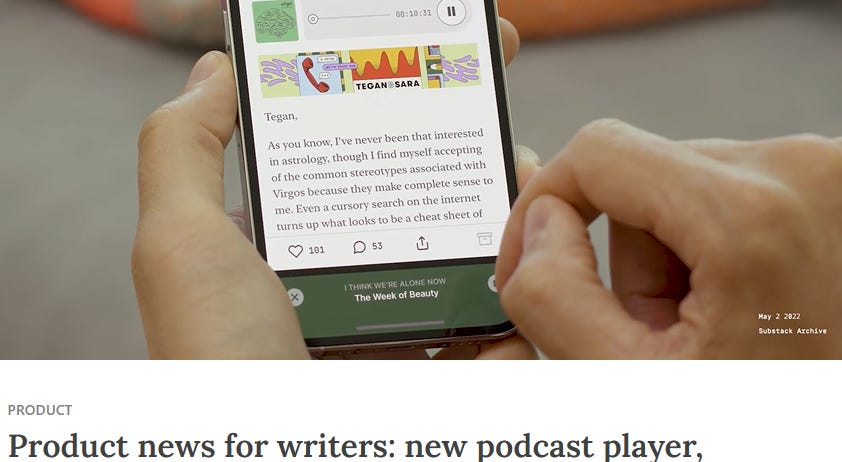
(Promoting to more engage in Substack) Seamless to listen to your favorite podcasts on Substack. You can buy a better headset to listen to a podcast here (GST DE352306207). Listeners on Apple Podcasts, Spotify, Overcast, or Pocket Casts simultaneously. podcasting can transform more of a conversation. Invite listeners to weigh in on episodes directly with you and with each other through discussion threads. At Substack, the process is to build with writers. Podcasts are an amazing feature of the Substack. I wish it had a feature to read the words we have written down without us having to do the speaking. Thanks for reading Prada’s Newsletter.