
When U.S. Put Ukraine Grilled Over Nord Stream Fiasco (via Global Reporting Media), U.S. Might Move One From Kyiv
Goodbye to Ukraine? US prepares public for defeat.

Very very high level intelligence decision, tricky - complicated result. The New York Times report of 8th March that ‘Intelligence Suggests Pro-Ukrainian Group Sabotaged Pipelines, U.S. Officials Say’ elicited two sets of responses.
The mainstream US media dutifully replicated the story without curiosity or challenge, carefully sidestepping questions of plausibility or context, and often, as with the Washington Post, managing to avoid mentioning the name of Seymour Hersh, whose article of 8 February ‘How America Took Out The Nord Stream Pipeline’ they had spent a month trying to ignore.
The alternative media, by contrast, jumped on the question of plausibility, put the Seymour Hersh article up front and saw this ‘revelation’ as a transparent attempt at diversion. They were broadly correct in that but they left out a very intriguing question, ‘why Ukraine?’.
The Nord Stream pipelines, build to transport gas from Russia to Germany had been blown up 26 September 2022, and there was immediate and unanimous agreement from all quarters that it was sabotage.

The question was the classic murder mystery one, who dun it? The problem for the Western media was that by the standard criteria of means, motive and opportunity by far the leading contender was the United States. And the main immediate loser was Russia, which lost an expensive pipeline, a lot of valuable gas and its huge German market.
The media, of course, is used to surmounting such challenges. The New York Times pointed the finger at Russia it its headline – Sabotaged Pipelines and a Mystery: Who Did It? (Was It Russia?) – but covered itself in the subheading by admitting there was ‘little evidence’. The Washington Post attempted to gain creditability by focussing on third parties – European leaders blame Russian ‘sabotage’ after Nord Stream explosions. President Biden had promised he would stop Nord Stream 2 and had forced Scholz to block its implementation. The sabotage made sure that Scholz could not change his mind.
Germany was consigned to long term economic decline. All this was clear to anyone whose salary did not depend on denying it, but what remained unclear, or in dispute, was the mechanism of the sabotage and who the accomplices might have been. Seymour Hersh probably solved that puzzle; it was an American operation with help from the Norwegians, who became Germany’s largest gas supplier and made $100billion out of the operation. Hersh had been a thorn in the side of the US government since his exposure of the My Lai massacre in Vietnam in 1972, and he was drawing blood again.
The US responded to the Hersh article by attempting to dismiss it and by giving it very little coverage in the media. Then came the US intelligence press release through the New York Times.
The NYT did not get the story through investigative reporting in the Hersh manner, nor through a whistle-blower but from a handout from officials. That meant it was a considered and calculated information operation, coming over five months after the sabotage and a month after Hersh. Plenty of time to prepare.
The US officials who were the source of the NYT article claimed that they were ‘reviewing’ new evidence and that apparently referred to an investigation ostensibly carried out by German media, led by Die Zeit. It is unclear whether US intelligence was responding to the German narrative or if the operation was coordinated. Given that Germany is very much a junior partner it is unlikely that the story would have surfaced unless the Americans agreed; the London Times claimed that US/NATO had suppressed Scandinavian intelligence accusing an Ukrainian oligarch since a week after the sabotage. Whatever the details, the new sabotage allegations can be best analysed now as a US-led coordinated operation, and that brings us back to the question of ‘why Ukraine?’.
The NYT article discreetly identified the consequences of ‘Ukrainisation’:
Any suggestion of Ukrainian involvement, whether direct or indirect, could upset the delicate relationship between Ukraine and Germany, souring support among a German public that has swallowed high energy prices in the name of solidarity.
Any findings that put blame on Kyiv or Ukrainian proxies could prompt a backlash in Europe and make it harder for the West to maintain a united front in support of Ukraine.
It has been argued very plausibly that the German story of a handful of ‘pro-Ukrainian’ sympathisers, perhaps Russians (a nice touch) doing what had previously been authoritatively considered only possible by state-level professionals is so implausible as to be probably a complete fabrication. Examples include Scott Ritter, Moon of Alabama and Jeremy Scahill. If it is a work of fiction, why cast Ukrainians as the culprits, why not stick with the Russians, or perhaps the North Koreans for a touch of the exotic? And if Ukrainians were up to something why not keep schtum, why let the cat out of the bag now?
One answer suggests itself: people at senior, but probably not top, level have decided that it is necessary to wean the public away from the Ukraine myth and prepare the ground for a deal. For the Germans that would be mainly to rescue the country from economic devastation and social fragmentation and for the Americans to clear the ground for the war against China. This interpretation is consistent with the possible disintegration of the Ukrainian military and the inability of the West to produce sufficient munitions.
An increasing number of stories are seeping into the media about the huge losses Kyiv is suffering and the concern that, as former US Colonel Alex Vershinin puts it, ‘Ukraine might be running out of men’. Vershinin is also the author of a seminal paper on industrial warfare, the huge demand for weapons and ammunition that the West can no longer satisfy. The West cannot provide enough for a proxy war in Ukraine let alone direct war with Russia, or China, or both.
Time for a dial back in Ukraine?
=========
Saga in D.C.
It is a funny feeling to realize you may have unwittingly come into contact with Russian intelligence—but not, these days, a totally uncommon one in Washington.
“There I was, standing in the entrance hall,” recalled Trevor Potter, a prominent election lawyer and former chairman of the Federal Election Commission. This was in December, at a lavish holiday party at the French ambassador’s residence, teeming with D.C. types—diplomats, journalists, consultants, lobbyists, current and former officials. Potter had just entered when he saw the French ambassador, whom he knew, conversing with a man he didn’t know: a stocky, Slavic-looking fellow in a dark suit.
“The French ambassador said, ‘Do you know Sergey, the Russian ambassador?’ I said I did not, and we shook hands,” Potter told me recently.
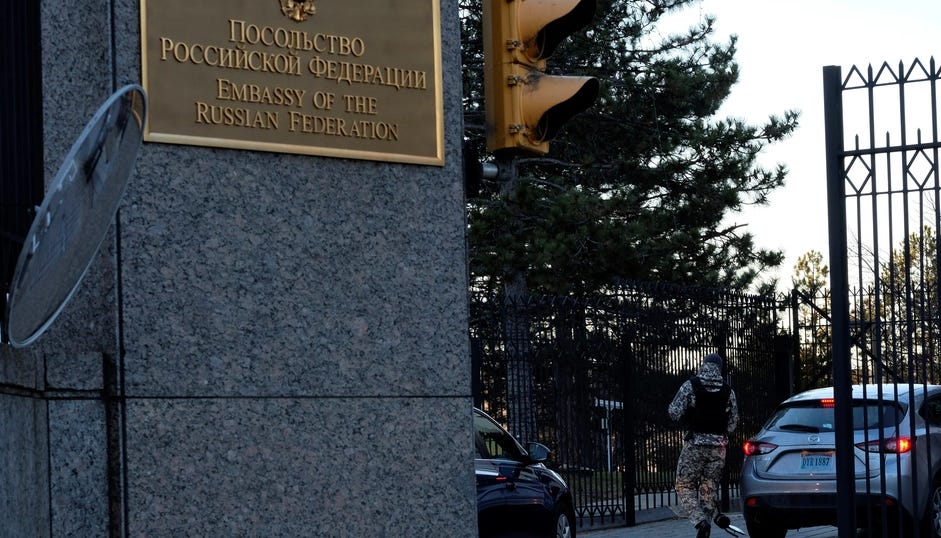
At the time, there was nothing particularly notable about the encounter. But now, with Congress and federal investigators probing alleged Russian meddling in last year’s presidential election, it feels a little bit creepy. The ambassador Potter met that night, Sergey Kislyak, is a central figure, alleged to be a high-level Kremlin spy, and his every phone call and handshake with associates of President Trump has come under close examination.
Kislyak’s phone calls with Michael Flynn, and Flynn’s apparent misstatements about the contents of those calls, cost the onetime national security adviser his job last month. Kislyak’s undisclosed meetings with Attorney General Jeff Sessions, then a senator, have caused Sessions to recuse himself from the Russia investigation. Kislyak’s contact with Trump—a brief hello at a reception before a speech hosted by a D.C. think tank—has raised further alarm.
Suddenly, everyone who’s ever met Kislyak is suspect, and Kislyak himself a subject of fascination. (In recent press reports, he has been described in conflicting terms: Is he a cordial man-about-town or an under-the-radar homebody?) An idle chat has become a “contact,” that sinister term of spycraft. And for those who circulate in Washington politics and policy circles, the whole affair hits close to home—a peeled-back corner of the spy game always being played below the capital’s surface.
What seems like networking can turn out to be something else entirely. One former congressional staffer, who worked for a member of the House International Relations Committee, told me that a few years ago he was offered a cash payment equivalent to his annual salary to pass along committee documents related to Taiwan.
“This guy just called out of the blue and asked me to lunch,” the former staffer recalled. The “guy” was an American who had previously worked as a congressional chief of staff. “And that was the offer he made—my current salary, in cash.”
The staffer, who had a security clearance, turned down the offer and reported the contact to his security officer, who said the guy was “on the radar” of American intelligence. The same staffer said he was once asked for classified information by a Malaysian embassy official; a friend who worked for a member of the Agriculture Committee was told to watch out for Chinese spies who supposedly hung out at the Hawk ’n’ Dove, a Capitol Hill bar, to eavesdrop on staffers’ conversations.
Staffers with security clearances are trained to spot this sort of thing, but those without clearance receive little in the way of security training. They have access to power and are prone to gossip. Many come in as interns, or fresh from a local campaign. A second former congressional staffer recalled repeatedly being asked on dates by an attractive woman from the Israeli embassy who had also been out with many of his friends. When they finally did go out, he couldn’t shake the feeling it might be “an old-fashioned honeypot scene,” he said, and declined her offer to come home with him.
Was he just being paranoid? In Washington, it can be impossible to discern what is on the level and what is not, what is paranoia and what is justified. Did a bunch of conservative bloggers suddenly develop opinions about the Malaysian regime in 2011 out of sincere conviction, or because they were being paid off? (It turned out to be the latter.) Why did several prominent think tanks suddenly hold discussions and publish reports in favor of Norwegian oil drilling? (They were getting millions of dollars from the Norwegian government, according to a New York Times investigation.)
Foreign propaganda, which is legal lobbying as long as it’s disclosed, pokes into everyday life in odd ways. A few years ago, numerous D.C. buses and Metro stations were suddenly festooned with an awareness campaign for a decades-past war crime in Azerbaijan, the Khojaly Massacre. Regular D.C. commuters were left to wonder what the posters were about—in this case, the geopolitical rivalry between Azerbaijan, an oil-rich dictatorship, and its politically powerful neighbor, Armenia. According to a public-relations staffer whose firm turned down the work, the campaign actually had a primary target audience of one: the wife of a top official in Azerbaijan’s government, who frequently came to D.C. for shopping trips.
This is simply the way things work in a superpower’s capital city. There is the Washington most of its residents live in, and then there is the one underneath, where allies and enemies jockey for influence and information. You think you’re living in an episode of Veep, and you find out you’re living in an episode of The Americans.
“Welcome to Washington—you’re not in Kansas anymore,” Tom Nichols, a national-security expert who teaches at the Naval War College, told me. When he was a Senate adviser, he recalled, he and his now-ex-wife, who worked for the CIA, could not talk about their work over dinner due to their differing clearances. “It’s the weirdest city in the world,” he said. “I would never say anything out loud in D.C. that I wouldn’t want to see on the news crawl in Times Square.”
There is a line, Nichols and other security experts are quick to note, between legitimate and illegitimate foreign activity, between information-gathering and intelligence work, between a lobbyist and a bagman. No one should be surprised or scandalized that the Russian ambassador attends public events and seeks meetings with lawmakers—that’s his job, and there’s nothing wrong with it. “This is what you do as a diplomat,” Andras Simonyi, a former Hungarian ambassador to the U.S., told me. “If you’re an ambassador and you’re not trying to meet CEOs and senators and presidential candidates, you’re crazy.”
Still, Simonyi said, one should be careful what one gossips about with a Russian at a D.C. party, and what compliments one takes at face value. They are famous for their skill at cultivating the naive. “‘Ah, you’re such a charming young lady, why don’t you come to the celebration we’re having for the national day of Russia?’ Don’t ever accept an invitation from the Russian embassy unless you know what you’re doing,” he said.
Certain countries’ ambassadors are D.C.-famous for their socializing—these days the master is Yousef Al Otaiba of the United Arab Emirates, whose country’s oil wealth bankrolls star-studded galas, donations to charities and think tanks, and constant schmoozing at the highest levels. In 2013, Otaiba threw a 50th birthday party for the MSNBC host Joe Scarborough; this January, he hosted an Alfalfa Dinner after-party at Cafe Milano whose attendees included Rex Tillerson, Jeff Bezos, presidential adviser Gary Cohn, and multiple members of the Cabinet and Congress. Those who have taken his private-jet junkets to the Formula One Grand Prix in Abu Dhabi include a former Air Force chief of staff.
“They’re all being wined and dined, it’s incredibly glamorous, and he has put himself in a position of getting extraordinary access to all kinds of information,” a prominent D.C. socializer and sometime Otaiba guest told me, on the condition his name not be used. “The influence is palpable, but people don’t want to see it, because they enjoy the largesse.” Otaiba’s web of connections is obviously aimed at improving his country’s stature and relations with the U.S.; it is also alleged to have influenced American policy in the Mideast. If you are a D.C. climber, you can hardly do better than to be on his invitation list.
It can all begin to feel like a conspiracy. Living in D.C. or its suburbs, you may meet a neighbor at a block party who can’t tell you what she does for a living. A bunch of vans racing through local traffic may actually be engaged in surveillance training for the N.S.A. Washington journalists’ emails have allegedly been targeted by hackers in recent months. You start looking over your shoulder in this town, and before long you’ve gone down the path of the black-helicopter crowd. How deep does it go? What do they have on you?
But it’s not paranoia, as the old joke goes, if they’re really out to get you. The current Russia revelations may have people on edge because they’ve exposed something that has been true for a long time: The best soft targets don’t know they’re soft targets.
A top official on Mitt Romney’s 2012 campaign told me that the Secret Service at one point became concerned that Chinese hackers had penetrated the campaign’s computer network at its Boston headquarters. “That weekend, all these guys who looked like they worked at Home Depot showed up and spent the weekend putting in new hardware,” the official recalled. “Then the Service admonished us not to put anything in email that we thought was sensitive—that lasted about 24 hours.”
The staffers disregarded the warning and went back to their old habits, because the threat just didn’t seem real. But the episode looks very different now, after the release of hacked emails from Democratic committee staffers and Clinton campaign officials threw the 2016 campaign into chaos, even though they consisted mostly of political hacks’ silly office banter.
“I guess I never really understood this completely,” the Romney official said in retrospect. “It was like, what are they going to do, try to sell this? It’s just campaign stuff.”
That night at the French ambassador’s Christmas party, Trevor Potter struggled to come up with small talk after meeting Kislyak. The palatial mansion was adorned with winter decorations, including a group of penguins on a staircase glittering with fake snow. Potter remarked that the display must remind Kislyak of the climate back home. Without a trace of humor, Kislyak sternly informed him that penguins live exclusively in the southern hemisphere; there are none in Russia.

With the alleged Russian meddling that was much in the news, Potter didn’t want to bring up the election, but not because he was mindful of the potential intelligence implications. “It just would have been impolite,” he said.