
Rio, Tariff, and Palestine

The BRICS group of nations just concluded its 17th annual summit in the Brazilian city of Rio de Janeiro. But despite member states adopting a long list of commitments covering global governance, finance, health, AI, and climate change, the summit was a lackluster affair.
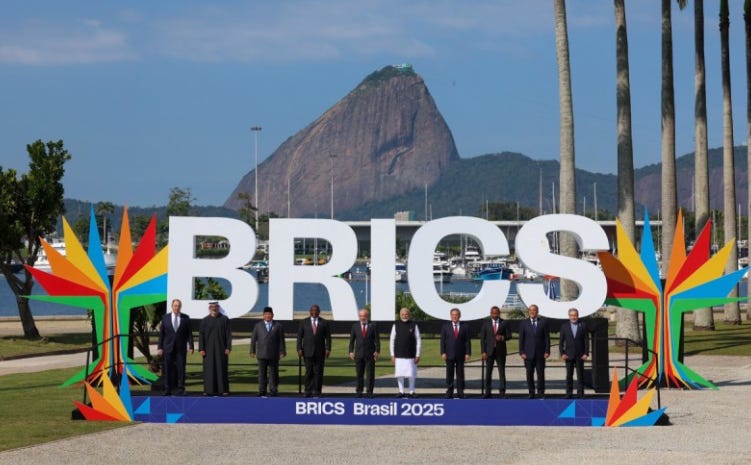
Conspicuously absent were the two most prominent leaders from the group’s founding members Brazil, Russia, India, China and South Africa. Russian President Vladimir Putin only attended virtually due to an outstanding arrest warrant issued by the International Criminal Court over his role in the war in Ukraine.
Chinese President Xi Jinping avoided the summit altogether for unknown reasons, sending his prime minister, Li Qiang, instead. This was Xi’s first no-show at a BRICS summit, with the snub prompting suggestions that Beijing’s enthusiasm for the group as part of an emerging new world order is in decline. Perhaps the most notable takeaway from the summit was a statement that came not from the BRICS nations but the United States.
As BRICS leaders gathered in Rio, US President Donald Trump warned on social media: “Any Country aligning themselves with the Anti-American policies of BRICS, will be charged an ADDITIONAL 10% Tariff. There will be no exceptions to this policy.”
Trump has long been critical of BRICS, largely because the group has consistently floated the idea of adopting a common currency to challenge the dominance of the US dollar in international trade. Such a move makes sense if we focus on trade figures In 2024, the value of trade among the BRICS nations was around US$5 trillion, accounting for approximately 22 percent of global exports. Member nations have always felt their economic potential could be fully realized if they were not reliant on the US dollar as their common currency of trade. During their 2024 summit, held in the Russian city of Kazan, the BRICS nations entered into serious discussions around creating a gold-backed currency.
At a time when the Trump administration is waging a global trade war, the emergence of an alternative to the US dollar would be a very serious pushback against US economic hegemony. But the freshly concluded BRICS summit did not present any concrete move toward achieving that objective. In fact, the 31-page Rio de Janeiro joint declaration even contained some reassurances about the global importance of the US dollar. There are two key obstacles hindering BRICS from translating its vision of a common currency into reality.
The first is that some founding nations are uncomfortable with adopting such an economic model, in large part due to internal rivalries within BRICS itself. India, currently the fourth-largest economy in the world, has a history of periodic confrontation and strategic competition with China. It is reticent about adopting an alternative to the US dollar, concerned that this could make China more powerful and undercut India’s long-term interests.
The second is that the BRICS nations are dependent on their bilateral trade with the US. Simply put, embracing an alternative currency is counterproductive when it comes to the current economic interests of individual countries. Brazil, China and India, for example, all export more to the US than they import from it. In December 2024 following his election as US president, Trump said, “We require a commitment from these countries that they will neither create a new BRICS currency nor back any other currency to replace the mighty US dollar or they will face 100 percent tariffs and should expect to say goodbye to selling into the wonderful US economy.”
This blunt message all but killed any enthusiasm there was for this grand economic model. BRICS is a behemoth. Its 11 members account for 40 percent of the world’s population and economy. But the bloc is desperately short of providing any cohesive, alternative global leadership. While Brazil used its position as host to highlight BRICS as a truly multilateral forum capable of providing leadership in a new world order, such ambitions are thwarted by the many contradictions plaguing this bloc. Among these are tensions between founding members China and India, which have been running high for decades. There are other contradictions, too.
Dedollarization was a key focus of the summit. BRICS announced plans to move forward with developing a cross-border payment system, a crucial step toward challenging the US dollar’s dominance in global trade. By building an alternative to US-controlled financial networks like the SWIFT system, member states aim to reduce their exposure to unilateral sanctions, which have become a central tool of American economic power in recent years. “The world needs to find a way that our trade relations don’t have to pass through the dollar,” Lula told journalists.
Another major focus of this year’s summit was artificial intelligence. All 10 members, plus partner states Bolivia, Vietnam, and Cuba, discussed “the transformative potential of AI and the need for ethical and inclusive regulations.” BRICS emphasized that any global AI governance regime should “promote advancements in productivity and quality of life, with a focus on sustainable development,” and be characterized by “responsible development… in alignment with national laws and international standards.” BRICS also stressed that AI development “must prioritize safety, prevent malicious uses and be based on global collaboration for responsible regulation.”
From Rio, BRICS members decried Trump’s tariff threats against organization members and condemned the recent US-Israeli bombing of Iran. The group’s joint statement described the targeting of “civilian infrastructure and peaceful nuclear facilities” as a “violation of international law.” BRICS members also expressed “grave concern” over Israel’s genocidal assault on Gaza. Lula directly addressed the crisis in his summit speech, stating: “We cannot remain indifferent to the genocide carried out by Israel in Gaza, the indiscriminate killing of innocent civilians and the use of hunger as a weapon of war.”

[Brazilian Portuguese of poetry IF I MUST DIE - REFAAT ALAREER]
[REFAAT ALAREER IF I MUST DIE]
It is significant that BRICS condemned US-Israeli aggression and the assault on Gaza. However, the organization is not primarily a political alliance, and its leadership lacks a unified stance or coordinated strategy for confronting military actions, even when they directly impact the region and member states.
Mao Zedong once described Israel as one of two “bases of imperialism” in Asia (the other being Taiwan). Today, Chinese policy toward the US empire’s main ally in the Middle East has changed significantly. Despite statements in support of Palestine, China—the economic core of BRICS—is currently Israel’s second-largest trading partner, and the Chinese and Israeli ambassadors met recently to discuss “deepening China-Israel economic and trade cooperation.” Russia, too, has a close strategic and economic relationship with Israel, as does India. These partnerships continued as Israel launched illegal and unprovoked attacks on Iran, a BRICS member, in June.
If BRICS were serious about mounting a strong challenge to imperial power, that effort would include cutting ties with and sanctioning key outposts of US military influence, such as Israel, and taking a unified stance against aggressive US-aligned states. But the group has not taken such steps. In fact, some of its own members—such as Egypt, Saudi Arabia, and the UAE—have actively advanced US geopolitical interests in their respective regions.
In their joint Rio declaration, the group’s members decried the recent Israeli and US attacks on Iran. Brazilian President Luiz Inácio Lula da Silva also used his position as summit host to criticize the Israeli offensive in Gaza. But this moral high ground appears hollow given that the Russian Federation, a founding member of BRICS, is on a mission to destroy Ukraine. And rather than condemning Russia, BRICS leaders used the Rio summit to criticize recent Ukrainian attacks on Russia’s railway infrastructure. BRICS’s declared intention to address the issue of climate change is also problematic.
The Rio declaration conveyed the group’s support for multilateralism and unity to achieve the goals of the Paris Agreement. But despite China making significant advances in its green energy sector, BRICS contains some of the world’s biggest emitters of greenhouse gases as well as several of the largest oil and gas producers. BRICS can only stay relevant and provide credible leadership in a fast-changing international order when it addresses its many inner contradictions. ---