
Wild Wild Rogue State

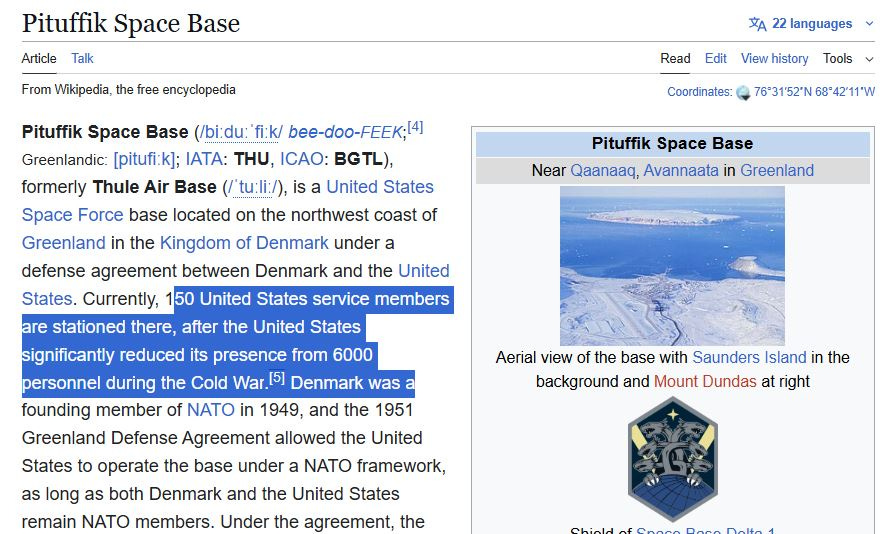
Trump and members of his Cabinet have made a case for acquiring Greenland that’s so simple, even self-evident, it seems hard to refute: U.S. national-security interests in the Arctic are just too important to ignore. Not taking over the autonomous territory of Denmark would “give up the Arctic to China, to Russia, and to other regimes that don’t have the best interests of the American people at heart,” Vice President J. D. Vance declared last March during a visit to the Pituffik Space Base, on Greenland’s northwest coast.
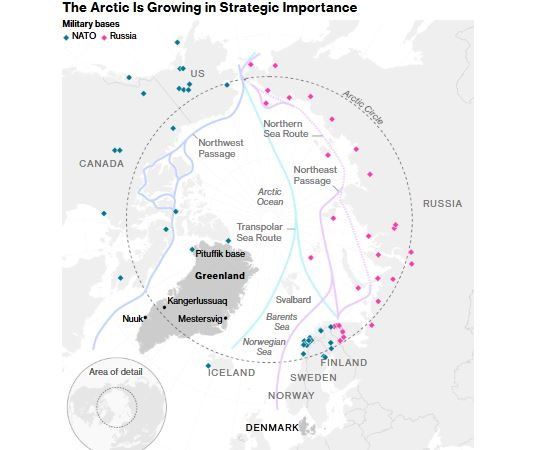
Five years ago, Congress had a similar sense of alarm about Russia and China’s head start in exploring and potentially developing one of the world’s last great untapped regions, with its rich minerals, abundant (if icebound) seas, and strategic location almost connecting the continent of Europe with the northernmost reaches of the Americas.
2021 National Defense Authorization Act called for the creation of the Arctic and Global Resilience Policy Office at the Pentagon, which was set up in year 2022. The office produced the Defense Department’s 2024 Arctic Strategy, dedicating Washington to increased Arctic defense capabilities, expanded collaboration with allies on Arctic security, and strengthened military readiness for Arctic operations.
The administration’s intense interest in acquiring Greenland, by force if necessary, might appear to be a natural outgrowth of the Pentagon’s work. Instead, it’s a clear repudiation of it. Not only has the demand for Greenland infuriated the same European allies on which the Arctic strategy depends, the Pentagon office itself has been quietly shuttered. In sum, even as the administration says it needs Greenland to advance U.S. security interests in the Arctic, it has closed the office set up to advance U.S. security interests in the Arctic.
The Arctic was a crucial strategic front in the Cold War, the shortest route for potential missile strikes and bomber flights. The United States and the Soviet Union maneuvered submarines in the region, competing for dominance at the top of the world.
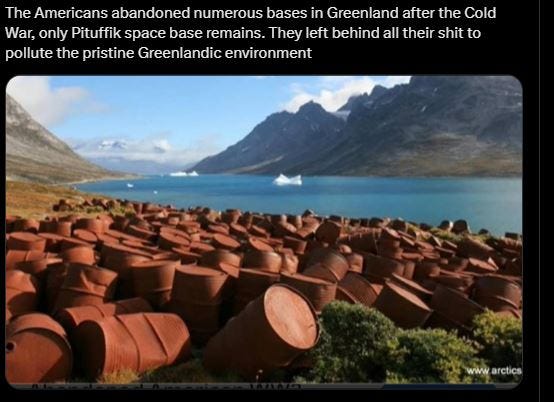
A Cold War–era agreement allows Washington broad authority to conduct military operations on Greenland. The agreement, signed by Denmark and the United States in 1951, allows the U.S. to “construct, install, maintain, and operate” bases across the island, station personnel, and set the terms of “landings, takeoffs, anchorages, moorings, movements, and operation of ships, aircraft, and water-borne craft.” Pituffik is the only current U.S. base.
As warming seas open new shipping routes and enable access to natural resources, the United States and its adversaries are again scrambling for position in the Arctic. China released a white paper in 2018 that declared itself a “Near-Arctic State,” using this characterization to assert its interests in the region. In 2020, Russia set a 15-year time frame for a set of aspirations in the Arctic, including the establishment of sovereignty over its northern sea route, the revitalization of Soviet-era military bases, and the creation of new commercial-shipping infrastructure. Russia has grown its fleet of icebreakers and other vessels needed to navigate the Arctic’s challenging conditions, and the Russian navy has held joint drills in the region with China, an ominous development for the United States.
The Pentagon’s Arctic office, in its short life, brought together agency leaders on policy planning to ensure that the government had the communication, intelligence, and surveillance tools for effective deterrence alongside allies with regional know-how. When Trump returned to power early last year, his team discussed restructuring the office, but the plans never materialized. It took too long to get leadership into place, especially Elbridge Colby, who wasn’t confirmed as undersecretary of defense for policy until April.
The office began a slow-motion demise as it shed personnel who were never replaced, three former U.S. officials told us, speaking on the condition of anonymity because of the matter’s sensitivity. Around the time of the government shutdown last fall, the office effectively ceased to exist. The office’s website now leads to a 404 - Page not found! message. Some of the office’s functions have been moved to other parts of the government, but the number of people working on these issues at the Pentagon has been reduced by almost three-quarters, one of the former officials said. The office’s closure has not been previously reported.
One of the former officials we spoke with said the office was politically vulnerable because it was a creation of the Biden administration and focused in part on responding to climate change. The Pentagon has canceled climate-related programs and sought to weed out contracts and initiatives that even use the word climate. Last spring, Defense Secretary Pete Hegseth wrote on social media that his department “does not do climate change crap.”
The policy office’s demise also reflects Trump’s interest in hemispheric dominance. Pentagon Press Secretary Kingsley Wilson, in a statement, said that the office had not been shut down but rather “restructured to better align with the president’s priorities,” with work parceled out to the office of the assistant secretary responsible for homeland defense and the Americas. That puts strategy for U.S. interests around the North Pole together with Venezuela, the Panama Canal, and the Gulf of Mexico. The Pentagon last summer also shifted Greenland from U.S. European Command, responsible for Europe and Russia, to Northern Command, responsible for North America. An administration official told us the closure of the policy office was designed to achieve greater efficiency and noted that there is still an inter-agency team working on Arctic issues.
Meanwhile, Trump has yet to fill the role of ambassador-at-large for Arctic affairs, a position created in 2022 at the urging of Republican Senator Lisa Murkowski, who represents Alaska. Trump did, however, name Jeff Landry, a political ally and the governor of Louisiana, as special envoy to Greenland. Trump justified the appointment by recalling the Louisiana Purchase—the acquisition from the French of territory including land from 15 current states and two Canadian provinces, in 1803—and said Landry had approached him about the job. “He’s very proactive,” Trump told reporters. Anna Kelly, a White House spokesperson, told us Greenland would be “better served” if it were protected by the U.S.
In unveiling the Arctic strategy in 2024, senior Pentagon officials stressed international cooperation. Amanda Dory, at the time the acting undersecretary of defense for policy, argued that engagement with allies “underpins the whole document and is foundational to our approach to the Arctic.” She saluted “like-minded and highly capable allies” including Denmark, Norway, and two Arctic nations that were new NATO members, Finland and Sweden.
One former U.S. official based in an allied Arctic nation told us these partnerships were the best U.S. asset in the region. “We had great partnerships that were giving us everything we could ask for in the Arctic,” he said. “Going at it alone, we’re not the strongest power in the Arctic. So we gain less by behaving like a hegemonic power than we gained by working with the partners that were there.”
But recently, those alliances have been severely strained, if not broken. Trump’s repeated insistence on obtaining Greenland has prompted a furious reaction from European governments. In the long run, that may leave Washington less able to counter Russian and Chinese maneuvering in the Arctic—if that was indeed Trump’s aim in the first place. The president recently told The Atlantic that Greenland is “surrounded by Russian and Chinese ships” (a claim that former officials described as unsupported by evidence), but the administration’s National Security Strategy, issued at the end of last year, seemed to shy from competition with U.S. adversaries in favor of maximizing economic gains. The document envisioned “strategic stability with Russia” and called for a “genuinely mutually advantageous economic relationship with Beijing.” It made no mention of the Arctic.
==================
If you feel powerless to help Gaza, you still has a choice: donate. When so much of what exists is false, authenticity is a powerful weapon we can wield that the state never could. So if you feel lost, hopeless, depressed, angry and afraid, I implore you to return - again - again - and again - to the feeling of love that exists within you that brought you here in the first place. It is only through this that we can remake the world. To redress Gaza’s famine, displacement, and destruction, independent and impartial humanitarian organizations - UN agencies, international and national NGOs - must be allowed to deliver relief at scale. To salvage Gaza’s people from the devastation inflicted by Israel, it must be unified with the West Bank to form an independent and sovereign Palestinian State, not to be parceled and colonized by the former.



Meanwhile, children continue to be shredded by US bombs, and the starvation reaches new depths of hellish collective punishment. If both parties are going to continue to support an ongoing genocide, at least they can both be honest about doing so, rather than having one openly bloodthirsty party, and another—unconvincingly—playing the role of powerless, bumbling humanitarian.
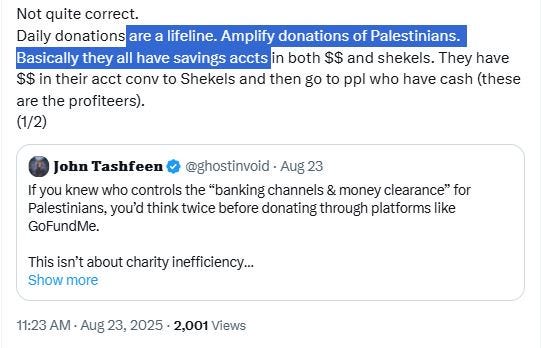

Please keep donate Gaza especially if you, as reader, has [background] International Relation [whatever universities]. IR Graduate means [you must, at least] get some semester [about] studying Middle East [in macro, not specifically Gaza].
We need more people to share fundraisers instead of only talking about Gaza. Some people think that those in Gaza don’t need money but that’s wrong. Almost everyone lost their source of income while essentials, food & medicine get sold for astronomical prices. So I put my attempt in all social media as I can, in twitter / X, in substack [since October 2023 I put link donation], in bluesky or bsky, in threads, in instagram.

Link to donate World Food Programme - Palestine appeal: click here




[Daniel Brühl]


Most campaign shared or circulated in social media are for REAL people in Gaza. They’re legit. There are a lot of small campaigns for struggling families. This is their only lifeline. By donating & sharing, you are literally making history and alleviating part of their pain
Please do not rely on me alone for sharing your campaign. I’m only 1 person and sometimes I’m not online which is unreliable. I never ignore anybody on purpose but I have a very limited capacity & very little energy and time.

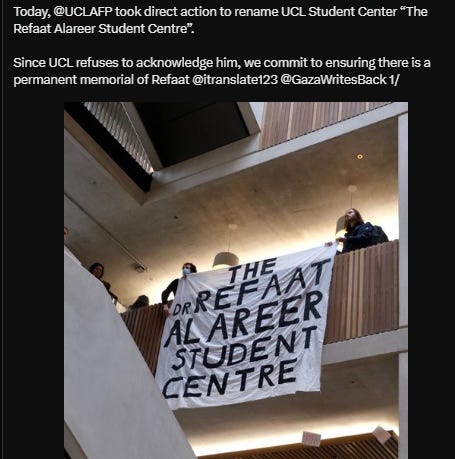

[Refaat Rafiq Alareer IF I MUST DIE] Refaat Rafiq Alareer was extremely hungry, November 2023, days before Refaat killed by Israel airstrike. If November 2023 already [one-by-one Gazan] extremely famine, extremely hungry, imagine November 2025 or more than 2 years Israel’s Genocide in Gaza.





Thanks for reading Prada’s Newsletter.