
Blurred Lines: Between taking down “porn revenge” or betting online, and (dilemma) the state surveillance us.

Tech Companies are starting to face legal and financial consequences for their alleged use of dark patterns, deceptive website or app user interfaces used to trick or pressure consumers into making choices they otherwise might not. Less than two years after Indonesia introduced a set of controversial internet laws, officials have plans to deploy new methods to enforce them, including charging what could amount to thousands of dollars in fines to platform companies that refuse to take down content considered “unlawful” by government authorities.
The plan, which was detailed in internal presentations given to leading tech companies operating in the country, offer a window into how Indonesia plans to implement some of its harshest laws governing digital platforms and content moderation. The plan comes amid a growing number of other countries in the region tightening controls over how social media platforms operate within their boundaries. In recent years, Indonesia has joined countries like Myanmar, Cambodia, and Vietnam, where the governments have proposed or are using legal and bureaucratic tools to deploy harsh cyber laws to impede the individual rights of civilians.
In early January, the local teams of global tech companies such as Google, Meta, Twitter, and ByteDance received an invitation for a two-day virtual meeting with Indonesia’s Ministry of Communication and Information Technology, also known as Kominfo. Joined by high-profile regional e-commerce and telco companies, they gathered on Zoom to listen to a presentation by Teguh Arifiyadi, a ministry official, about the government’s plan to enforce its updated internet laws, namely the Law Regarding Electronic Information and Transactions (ITE Law), Government Regulation 71 (GR 71), and Ministerial Regulation 5 (MR5).
During the meeting, Mr Teguh Arifiyadi told attendees that each of the companies would have to register as a Private Scope Electronic Systems Operator (PSE) in Indonesia. Once registered, platforms would then be obliged to take down any content the government deems “unlawful” — a broad label that could apply to everything from pornography to making fun of the president.

*this pict via COCONUT web, to describe sexual harassment/contains graphic descriptions of sexual harassment, for investigation by COCONUT.
According to a senior official at a social media platform that attended the meeting, Arifiyadi told the gathering that companies that failed to comply within the turnaround time could face fines or risk getting blocked. One estimate for the first offense, according to calculations based on another presentation document shared, could reach as much as $33,000 per violation.
The latest version of the document, which was finalized after the January meeting, details indexes for calculating fines based on the company’s gross revenues, compliance rate, and types of content, among other indicators. The new measures outlined in the document dictate that once companies are notified of a takedown notice, they have 24 hours to take down content, and just four hours to take down content labeled as “urgent.”
The social media platform official, who asked to speak on condition of anonymity because he feared reprisals by authorities, said that the meeting’s participants — particularly those working for social media companies — were shocked. Definitions surrounding “prohibited content” were too broad, and if implemented on the thousands of pieces of content each platform churns out every day, they could be forced to pay hundreds of million dollars overnight, significantly impacting operating costs in the country.
“We told Kominfo that vague definitions in the regulation would create confusion among businesses and a murky investment climate… [but] they seemed to hear us half-heartedly,” the platform official told.
Rofi Uddarojat, who heads public policy and government relations at the Indonesian E-commerce Association and regularly attends meetings with Kominfo regarding the regulation, he also raised concerns about the proposed changes. “We wanted a clear format and standard for takedown requests and a maximum limit for the number of those requests,” he said. Despite these concerns, he claims Kominfo pushed through with the largely unchanged proposed measures.
Indonesia’s new content moderation regulation is one of the strictest digital censorship laws in the region. MR5 came into effect in 2020 and the GR 71 in 2019, but specific measures were needed to make the laws binding. Several government agencies including Kominfo, the Ministry of Finance, and the Coordinating Ministry for Political, Legal, and Security Affairs then drafted the necessary requirements, according to an attendee of the Kominfo meeting. Kominfo announced its collaboration with the finance ministry in an official statement.
“It is simply about expanding state power in cyberspace,” said Gatra Priyandita, an analyst at the Australian Strategic Policy Institute. Priyandita said that the law will hurt smaller tech companies that have fewer resources to ensure timely moderation. But, even the world’s biggest tech platforms could face challenges, particularly if they are requested to take down information concerning issues that are taboo in Indonesia, but not in the U.S., such as conversations around the LGBTQIA community or West Papua, Priyandita added.
“Having to respond a lot more quickly and without court orders makes it a lot more complicated for the bigger tech firms,” he said. “Four hours is a bit tight… if there’s a lot of requests to take down information at the same time, I guess it will bog down the company in question.”
Kominfo is known to have requested takedowns for thousands of pieces of content in a month, sometimes more, according to internal transparency reports by leading tech companies. Between June and December 2021, Kominfo asked Google to delist over 500,000 URLs across its search engine, the company’s transparency report showed. (The company eventually delisted only .03 percent of the requested URLs.) Twitter reported that it received legal demands to remove content from nearly 30,000 accounts between July and December 2021.
Kominfo asked his company to take down thousands of pieces of content at one time. Under the new regulation, that could translate to millions in fines. The ministry’s document also stipulates that if a platform fails to take down content, Kominfo would double, then triple the fines, before eventually blocking the platform.
Government facing a bigger dilemma because a brutality, violation on online platform also rocketing year by year. But in other side, if government regulated, pundits says “expanding state power in cyberspace; surveillance by the state”.
As is common in Asia, light skin color is fetishized in Indonesia due to, among others, a relentless multi-million dollar skin bleaching industry and a pop culture (k-pop/Korea Pop culture; or wibu Japan Pop culture) that favors women with fair complexions.
In Indonesia, that fetishization is also bound to generations of resentment towards the racial minority, with the mass rapes of Chinese-Indonesian women in 1998 being one of the darkest example of that hatred to the rich - minority (Chinese Overseas) being acted out in the country’s history.

*this pict via COCONUT web, to describe sexual harassment/contains graphic descriptions of sexual harassment, for investigation by COCONUT.
Like many other victims, there is often a strong racial element in the online sexual abuse women. Many are referred to online by “amoy” or “chindo”, a derogatory term referring to Chinese-Indonesian women that is still widely used in everyday conversation and in online forums to this day. Thousands of Twitter accounts that regularly shared intimate photos and videos of Chinese-Indonesian women. Often, they repurposed those images to create frighteningly vulgar and invasive content of their own. Of those thousands, we found 155 accounts focused specifically on abusing, sexualizing, and fetishising Chinese-Indonesian women. Many of those accounts had significant social media followings, ranging from hundreds to thousands. All of these accounts are still very active, with some newly created in 2022.
The perpetrators hide their true identities and often change their handles to avoid prosecution or getting reported by the victims. Many use backup accounts they can immediately switch to if their main account gets suspended. If they were an army, then one particularly relentless predator, who went by three different handles from 2021 to 2022, would be one of their generals. One labeled himself a “cum-tributer,” which is exactly as repulsive as it sounds, and a “ratings agency,” reposting private photos of many Chinese-Indonesian women while scoring their physical attributes.
And then there are the impostor accounts, who assume the identities of their victims to engage in sexual fantasy role-play for their own and their followers’ gratification. Often, these accounts delve into racial dynamics; specifically, they act out scenarios in which Chinese-Indonesian women become submissive to the desires of another Chinese overseas men or to be desires pribumi (a loose term to describe native Indonesians) men. One prolific twitterati in Indonesia (he’s Chinese overseas) argues that rocketing cases “fetishising” Chinese-overseas women in Indonesia may be just from other Chinese-overseas men. He’s not confident the fetishising came (dominant) from “pribumi”. The fact that, after 1998, more Chinese-overseas in Indonesia living in “very strict”, “very exclusive” security (in the school, or home) may relevant with the logic that only Chinese-overseas man knew and get a exclusive photos from another Chinese-overseas women (if these photos is actually never uploaded by women side via social media).
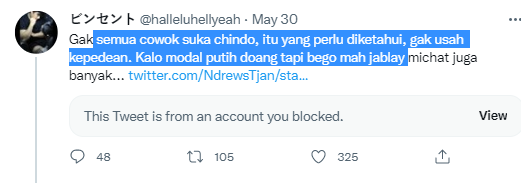
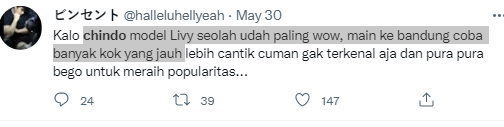
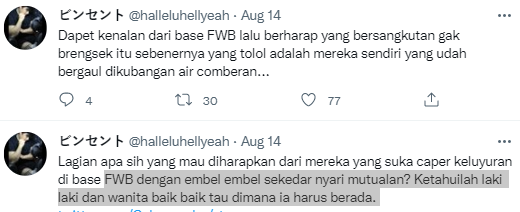
These accounts only represent the tip of the sleazy iceberg. They make up a highly coordinated, highly active community, obtaining victims’ personal images – mostly from social media and content sharing platforms – before trading them among each other. The images then spread like wildfire; once one is shared, it seems nothing can stop its circulation.
This never-ending non-consensual sharing of intimate images shows a systematic failure to protect sexual violence victims in Indonesia, both offline and online. Thanks to the new law, cyber gender-based violence is now unambiguously categorized as a type of crime. It specifically defines the taking and/or spreading of intimate images without consent as a crime punishable by up to four years in prison. Victims are now legally entitled to legal representation and psychological counseling, as well as compensation for material and immaterial damages. Yet it remains to be seen how it will interact with existed controversial Indonesian laws: the Electronic Information and Transaction ACT (UU ITE) and the Pornography Law, and now another (plan/draft) regulation by Kominfo/Telco Ministry – “fine based / fine centric regulation”, given just four hours to take down content or face as much as $33,000 per violation in fines. Laws are considered to be ambiguously-worded and have been used, time and time again, to criminalize victims instead of perpetrators.
Mr. Johnny Gerald Plate, new Telco Minister, who was sworn in October 2019, said in November 2019 that the existing rules to protect data were spread across many laws and needed to be brought together under one law. He aims to bring in a new law to protect personal data by next year as it follows in the footsteps of Southeast Asian neighbours such as Singapore and also the European Union.
The government had a “roadmap to data sovereignty” to reflect the growing importance of data and planned to establish the new law in Southeast Asia’s biggest economy. The unique situation: Mr. Plate was born in Ruteng NTT, a very small town and secluded area in Indonesia. His spirit to expand more aggressively about broadband across Indonesia, very solid, because he’s Ruteng - native, with less infrastructure (including communication infrastructure). The move comes amid wider regional efforts by Southeast Asian governments to demand action from global tech giants on content regulation and tax policy.
The stakes are high for both governments, which are counting on the digital economy to drive growth, and internet companies, which view Southeast Asia’s social-media-loving population of 641 million as a key growth market. Only 2 weeks after debate regulating PSE in Indonesia, India (August 4th) plans to overhaul its competition law so that global technology companies will have to seek the country’s antitrust approval for many overseas mergers and acquisitions, an ambitious move by Prime Minister Narendra Modi’s government to gain the kind of influence over Big Tech that Europe and China have. Actually, Modi set a draft since October 2019, 1 month before Mr. Plate explain “more regulated” Tech in Indonesia. IT expert, Gergely Orosz, said with regulating Big Tech, local startups will get less competition, opportunity to grow.

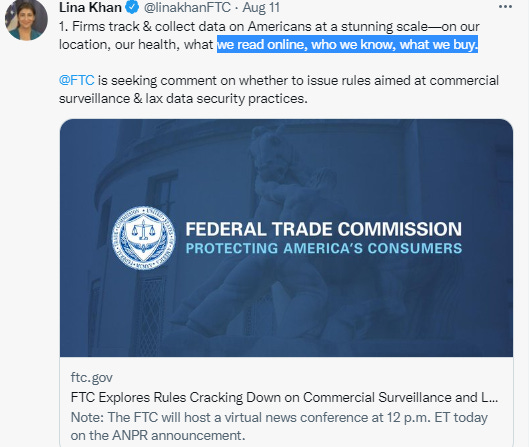
In U.S., as someone who gets a headache just *thinking* about IP (Intellectual Property), it’s a perfect demonstration of how the law — or lack of it — impacts real people. With virtual reality gaming and other metaverse applications going mainstream, digital goods modeled after real-life counterparts take on new significance, and lawyers and courts must grapple with how to apply IP law to the technology. The FTC is seeking public feedback on a proposed rulemaking to limit what it’s dubbed “commercial surveillance” by businesses that sell or share information collected about people. FTC also poised to take its first step toward writing consumer data protection rules that would govern businesses such as Alphabet Inc. and Meta Platforms Inc. Tech Companies are starting to face legal and financial consequences for their alleged use of dark patterns, deceptive website or app user interfaces used to trick or pressure consumers into making choices they otherwise might not. The latest version of the American Data Privacy and Protection Act would permit the California Privacy Protection Agency to enforce the new federal law just as it would the #CCPA--which would be preempted if this #ADPPA bill is passed.
In Europe, The EU is figuring out how #GDPR's right to be forgotten can be squared away with blockchain tech that never forgets. The fact that some consumers were able to trace their data to the dark web may have sped up this data breach settlement. Role for competition law to play in the quest to reduce the widening inequality gap. The European Commission’s antitrust enforcers were investigating Google’s app store rules. Google’s rivals have received confidential questionnaires from Brussels, probing billing terms and developer fees for the U.S. tech giant’s Play Store. Whether Big Tech firms should contribute to telecoms infrastructure because it wanted more clarity on where any future investments would go. Rest of the world, all administration’s in the world, already push to rein in corporate giants with tougher antitrust enforcement, to determine how much Big Tech firms should contribute.
To properly enforce its new DMA and DSA, the EU must recruit "more who want to work for the common good rather than the good snacks at Meta’s offices." European Data Protection Supervisor (EDPS) takes note that the negotiations would exclusively concern cross-border data flows and recommends detailing the reasons why, despite #adequacy decision granted to Japan on 23 Jan 2019 by EU Commission, further negotiations on cross-border data flows are considered necessary.
EDPS takes note that the negotiations would exclusively concern cross-border data flows and recommends detailing the reasons why, despite adequacy decision granted to Japan on 23 Jan 2019 by EU Commission, further negotiations on cross-border data flows are considered necessary. Data Free Flow was idea by the late of Abe Shinzo in G20 forum. EDPS welcomes the specification that the provisions on cross-border data flows with Japan should be coherent with the horizontal provisions for cross-border data flows and personal data protection in trade negotiations. The horizontal provisions represent balanced compromise btw public & private interests to tackle protectionist practices in 3rd countries while ensuring that trade agreements can't be used to challenge high level of protection by EU Charter fundamental rights & EU Data Protection. For the avoidance of doubt, EDPS recommends to expressly clarify in negotiating directives that the negotiated rules should not prevent EU or Member States from adopting, in duly justified cases, measures requiring controllers or processors to store personal data in the EU/EEA. if someone can explain to me why the EU - Japan free data flow talks are happening, despite the fact that they already have "the world’s largest area of safe data flows," please enlighten me. Could it be that Japan wants assurances against EU data localisation in the pipeline.
The EU is preparing for a series of legal assaults against the Digital Markets Act (DMA), as top law firms attempt to find vulnerability points in the bloc’s attempts to tame Big Tech. The German competition watchdog is expected to launch proceedings into Microsoft around September, to determine whether the company is of “paramount significance for competition across markets” & therefore potentially subject to new prohibitions. The latest in EU, (Aug. 17th), Belgium’s YouTube stars, like Nathan Acid and Average Rob have declared war to their government, claiming new transparency rules will endanger their privacy. Tech policy governing influencers needs to be smart: Content creators often work as a private person & develop their activities out of their home. Transparency requirements in Belgium is at odds with respecting their privacy.
==========
(per 17 Agustus 2022, saya memadukan riset personal saya dengan investigasi terbaru dari Antonia Timmerman - wartawan Rest of World (16 Agustus 2022), serta Kevin Ng - wartawan Coconut (April 2022), serta Ed Davies & Stanley Widianto - Reuters (16 November 2019), terkait regulasi lain yang saling bertaut dengan PSE. Khusus pada laporan Antonia dan Ed-Stanley, nyaris mirip, hanya sedikit berselisih angka dollar, kemungkinan karena volatilitas nilai Rupiah terhadap US Dollar. Menurut Ed-Stanley, Kominfo sudah pernah mempersiapkan draft/rancangan aturan sebesar US$ 36k sejak 2019 sebagai basis denda atas pelanggaran online, sementara Antonia menulis US$ 33k. Dirujuk pada nilai Rupiah pada 2019 dan 2022, dibulatkan bahwa kominfo mempersiapkan regulasi berbasis denda dengan angka denda mencapai 500 juta rupiah. Khusus Antonia mungkin lebih spesifik karena Antonia menambahkan “denda sistematis” ini berlaku jika dalam 4 jam pihak PSE gagal menghapus konten yang dianggap melanggar).
Antonia Timmerman report: click here
Kevin Ng report: click here
Stanley Widianto & Ed Davies report: click here